Loading...
Done
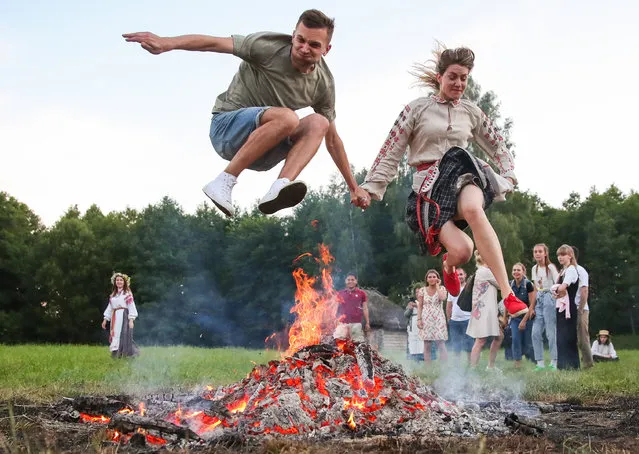
A man and a woman jump over a bonfire during Ivan Kupala Day celebrations held by the Belarusian State Museum of Folk Architecture and Rural Lifestyle in the village of Ozertso near Minsk, Belarus on July 4, 2020. Ivan Kupala Day, also known as Ivana-Kupala or Kupala Night, is a traditional pagan holiday celebrated in eastern Slavic cultures. Various rituals are traditionally performed on Kupala Night, including making flower wreaths, fortune-telling, jumping over bonfires, and burning a wheel-like effigy symbolizing the sun. (Photo by Natalia Fedosenko/TASS)

A man and a woman jump over a bonfire during Ivan Kupala Day celebrations held by the Belarusian State Museum of Folk Architecture and Rural Lifestyle in the village of Ozertso near Minsk, Belarus on July 4, 2020. Ivan Kupala Day, also known as Ivana-Kupala or Kupala Night, is a traditional pagan holiday celebrated in eastern Slavic cultures. Various rituals are traditionally performed on Kupala Night, including making flower wreaths, fortune-telling, jumping over bonfires, and burning a wheel-like effigy symbolizing the sun. (Photo by Natalia Fedosenko/TASS)
Details
07 Jul 2020 00:07:00
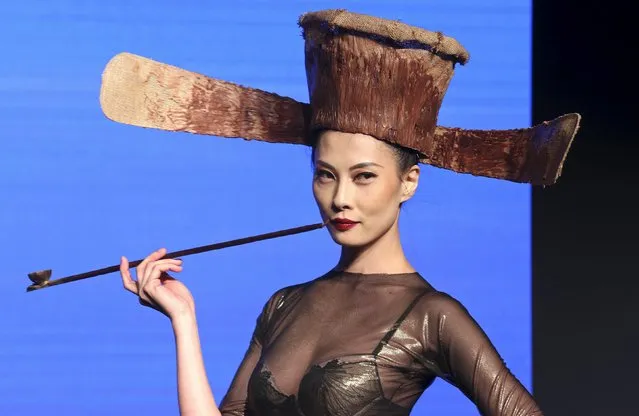
A model presents a creation made with chocolate by designer Wang Jingzhi and Maitre Chocolatier Roberto Rinaldini during the international exhibition of chocolate “Salon du Chocolat” in Milan, Italy, February 12, 2016. (Photo by Stefano Rellandini/Reuters)

A model presents a creation made with chocolate by designer Wang Jingzhi and Maitre Chocolatier Roberto Rinaldini during the international exhibition of chocolate “Salon du Chocolat” in Milan, Italy, February 12, 2016. (Photo by Stefano Rellandini/Reuters)
Details
14 Feb 2016 11:33:00
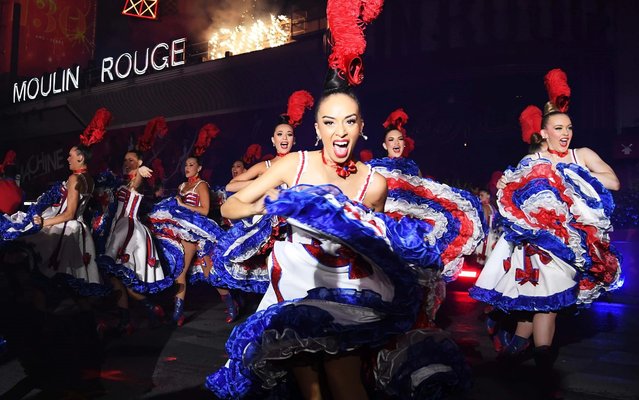
Dancers perform at the 130th Anniversary Le Moulin Rouge celebration on October 6, 2019 in Paris, France. (Photo by Pascal Le Segretain/Getty Images)

Dancers perform at the 130th Anniversary Le Moulin Rouge celebration on October 6, 2019 in Paris, France. (Photo by Pascal Le Segretain/Getty Images)
Details
08 Oct 2019 00:05:00
A participant in the Crazy Races extreme sports game competes in the cross-country obstacle race in Ufa, Russia on September 21, 2015. (Photo by TASS/Barcroft Media)

A participant in the Crazy Races extreme sports game competes in the cross-country obstacle race in Ufa, Russia on September 21, 2015. (Photo by TASS/Barcroft Media)
Details
23 Sep 2015 11:47:00
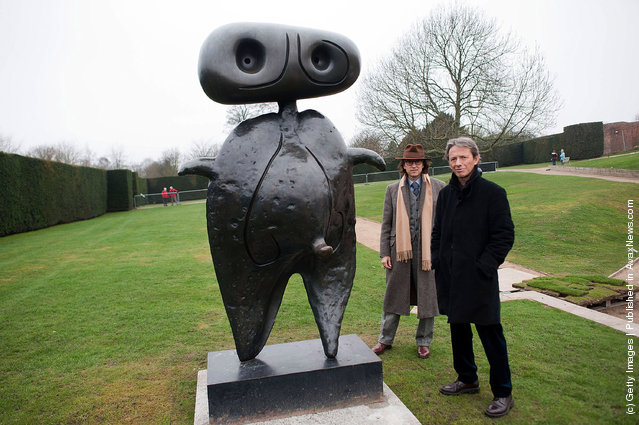
Joan Miro's, grandsons, Emilio Fernandez Miro and Joan Punyet Miro pose beside Personnage (1970) in the Yorkshire Sculpture park

“Joan Miro i Ferra (April 20, 1893 – December 25, 1983) was a Spanish Catalan painter, sculptor, and ceramicist born in Barcelona. Earning international acclaim, his work has been interpreted as Surrealism, a sandbox for the subconscious mind, a re-creation of the childlike, and a manifestation of Catalan pride. In numerous interviews dating from the 1930s onwards, Miro expressed contempt for conventional painting methods as a way of supporting bourgeois society, and famously declared an “assassination of painting” in favour of upsetting the visual elements of established painting”. – Wikipedia

Photo: Joan Miro's, grandsons, Emilio Fernandez Miro and Joan Punyet Miro pose beside Personnage (1970) in the Yorkshire Sculpture park on March 14, 2012 in Wakefield, England. Yorkshire Sculpture Park stages the first major UK survey of sculpture by Spanish artist Joan Miro. (Photo by Bethany Clarke/Getty Images)
Details
15 Mar 2012 13:47:00
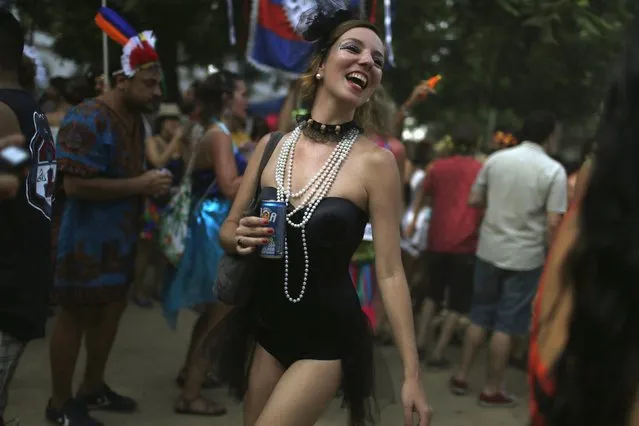
A reveller takes part in an annual block party known as “Cordao de Prata Preta”, one of the many carnival parties to take place in the neighbourhoods of Rio de Janeiro, February 6, 2016. (Photo by Pilar Olivares/Reuters)

A reveller takes part in an annual block party known as “Cordao de Prata Preta”, one of the many carnival parties to take place in the neighbourhoods of Rio de Janeiro, February 6, 2016. (Photo by Pilar Olivares/Reuters)
Details
07 Feb 2016 07:22:00
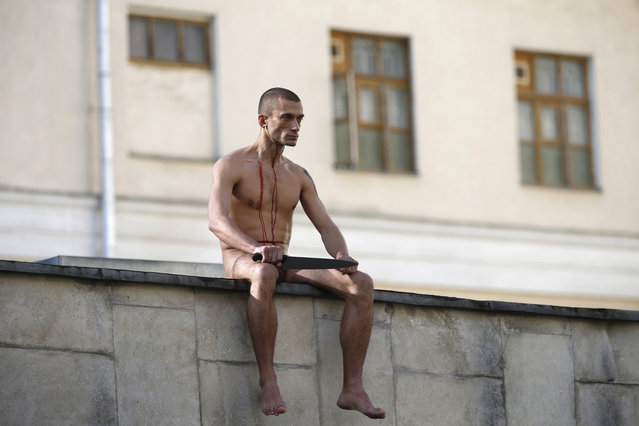
Artist Pyotr Pavlensky sits on the wall enclosing the Serbsky State Scientific Center for Social and Forensic Psychiatry after he cut off a part of his earlobe during his protest action titled “Segregation” in Moscow October 19, 2014. (Photo by Maxim Zmeyev/Reuters)

Artist Pyotr Pavlensky sits on the wall enclosing the Serbsky State Scientific Center for Social and Forensic Psychiatry after he cut off a part of his earlobe during his protest action titled “Segregation” in Moscow October 19, 2014. Pavlensky protested against the usage of forensic psychiatry for politically motivated purposes. He cut off his earlobe to demonstrate how authorities could “cut off” an unwanted individual from society by using psychiatric and medical diagnosis to forcefully send a person to a penitentiary hospital, according to Pavlensky. (Photo by Maxim Zmeyev/Reuters)
Details
21 Oct 2014 12:10:00
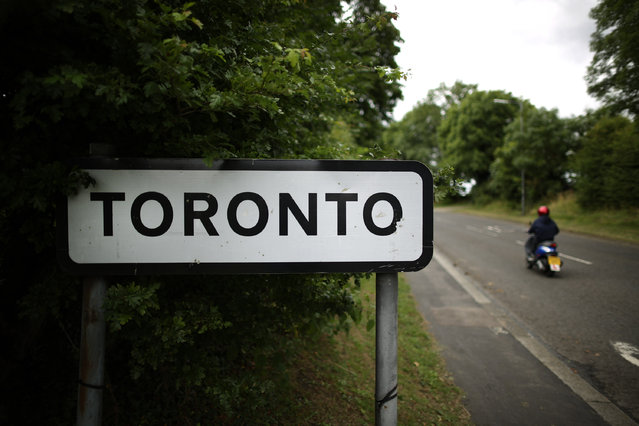
A road sign points the way on August 6, 2013 in Toronto, England. Originally called Newton Cap in the county of Durham, built for workers at the nearby colliery,  owner Henry Stobart re-named the village Toronto after visiting Canada. (Photo by Peter Macdiarmid/Getty Images)

A handful of villages in the U.K. share the same name as cities or countries from around the world, and they’re spending life in the shadows of their more famous namesakes. Photo: A road sign points the way on August 6, 2013 in Toronto, England. Originally called Newton Cap in the county of Durham, built for workers at the nearby colliery, owner Henry Stobart re-named the village Toronto after visiting Canada. (Photo by Peter Macdiarmid/Getty Images)
Details
29 Aug 2014 11:51:00