Loading...
Done


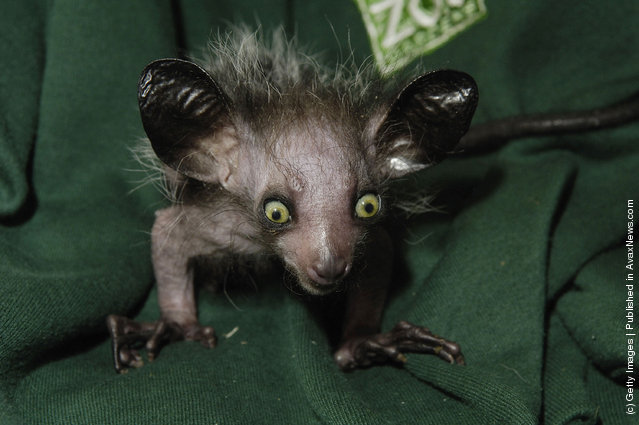
“The aye-aye (Daubentonia madagascariensis) is a lemur, a strepsirrhine primate native to Madagascar that combines rodent-like teeth and a special thin middle finger to fill the same ecological niche as a woodpecker. It is the world's largest nocturnal primate, and is characterized by its unusual method of finding food; it taps on trees to find grubs, then gnaws holes in the wood and inserts its narrow middle finger to pull the grubs out. The only other animal species known to find food in this way is the striped possum. From an ecological point of view the aye-aye fills the niche of a woodpecker as it is capable of penetrating wood to extract the invertebrates within”. – Wikipedia

Photo: In this handout image from Bristol Zoo is seen the first captive bred aye-aye in the UK named “Kintana” (meaning star in Malagasy) April 15, 2005 at Bristol Zoo Gardens, England. The zoo announced today only the second baby aye-aye to be hand-reared in the world (the first was in Jersey Zoo) and has now made his first public appearance since his birth on 11 February 2005. (Photo by Rob Cousins/Bristol Zoo via Getty Images)
Details
13 Apr 2011 13:33:00
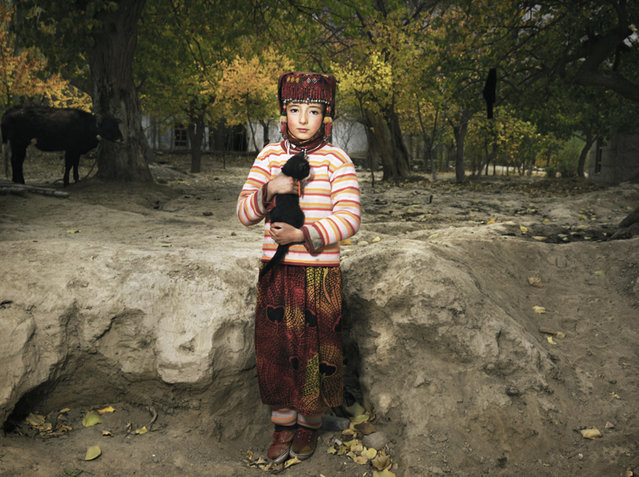
The Tashkurgan Tajik Autonomous County in Xinjiang Province People

“As a photographer, peregrinator and naturalist, I have been searching for the ultimate unworldly world. I've always been drawn to unusual travel destinations. For me, to lose myself in a different culture is a great way to find balance in my life...”. – Li Xinzhao. (Photo by Li Xinzhao)
Details
11 Feb 2013 11:26:00
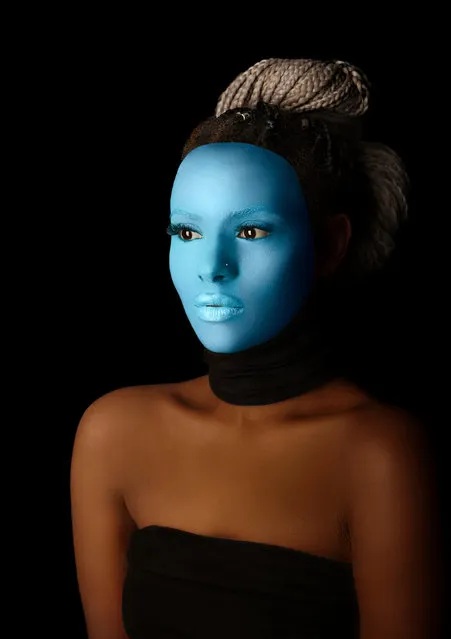
Brtukan. “Being a girl of colour in a society where the majority of the people are white, I have had to get used to all the different ways people approach me. From being asked what kind of rap music you listen to and how you wash your hair, to getting told, “you don’t sound black”, “you’re pretty for a black girl” or “you’re not that black so it’s OK”, as if being black is such a bad thing”. (Photo by Lisa Minogue/The Guardian)

As part of FLAIR Melbourne – a Flinders Lane art festival – Melbourne’s Lisa Minogue presents stylised photographic portraits of Australian women of colour, their faces painted vibrantly to accentuate their individuality and encourage the viewer to study each face more closely. Minogue asked each woman the same question: “What do the words “coloured girl” mean to you?”. (Photo by Lisa Minogue/The Guardian)
Details
17 Aug 2016 11:16:00
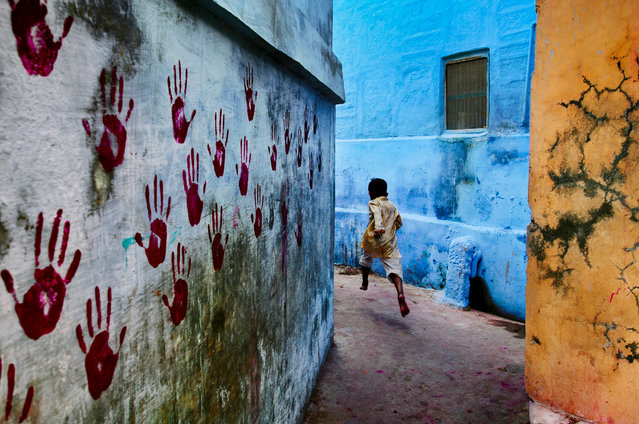
"Steve McCurry: India", co-organized by the Rubin Museum and the International Center of Photography, brings together photographs of India-its people, monuments, landscapes, seasons, and cities. The exhibition at the Rubin Museum in New York runs from November 18, 2015- April 4, 2016. Here: A boy in mid-flight in Jodhpur, Rajasthan, India, in 2007. (Photo by Steve McCurry)

"Steve McCurry: India", co-organized by the Rubin Museum and the International Center of Photography, brings together photographs of India-its people, monuments, landscapes, seasons, and cities. The exhibition at the Rubin Museum in New York runs from November 18, 2015 – April 4, 2016. Here: A boy in mid-flight in Jodhpur, Rajasthan, India, in 2007. (Photo by Steve McCurry)
Details
30 Nov 2015 08:06:00
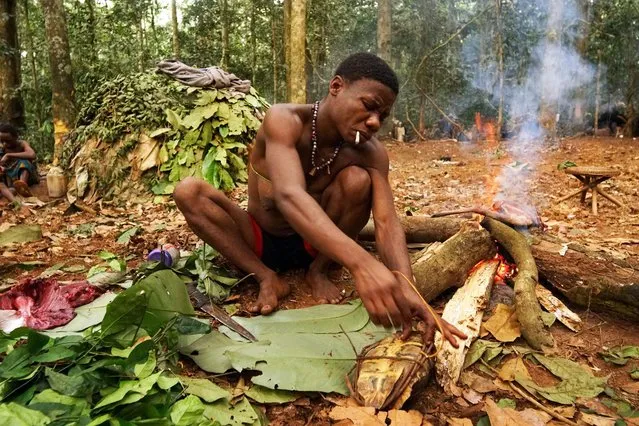
Baka pygmies in their forest home preparing food in, Sangha Forest, Central African Republic, February 2016. (Photo by Susan Schulman/Barcroft Images)

Baka pygmies in their forest home preparing food in, Sangha Forest, Central African Republic, February 2016. Here, in their forest home, traditional life continues in the face of multiplying challenges ranging from poachers, to ill health. Deep in the rainforests of central Africa lives one of the world’s most mysterious tribes. (Photo by Susan Schulman/Barcroft Images)
Details
18 Feb 2017 00:01:00
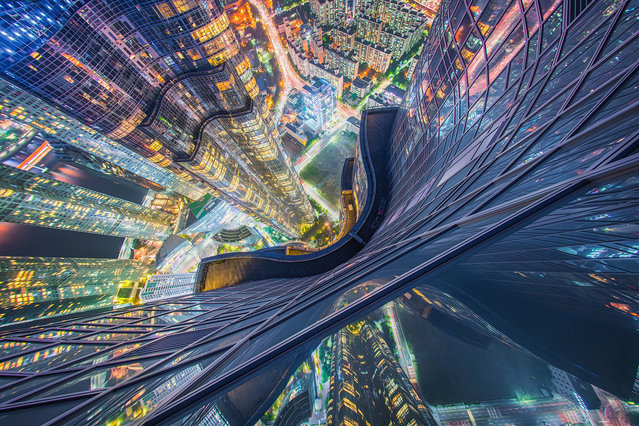
Scared of Heights. “Taken from the highest residential building in Asia: the Zenith in Busan. This was taken with official permission (which took me months to get) and safety measures were taken. I had to hang myself over the edge to get this shot. Not for the faint of heart! But when you’re at a height like this, the world below you just seems different. It takes away the fear one would normally have, and gives a sense of peace instead”. (Photo by Albert Dros/NatGeo Cities Travel Photographer of the Year 2017)

Scared of Heights. “Taken from the highest residential building in Asia: the Zenith in Busan. This was taken with official permission (which took me months to get) and safety measures were taken. I had to hang myself over the edge to get this shot. Not for the faint of heart! But when you’re at a height like this, the world below you just seems different. It takes away the fear one would normally have, and gives a sense of peace instead”. (Photo by Albert Dros/NatGeo Cities Travel Photographer of the Year 2017)
Details
03 Jul 2017 08:55:00
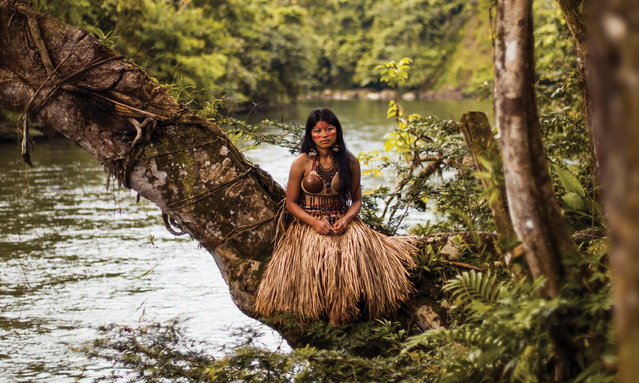
Ecuador: “More and more tribes of Amazonia are starting to adopt modern clothes for everyday life. But they are still keeping their traditional clothes for important events. I photographed this young woman in her wedding outfit”. (Photo by Mihaela Noroc/The Guardian)

Photographer Mihaela Noroc travelled the world from Ethiopia to the US and from Guatemala to France in search of natural and authentic beauty. She introduces some of the inspiring women she met on her journey. Here: Ecuador. “More and more tribes of Amazonia are starting to adopt modern clothes for everyday life. But they are still keeping their traditional clothes for important events. I photographed this young woman in her wedding outfit”. (Photo by Mihaela Noroc/The Guardian)
Details
27 Sep 2017 08:29:00
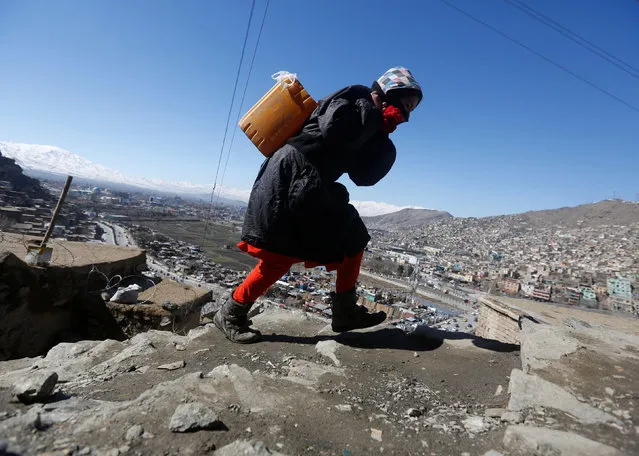
An Afghan girl carries water on her back as she climbs a hill in Kabul, Afghanistan February 20, 2017. (Photo by Omar Sobhani/Reuters)

An Afghan girl carries water on her back as she climbs a hill in Kabul, Afghanistan February 20, 2017. A growing population is straining water supplies in Afghanistan's capital, forcing those who can afford it to dig unregulated wells ever deeper to tap a falling water table. Finding water in arid Afghanistan is virtually always a challenge, but a drop in the groundwater level in Kabul caused by overuse and drought is making it even more difficult for residents, especially the poor. (Photo by Omar Sobhani/Reuters)
Details
02 Mar 2017 00:05:00