Loading...
Done
Sumo wrestler Kaiho eats a “chanko” meal in Nagoya, Japan on July 18, 2017. After ending practice at 10:30 a.m., the wrestlers mingle with fans, sign autographs and pose for photos before the first of their two daily meals. (Photo by Issei Kato/Reuters)

Sumo wrestler Kaiho eats a “chanko” meal in Nagoya, Japan on July 18, 2017. After ending practice at 10:30 a.m., the wrestlers mingle with fans, sign autographs and pose for photos before the first of their two daily meals. (Photo by Issei Kato/Reuters)
Details
20 Jul 2017 07:49:00
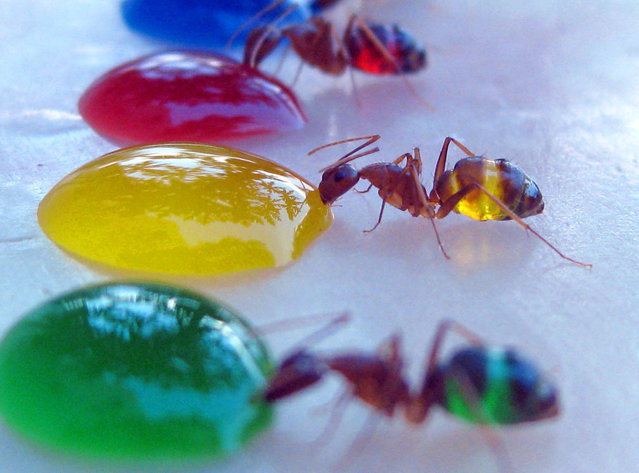
Colored Ants By Mohamed Babu

Scientist Mohamed Babu from Mysore, India captured beautiful photos of these translucent ants eating a specially colored liquid sugar. Some of the ants would even move between the food resulting in new color combinations in their stomachs.
Details
13 Jul 2015 09:28:00
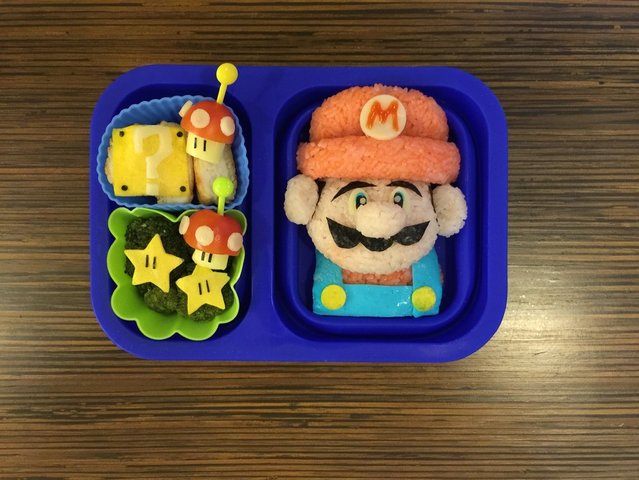
Food-Art By Nikki Garcia

A Filipino mother Nikki Garcia combined her love for arts and crafts with the Japanese tradition of bento boxes to combat her children’s eating habits.
Details
05 Jan 2016 08:04:00
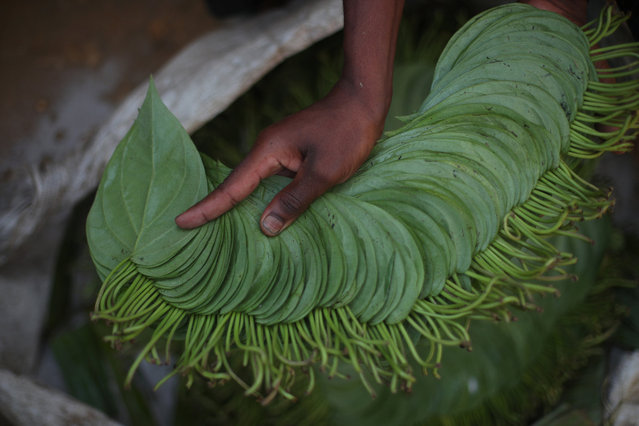
Faruk, 17, a Rohingya refugee trader holds betel leaves which are on sale at a stall in Palong Khali refugee camp near Cox's Bazar, Bangladesh, November 3, 2017. He left his village in Myanmar when the military opened fire towards the Rohingya. “I buy this betel leaf from Palong Khali market, in one bundle there are 160 pieces, I buy it for 80 taka and I sell it for 100 taka. Bangladeshi's and I sell for the same rate in the camp. Outside in the local market it is 80 taka per bundle. My problem is that I don't have money so I can't buy anything to eat, I can't buy fish to eat”, he said. (Photo by Hannah McKay/Reuters)

Faruk, 17, a Rohingya refugee trader holds betel leaves which are on sale at a stall in Palong Khali refugee camp near Cox's Bazar, Bangladesh, November 3, 2017. He left his village in Myanmar when the military opened fire towards the Rohingya. “I buy this betel leaf from Palong Khali market, in one bundle there are 160 pieces, I buy it for 80 taka and I sell it for 100 taka (1 Bangladeshi Taka = 0.012 US Dollar). Bangladeshi's and I sell for the same rate in the camp. Outside in the local market it is 80 taka per bundle. My problem is that I don't have money so I can't buy anything to eat, I can't buy fish to eat”, he said. (Photo by Hannah McKay/Reuters)
Details
27 Nov 2017 08:54:00
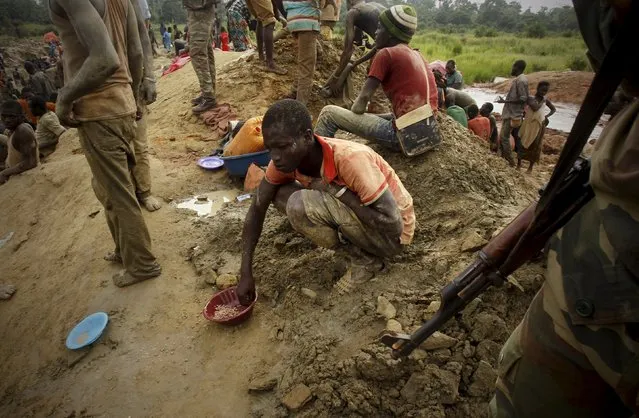
A gold prospector sits and eats close to a soldier at a gold mine near the village of Gamina, in western Ivory Coast, March 18, 2015. (Photo by Luc Gnago/Reuters)

Nestled among the cocoa plantations of western Ivory Coast is a gold mine that does not feature on any official maps. It is not run by an industrial mining company, nor does it pay taxes to the central government. The unlicensed mine is a key part of a lucrative business empire headed by the deputy commander of the West African nation's elite Republican Guard, United Nations investigators allege. Here: A gold prospector sits and eats close to a soldier at a gold mine near the village of Gamina, in western Ivory Coast, March 18, 2015. (Photo by Luc Gnago/Reuters)
Details
08 May 2015 13:54:00
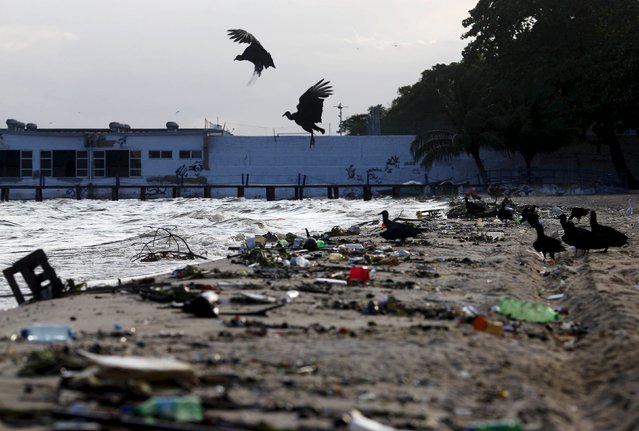
Vultures gather to eat waste in Bica beach, on the banks of the Guanabara Bay, with the Sugar Loaf mountain in background, 500 days ahead the Rio 2016 Olympic Games in Rio de Janeiro March 24, 2015. (Photo by Ricardo Moraes/Reuters)

Vultures gather to eat waste in Bica beach, on the banks of the Guanabara Bay, with the Sugar Loaf mountain in background, 500 days ahead the Rio 2016 Olympic Games in Rio de Janeiro March 24, 2015. As part of its Olympic bid, Rio promised to clean up 80 percent of the bay for the games. But local government officials have already admitted that a cleanup by 2016 is not achievable. Despite millions of dollars of investment over the years, the bay still stinks of sewage. Sailors who visited the city for test events complained of a floating sofa and a dead dog in the water. (Photo by Ricardo Moraes/Reuters)
Details
26 Mar 2015 12:16:00
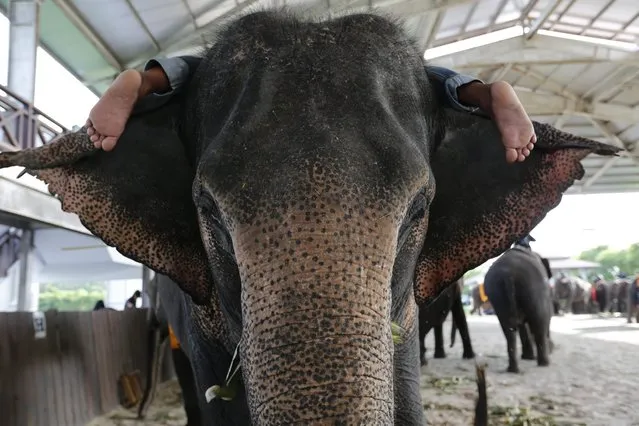
An elephant mahout (trainer) lies on his elephant his feet resting on its ears as it rests and eats prior to opening day's  play at the King's Cup Elephant Polo Tournament 2014 held near Bangkok, in Samut Prakan province, Thailand, 28 August 2014. (Photo by Barbara Walton/EPA)

An elephant mahout (trainer) lies on his elephant his feet resting on its ears as it rests and eats prior to opening day's play at the King's Cup Elephant Polo Tournament 2014 held near Bangkok, in Samut Prakan province, Thailand, 28 August 2014. The annual charity tournament runs until 31 August and involves 51 elephants who normally live on the streets and are used for begging. Sixteen competing elephant polo teams from 40 different nations take part in the charity event directed at raising funds to improve the lives of the elephants and elephant conservation in general. (Photo by Barbara Walton/EPA)
Details
29 Aug 2014 12:00:00
Maasai men of Matapato jostle to parade as they attend the Olng'esherr (meat-eating) passage ceremony to unite two age-sets; the older Ilpaamu and the younger Ilaitete into senior elderhood as the final rite of passage, in Maparasha hills of Kajiado, Kenya on September 23, 2020. Thousands of Maasai men clad in red and purple shawls and with their heads coated in red ochre gathered this week for a ceremony that transforms them from Moran (warriors) to Mzee (elders). (Photo by Thomas Mukoya/Reuters)

Maasai men of Matapato jostle to parade as they attend the Olng'esherr (meat-eating) passage ceremony to unite two age-sets; the older Ilpaamu and the younger Ilaitete into senior elderhood as the final rite of passage, in Maparasha hills of Kajiado, Kenya on September 23, 2020. Thousands of Maasai men clad in red and purple shawls and with their heads coated in red ochre gathered this week for a ceremony that transforms them from Moran (warriors) to Mzee (elders). (Photo by Thomas Mukoya/Reuters)
Details
29 Sep 2020 00:01:00