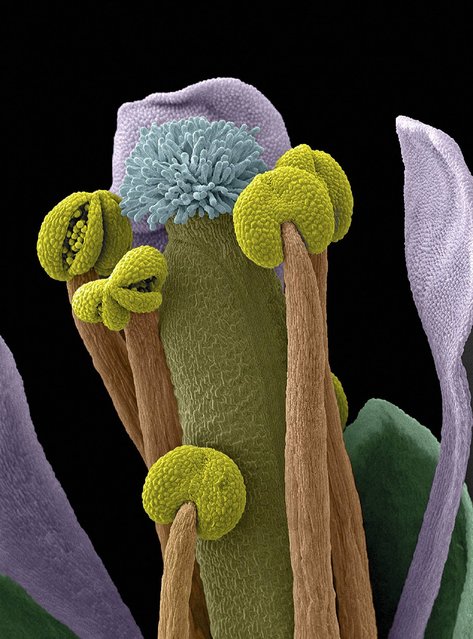
Beautiful, strange and occasionally alarming pictures from the shortlist for this year’s Wellcome image awards – which celebrate the very best in science photography and imaging – from an x-ray of a bat to a micrograph of a kidney stone. The exhibition opens on 12 March at three science centres and the Museum of Science and Industry in Manchester. Photo: Scanning electron micrograph (SEM) of an Arabidopsis thaliana flower, also commonly known as thale cress. Some of the anthers are open, revealing pollen grains ready for dispersal. Arabidopsis was the first plant to have its entire genome sequenced and is widely used as a model organism in molecular and plant biology. Horizontal width of image is 1200 microns. Magnification 100x. (Photo by Stefan Eberhard/Wellcome Images)
A model poses backstage ahead of the Wackie Ju show during Australian Fashion Week Presented By Pandora 2024 at Carriageworks on May 17, 2024 in Sydney, Australia. (Photo by Wendell Teodoro/Getty Images for AFW)
Invasion (laser girls) 2017. “I’m always thinking about my art practice, so any experience I have may spike a visual when I have an idea in mind. An example is that, when I was thinking about the Invasion series, I was inspired by Alfred Hitchcock’s movie The Birds (1963). I love Hitchcock’s other movies and have been contemplating a series based on Rear Window (1954). I also find inspiration outside the cinema in music clips and magazines”. (Photo by Michael Cook/Perimeter Books)
Iranian worshippers chant slogans during a protest after their Friday prayer, as part of widespread anger across the Muslim world about a film ridiculing Islam's Prophet Muhammad on September 14, 2012. (Photo by Vahid Salemi/Associated Press)
Children attend a war safety awareness class conducted by civil defence members, in the rebel-controlled area of Maaret al-Numan town in Idlib province, Syria May 14, 2016. (Photo by Khalil Ashawi/Reuters)
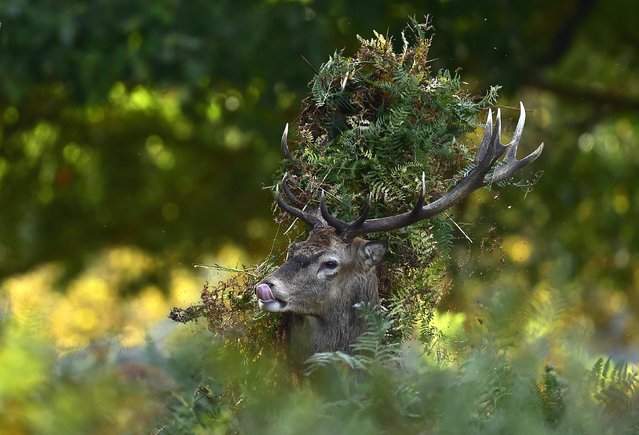
A male red deer with antlers covered in bracken, walks through undergrowth in Richmond Park in south west London, October 3, 2014. Over 600 red and fallow deer roam in the largest of London's Royal Parks, and have their numbers managed in an annual cull each November and February. (Photo by Toby Melville/Reuters)