Loading...
Done


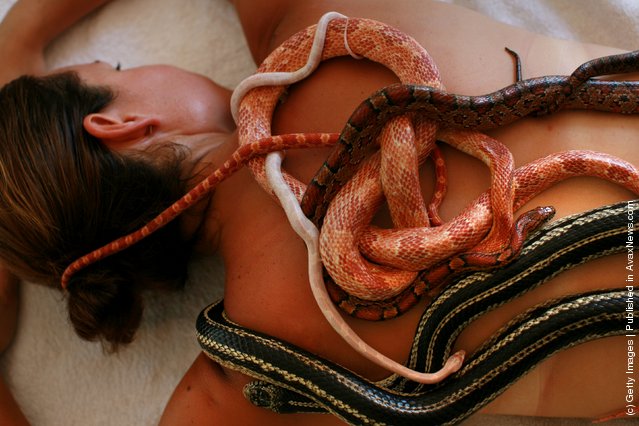
Meirav Stardinner receives a snake massage from Ada Barak at Barak's snake spa on September 11, 2008 in Talmei Elazar, Israel. Barack's income comes mostly from exhibiting her plants which eat everything from insects to small mammals. She discovered snakes' therapeutic value after letting people hold them after her act “Some people said that holding the snakes made them feel better, relaxed”, she says. “One old lady said it was soothing, like a cold compress”. Now she uses a combination of big snakes for deep massage and little ones for light massage, though all are non-venemous. (Photo by Uriel Sinai/Getty Images)
Details
07 May 2011 11:58:00
Police detain a woman during a protest against Prime Minister Benjamin Netanyahu and his government's handling of the coronavirus disease (COVID-19) crisis, near Netanyahu's residence in Jerusalem on July 24, 2020. (Photo by Ammar Awad/Reuters)

Police detain a woman during a protest against Prime Minister Benjamin Netanyahu and his government's handling of the coronavirus disease (COVID-19) crisis, near Netanyahu's residence in Jerusalem on July 24, 2020. Reimposed coronavirus curbs after a rise in new COVID-19 cases have prompted Israelis demanding better state aid to take to the streets in almost daily demonstrations. Public anger has also been fueled by corruption alleged against Netanyahu, who went on trial in May for bribery, fraud and breach of trust – charges he denies. (Photo by Ammar Awad/Reuters)
Details
25 Jul 2020 00:07:00
American singer and model Ciara in the second decade of March 2023 makes a very important phone call. (Photo by ciara/Instagram)

American singer and model Ciara in the second decade of March 2023 makes a very important phone call. (Photo by ciara/Instagram)
Details
29 Mar 2023 03:54:00
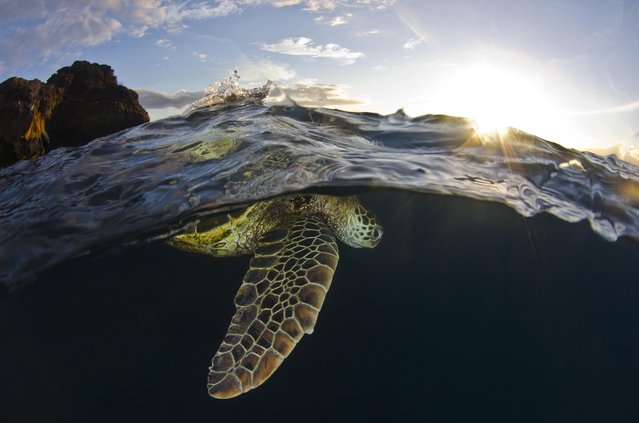
Breath at sunset, captures a sea turtle at a dive site called Black Rock. Kāʻanapali, Hawaiʻi, August 2013. (Photo by Christopher Doherty/Smithsonian.com)

Breath at sunset, captures a sea turtle at a dive site called Black Rock. Kāʻanapali, Hawaiʻi, August 2013. (Photo by Christopher Doherty/Smithsonian.com)
Details
28 Apr 2014 12:20:00
The tempestuous stellar nursery called the Carina Nebula, located 7,500 light-years away from Earth in the southern constellation Carina. (Photo by Reuters/NASA)

The tempestuous stellar nursery called the Carina Nebula, located 7,500 light-years away from Earth in the southern constellation Carina. (Photo by Reuters/NASA)
Details
22 Oct 2014 13:34:00
People walk near to a motorcycle ride called “Caravan of Terror”, in Caracas, Venezuela on October 29, 2022. (Photo by Leonardo Fernandez/Reuters)

People walk near to a motorcycle ride called “Caravan of Terror”, in Caracas, Venezuela on October 29, 2022. (Photo by Leonardo Fernandez/Reuters)

Details
26 Nov 2022 03:35:00
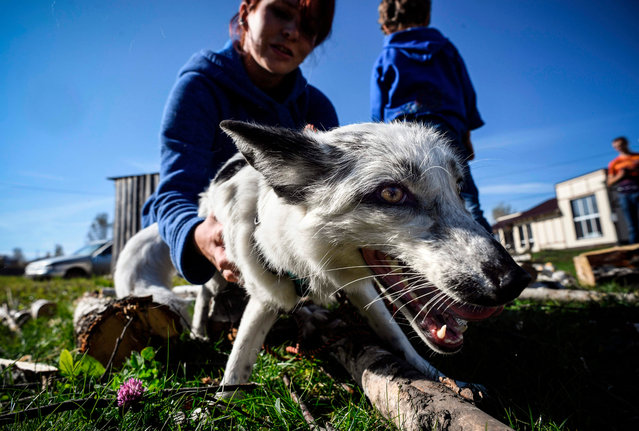
Tatyana Abramova, 33, plays with her home fox Plombir at her countryside house outside Siberian city of Novosibirsk on September 12, 2020. The official start of the Soviet experiment to better understand the domestication of animals by humans began in 1959, and was initiated by geneticists Dmitri Beliaiev and Lioudmila Trout on a farm in Akademgorodok, the scientific center of excellence in Siberia. Their primary objective was to domesticate foxes, to understand how the ancestor of wolves, another canine, evolved into a loyal and loving dog. And understand what this domestication tells us about the genetic evolution of species. (Photo by Alexander Nemenov/AFP Photo)

Tatyana Abramova, 33, plays with her home fox Plombir at her countryside house outside Siberian city of Novosibirsk on September 12, 2020. The official start of the Soviet experiment to better understand the domestication of animals by humans began in 1959, and was initiated by geneticists Dmitri Beliaiev and Lioudmila Trout on a farm in Akademgorodok, the scientific center of excellence in Siberia. Their primary objective was to domesticate foxes, to understand how the ancestor of wolves, another canine, evolved into a loyal and loving dog. And understand what this domestication tells us about the genetic evolution of species. (Photo by Alexander Nemenov/AFP Photo)
Details
25 Oct 2020 00:05:00
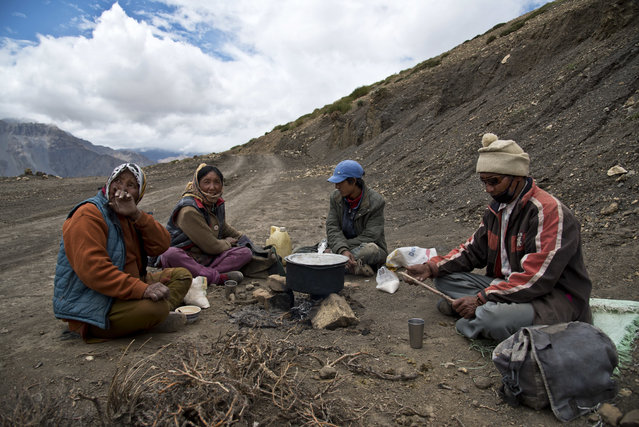
In this August 17, 2016, photo, from left to right, Chhering Chodom, 60, Tashi Yangzom, 50, Lobsang Chhering, 27, and Dorje Tandup, 58, drink milk tea on the side of the road. For centuries, the sleepy valley nestled in the Indian Himalayas remained a hidden Buddhist enclave forbidden to outsiders. Enduring the harsh year-round conditions of the high mountain desert, the people of Spiti Valley lived by a simple communal code – share the Earth's bounty, be hospitable to neighbors, and eschew greed and temptation at all turns. That's all starting to change, for better or worse. Since India began allowing its own citizens as well as outsiders to visit the valley in the early 1990s, tourism and trade have boomed. And the marks of modernization, such as solar panels, asphalt roads and concrete buildings, have begun to appear around some of the villages that dot the remote landscape at altitudes above 4,000 meters (13,000 feet). (Photo by Thomas Cytrynowicz/AP Photo)

In this August 17, 2016, photo, from left to right, Chhering Chodom, 60, Tashi Yangzom, 50, Lobsang Chhering, 27, and Dorje Tandup, 58, drink milk tea on the side of the road. For centuries, the sleepy valley nestled in the Indian Himalayas remained a hidden Buddhist enclave forbidden to outsiders. Enduring the harsh year-round conditions of the high mountain desert, the people of Spiti Valley lived by a simple communal code – share the Earth's bounty, be hospitable to neighbors, and eschew greed and temptation at all turns. That's all starting to change, for better or worse. (Photo by Thomas Cytrynowicz/AP Photo)
Details
15 Sep 2016 09:22:00