Loading...
Done
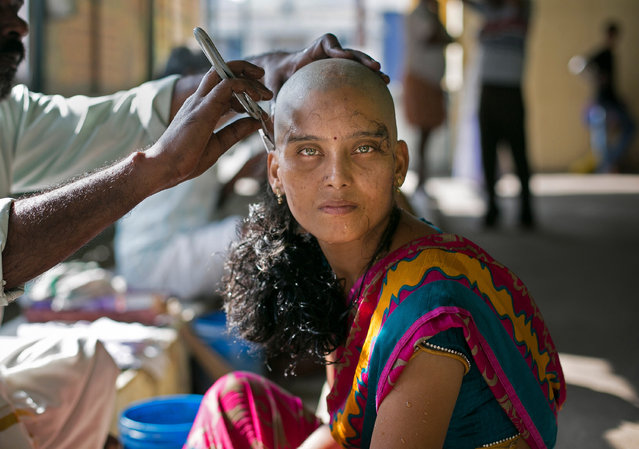
28 year old Rupa has her hair shaven to donate to the Gods at the Thiruthani Murugan Temple November 10, 2016 in Thiruttani, India. Rupa donated her hair with the wish that her daughter's illness is cured. The process of shaving ones hair and donating it to the Gods is known as tonsuring. It is common for Hindu believers to tonsure their hair at a temple as a young child, and also to celebrate a wish coming true, such as the birth of a baby or the curing of an illness. The “temple hair”, as it's known, is then auctioned off to a processing plant and then sold as pricey wigs and weaves in the US, Europe and Africa. (Photo by Allison Joyce/Getty Images)

28 year old Rupa has her hair shaven to donate to the Gods at the Thiruthani Murugan Temple November 10, 2016 in Thiruttani, India. Rupa donated her hair with the wish that her daughter's illness is cured. The process of shaving ones hair and donating it to the Gods is known as tonsuring. It is common for Hindu believers to tonsure their hair at a temple as a young child, and also to celebrate a wish coming true, such as the birth of a baby or the curing of an illness. The “temple hair”, as it's known, is then auctioned off to a processing plant and then sold as pricey wigs and weaves in the US, Europe and Africa. (Photo by Allison Joyce/Getty Images)
Details
21 Nov 2016 10:30:00
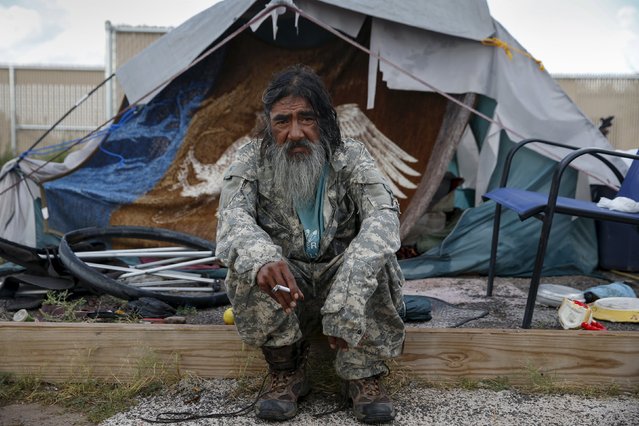
Daniel J. Wabsey, a 58-year-old war veteran, sits outside his tent at Camp Hope in Las Cruces, New Mexico October 6, 2015. “I've been traveling for 35 or 38 years. Getting inside would take a while to get used to. I just want to be able to eat, sleep and be safe. We all get along and understand in Camp Hope. We've all been there. With common sense you can survive out here”, Wabsey said. Camp Hope describe themselves as an “alternative transitional living project for the homeless”. Around 50 people live at the camp. (Photo by Shannon Stapleton/Reuters)

Daniel J. Wabsey, a 58-year-old war veteran, sits outside his tent at Camp Hope in Las Cruces, New Mexico October 6, 2015. “I've been traveling for 35 or 38 years. Getting inside would take a while to get used to. I just want to be able to eat, sleep and be safe. We all get along and understand in Camp Hope. We've all been there. With common sense you can survive out here”, Wabsey said. Camp Hope describe themselves as an “alternative transitional living project for the homeless”. Around 50 people live at the camp. (Photo by Shannon Stapleton/Reuters)
Details
19 Dec 2015 08:05:00
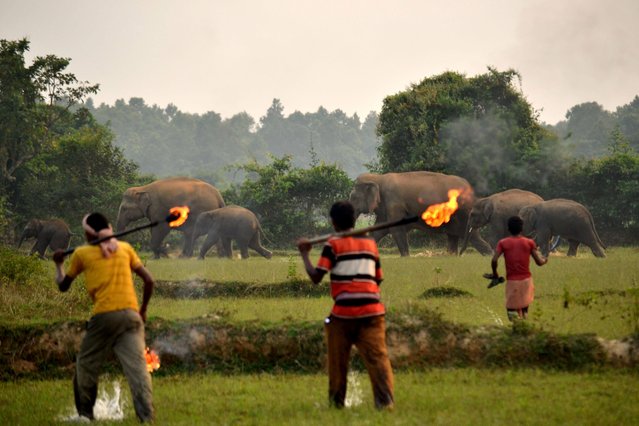
These heartbreaking photo show a confused family of elephants attempting to navigate a railway line built straight through their habitat on October 16, 2012. Taken by Biplab Hazra in Bishnupur, India, the images show the extreme lengths the inhabitants of the town go to to deter elephants from damaging their crops and property. As the images show, villagers often resort to extreme tactics in an effort to drive the elephants out  with one shocking photograph revealing firebombs being launched at a mother and calf as they cross the road. Elephants encroaching out of their habitats is an increasingly common occurrence with deforestation in much of India. (Photo by Biplab Hazra/Caters News Agency)

These heartbreaking photo show a confused family of elephants attempting to navigate a railway line built straight through their habitat on October 16, 2012. Taken by Biplab Hazra in Bishnupur, India, the images show the extreme lengths the inhabitants of the town go to to deter elephants from damaging their crops and property. As the images show, villagers often resort to extreme tactics in an effort to drive the elephants out with one shocking photograph revealing firebombs being launched at a mother and calf as they cross the road. Elephants encroaching out of their habitats is an increasingly common occurrence with deforestation in much of India. (Photo by Biplab Hazra/Caters News Agency)
Details
26 Jan 2019 00:05:00
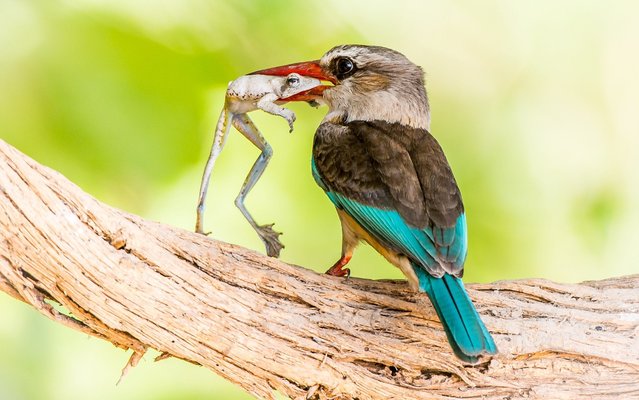
A brown-hooded kingfisher sits on a branch with a freshly caught frog in it's beak. Riaan Marais who took the photo said, “We were doing a boat safari on the Rufiji river in Selous Game Reserve, Tanzania when I spotted the bird with the frog on an overhanging branch on the river bank. It most probably caught the frog in the reeds along the river’s edge as this is where these frogs stay. The kingfisher must have caught the Common Reed Frog just before I took the image, as the frog was still alive, I had a brief moment to take the image before the bird flew off with the frog”. (Photo by Riaan Marais/Solent News and Photo Agency)

A brown-hooded kingfisher sits on a branch with a freshly caught frog in it's beak. Riaan Marais who took the photo said, “We were doing a boat safari on the Rufiji river in Selous Game Reserve, Tanzania when I spotted the bird with the frog on an overhanging branch on the river bank. It most probably caught the frog in the reeds along the river’s edge as this is where these frogs stay. The kingfisher must have caught the Common Reed Frog just before I took the image, as the frog was still alive, I had a brief moment to take the image before the bird flew off with the frog”. (Photo by Riaan Marais/Solent News and Photo Agency)
Details
10 Jun 2018 00:03:00


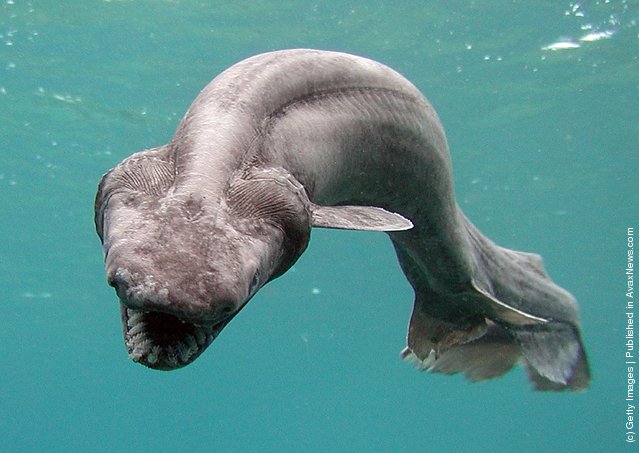
“The frilled shark (Chlamydoselachus anguineus) is one of two extant species of shark in the family Chlamydoselachidae, with a wide but patchy distribution in the Atlantic and Pacific Oceans. This uncommon species is found over the outer continental shelf and upper continental slope, generally near the bottom though there is evidence of substantial upward movements. It has been caught as deep as 1,570 m (5,150 ft), whereas in Suruga Bay, Japan it is most common at depths of 50–200 m (160–660 ft). Exhibiting several “primitive” features, the frilled shark has often been termed a «living fossil»”. – Wikipedia

Photo: A 1.6 meter long Frill shark swims in a tank after being found by a fisherman at a bay in Numazu, on January 21, 2007 in Numazu, Japan. The frill shark, also known as a Frilled shark usually lives in waters of a depth of 600 meters and so it is very rare that this shark is found alive at sea-level. It's body shape and the number of gill are similar to fossils of sharks which lived 350,000,000 years ago. (Photo by Awashima Marine Park/Getty Images)
Details
05 May 2011 10:01:00
12-year-old Chinese girl Sun Yangyang suffering from Cockayne syndrome

“Cockayne syndrome (also called Weber-Cockayne syndrome, or Neill-Dingwall Syndrome) is a rare autosomal recessive congenital disorder characterized by growth failure, impaired development of the nervous system, abnormal sensitivity to sunlight (photosensitivity), and premature aging. Hearing loss and eye abnormalities (pigmentary retinopathy) are other common features, but problems with any or all of the internal organs are possible. It is associated with a group of disorders called leukodystrophies. The underlying disorder is a defect in a DNA repair mechanism. It is named after English physician Edward Alfred Cockayne (1880–1956)”. – Wikipedia

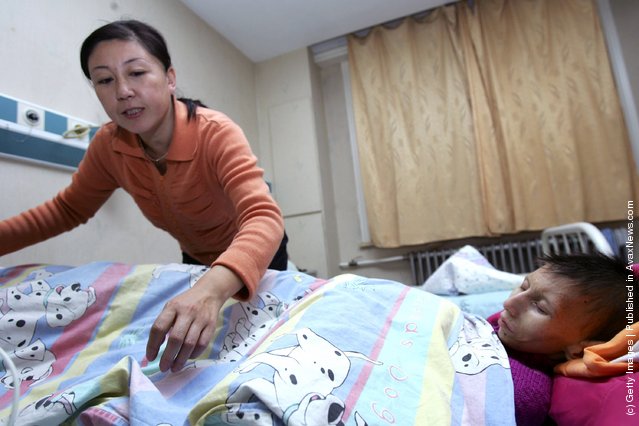
Photo: Mother of 12-year-old Chinese girl Sun Yangyang suffering from Cockayne syndrome, tends her at the First Affiliated Hospital of Jilin University on November 11, 2006 in Changchun of Jilin Province, China. The disease results in the senile appearance of Yangyang and also causes eyesight, hearing weakness and other problems. Doctors failed to cure the girl... (Photo by China Photos/Getty Images)
Details
08 Aug 2011 11:17:00
Yang Juan, an employee at Goopal Group, takes a nap in her seat after lunch, in Beijing, China, April 21, 2016. (Photo by Jason Lee/Reuters)

Yang Juan, an employee at Goopal Group, takes a nap in her seat after lunch, in Beijing, China, April 21, 2016. Office workers sleeping on the job is a common sight in China, where a surplus of cheap labour can lead to downtime at work. But in China's technology sector, where business is growing faster than many start-up firms can hire new staff, workers burn the midnight oil to meet deadlines and compete with their rivals. Some companies provide sleeping areas and beds for workers to rest during late nights. (Photo by Jason Lee/Reuters)
Details
12 May 2016 14:53:00
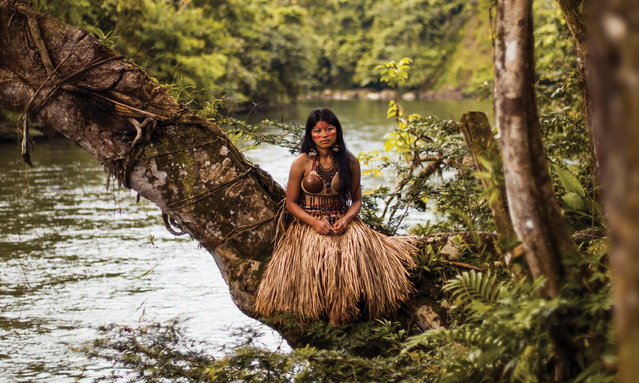
Ecuador: “More and more tribes of Amazonia are starting to adopt modern clothes for everyday life. But they are still keeping their traditional clothes for important events. I photographed this young woman in her wedding outfit”. (Photo by Mihaela Noroc/The Guardian)

Photographer Mihaela Noroc travelled the world from Ethiopia to the US and from Guatemala to France in search of natural and authentic beauty. She introduces some of the inspiring women she met on her journey. Here: Ecuador. “More and more tribes of Amazonia are starting to adopt modern clothes for everyday life. But they are still keeping their traditional clothes for important events. I photographed this young woman in her wedding outfit”. (Photo by Mihaela Noroc/The Guardian)
Details
27 Sep 2017 08:29:00