Loading...
Done
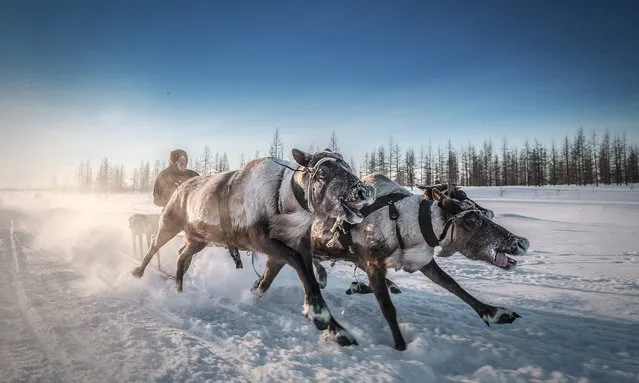
Take me away, deer, Russia. The Nenet people of Arctic Russia use reindeer and sledges as a prime mode of transport. The animals’ navigational ability means that in severe conditions they are sometimes the only hope of survival. (Photo by Kamil Nureev/Smithsonian Photo Contest)

Take me away, deer, Russia. The Nenet people of Arctic Russia use reindeer and sledges as a prime mode of transport. The animals’ navigational ability means that in severe conditions they are sometimes the only hope of survival. (Photo by Kamil Nureev/Smithsonian Photo Contest)
Details
06 Mar 2017 00:05:00
Players in action during the Swamp Soccer Championships 2019 in Hyrynsalmi, Finland, 19 July 2019. The World Championship in swamp football is played annually on Vuorisuo bog in Hyrynsalmi. (Photo by Tomi Hanninen/EPA/EFE)

Players in action during the Swamp Soccer Championships 2019 in Hyrynsalmi, Finland, 19 July 2019. The World Championship in swamp football is played annually on Vuorisuo bog in Hyrynsalmi. (Photo by Tomi Hanninen/EPA/EFE)
Details
21 Jul 2019 00:07:00
A girl plays with coloured chicks for sale prior to Easter celebrations in Byblos March 22, 2015. (Photo by Jamal Saidi/Reuters)

A girl plays with coloured chicks for sale prior to Easter celebrations in Byblos, Lebanon on March 22, 2015. (Photo by Jamal Saidi/Reuters)
Details
28 Mar 2015 11:23:00
Body builders preparing at the backstage during the Bodybuilding Cup in Kiev, Ukraine on November 7, 2015 which includes classic bodybuilding, physicist and body fitness and bikini in the competition. (Photo by Nazar Furyk/Pacific Press)

Body builders preparing at the backstage during the Bodybuilding Cup in Kiev, Ukraine on November 7, 2015 which includes classic bodybuilding, physicist and body fitness and bikini in the competition. (Photo by Nazar Furyk/Pacific Press)
Details
10 Nov 2015 13:32:00
“Cassowaries are large, flightless birds related to emus and (more distantly) to ostriches, rheas, and kiwis”, writes Olivia Judson in the September issue of National Geographic magazine. (Photo by Christian Ziegler/National Geographic)

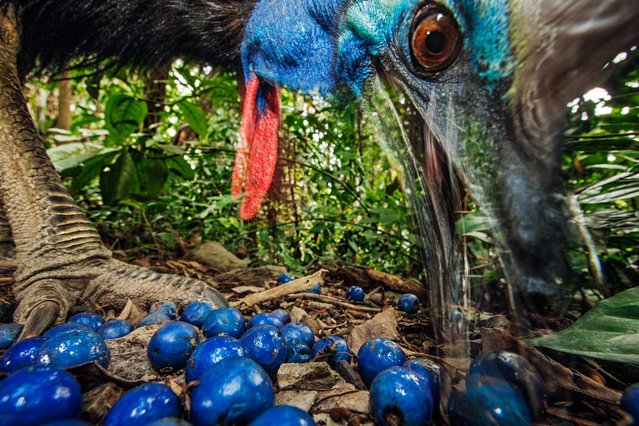
“Cassowaries are large, flightless birds related to emus and (more distantly) to ostriches, rheas, and kiwis”, writes Olivia Judson in the September issue of National Geographic magazine. How large? People-size: Adult males stand well over five foot five and top 110 pounds. Females are even taller, and can weigh more than 160 pounds. Dangerous when roused, they’re shy and peaceable when left alone. But even birds this big and tough are prey to habitat loss. The dense New Guinea and Australia rain forests where they live have dwindled. Today cassowaries might number 1,500 to 2,000. And because they help shape those same forests – by moving seeds from one place to another – “if they vanish”, Judson writes, “the structure of the forest would gradually change” too. (Photo by Christian Ziegler/National Geographic)

Details
06 Jan 2014 12:21:00
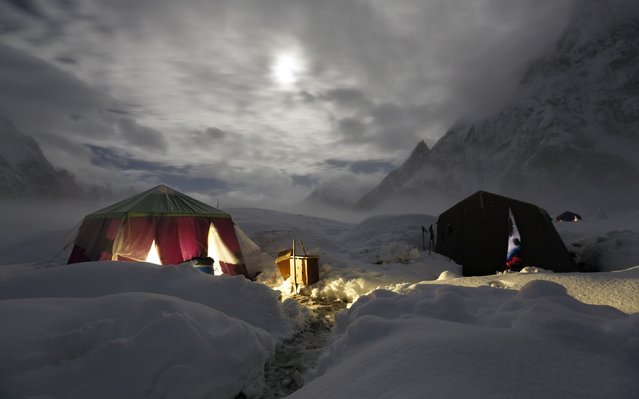
The moon illuminates the snow-covered Concordia, the confluence of the Baltoro and Godwin-Austen glaciers, near the world's second highest mountain the K2 (8,000 meters) in the Karakoram mountain range in Pakistan September 6, 2014. (Photo by Wolfgang Rattay/Reuters)

The moon illuminates the snow-covered Concordia, the confluence of the Baltoro and Godwin-Austen glaciers, near the world's second highest mountain the K2 (8,000 meters) in the Karakoram mountain range in Pakistan September 6, 2014. While other parts of Pakistan and northern India were flooded, Concordia in the Karakoram mountain range was covered with a seasonally unusual amount of snow. Geographically, Pakistan is a climbers paradise. It rivals Nepal for the number of peaks over 7,000 meters and is home to the world's second tallest mountain, K2, as well as four of the world's 14 summits higher than 8,000 meters. (Photo by Wolfgang Rattay/Reuters)
Details
24 Oct 2014 12:27:00
On August 31, 2012, a long filament of solar material that had been hovering in the sun's atmosphere, the corona, erupted out into space at 4:36 p.m. EDT. The coronal mass ejection, or CME, traveled at over 900 miles per second. The CME did not travel directly toward Earth, but did connect with Earth's magnetic environment, or magnetosphere, causing aurora to appear on the night of Monday, September 3. (Photo by NASA/GSFC/SDO)

On August 31, 2012, a long filament of solar material that had been hovering in the sun's atmosphere, the corona, erupted out into space at 4:36 p.m. EDT. The coronal mass ejection, or CME, traveled at over 900 miles per second. The CME did not travel directly toward Earth, but did connect with Earth's magnetic environment, or magnetosphere, causing aurora to appear on the night of Monday, September 3. (Photo by NASA/GSFC/SDO via The Atlantic)
Details
14 Sep 2012 09:01:00
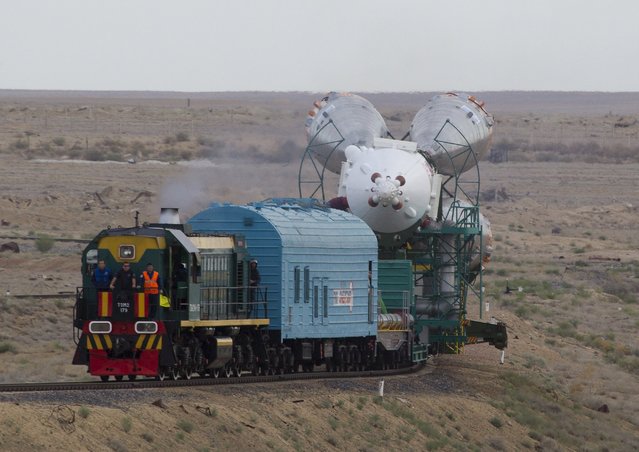
The Soyuz TMA-18M spacecraft is transported from an assembling hangar to its launch pad at the Baikonur cosmodrome, Kazakhstan, August 31, 2015. (Photo by Shamil Zhumatov/Reuters)

The Soyuz TMA-18M spacecraft is transported from an assembling hangar to its launch pad at the Baikonur cosmodrome, Kazakhstan, August 31, 2015. The Soyuz is scheduled to blast off with Aidyn Aimbetov of Kazakhstan, Sergei Volkov of Russia and Andreas Mogensen of Denmark to the International Space Station (ISS) on September 2, 2015. (Photo by Shamil Zhumatov/Reuters)
Details
01 Sep 2015 14:45:00