Loading...
Done
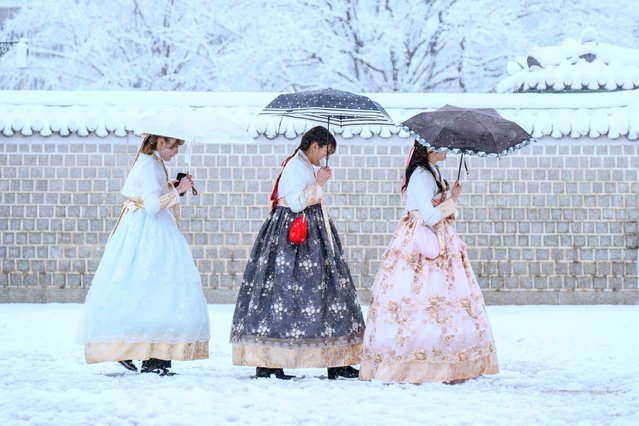
Visitors wearing traditional hanbok dresses are seen on the grounds of Gyeongbokgung Palace amid heavy snowfall in central Seoul on November 27, 2024. South Korea's capital was blanketed on November 27 by the heaviest November snowfall since records began over a century ago, the weather agency said. (Photo by Anthony Wallace/AFP Photo)

Visitors wearing traditional hanbok dresses are seen on the grounds of Gyeongbokgung Palace amid heavy snowfall in central Seoul on November 27, 2024. South Korea's capital was blanketed on November 27 by the heaviest November snowfall since records began over a century ago, the weather agency said. (Photo by Anthony Wallace/AFP Photo)
Details
16 Dec 2024 03:49:00
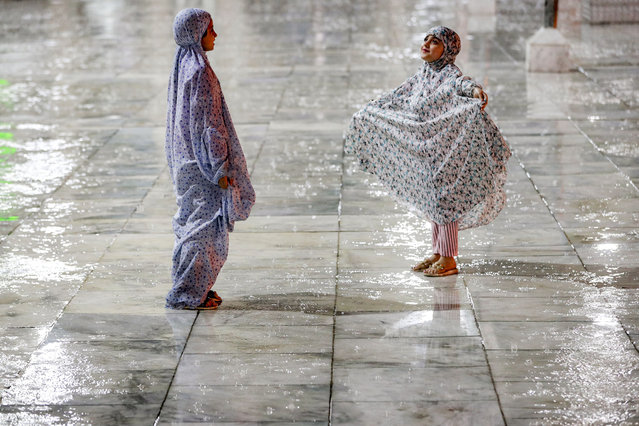
Young Muslim worshippers stand in the rain at the shrine of the 12th-century Sunni cleric Abdul Qadir al-Jilani (Gilani) in Baghdad as people gather to perform the prayers for Eid al-Fitr, which marks the end of the Muslim holy fasting month of Ramadan, as observed locally on March 31, 2025. (Photo by Ahmad Al-Rubaye/AFP Photo)

Young Muslim worshippers stand in the rain at the shrine of the 12th-century Sunni cleric Abdul Qadir al-Jilani (Gilani) in Baghdad as people gather to perform the prayers for Eid al-Fitr, which marks the end of the Muslim holy fasting month of Ramadan, as observed locally on March 31, 2025. (Photo by Ahmad Al-Rubaye/AFP Photo)
Details
24 Apr 2025 03:13:00
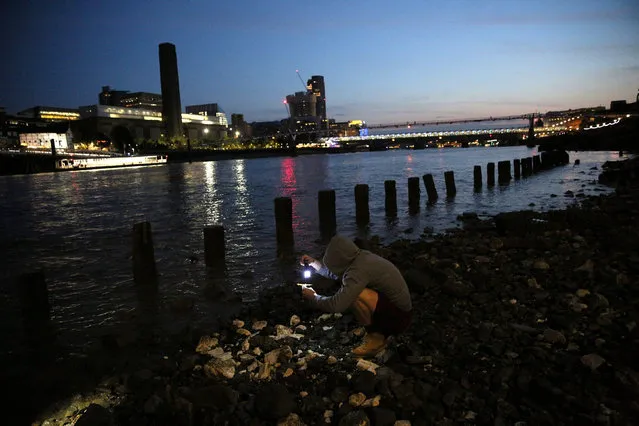
A mudlark uses a torch to look for items on the bank of the River Thames in London, Britain June 06, 2016. Mudlarking is believed to trace its origins to the 18th and 19th century, when scavengers searched the Thames' shores for items to sell. These days, history and archaeology fans are the ones hoping to find old relics such as coins, ceramics, artifacts or everyday items from across centuries. They wait for the low tide and then scour specific areas of exposed shores. "If you're in a field you could be out all day long, with the river you're restricted to about two or three hours," mudlark Nick Stevens said. While many just use the naked eye for their searches, others rely on metal detectors for which a permit from the Port of London Authority is needed. Digging also requires consent. (Photo by Neil Hall/Reuters)

A mudlark uses a torch to look for items on the bank of the River Thames in London, Britain June 06, 2016. Mudlarking is believed to trace its origins to the 18th and 19th century, when scavengers searched the Thames' shores for items to sell. These days, history and archaeology fans are the ones hoping to find old relics such as coins, ceramics, artifacts or everyday items from across centuries. their finds with the Portable Antiquities Scheme. Any item over 300 years old must be recorded. (Photo by Neil Hall/Reuters)
Details
27 Aug 2016 10:43:00
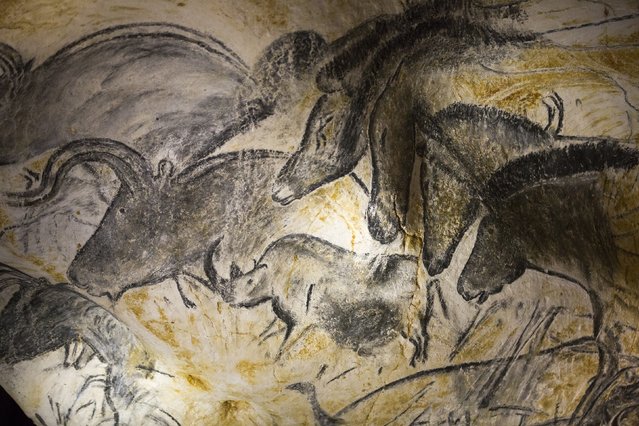
A replica of pre-historic drawings showing horses, rhinoceros and aurochs is seen on a wall during a press visit at the site of the Cavern of Pont-d'Arc project in Vallon Pont d'Arc April 8, 2015. (Photo by Robert Pratta/Reuters)

A replica of pre-historic drawings showing horses, rhinoceros and aurochs is seen on a wall during a press visit at the site of the Cavern of Pont-d'Arc project in Vallon Pont d'Arc April 8, 2015. The Cavern of Pont-d'Arc project is a replica of the pre-historic Decorated Cave of Pont-d'Arc known as Grotte Chauvet, in Vallon Pont-d'Arc in the Ardeche region, containing the world's earliest known art which was recently named a UNESCO World Heritage site. The facsimile cavern, which condenses some 8000m² of the original site into 3000m², will display faithful reproductions of paintings and engravings and will be inaugurated on April 10 and will open to the public on April 25. (Photo by Robert Pratta/Reuters)
Details
09 Apr 2015 14:23:00
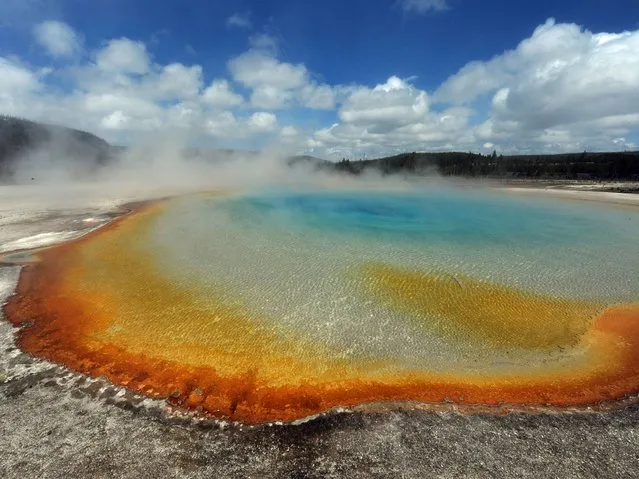
View of the “Sunset Lake” hot spring with it's unique colors caused by brown, orange and yellow algae-like bacteria called Thermophiles, that thrive in the cooling water turning the vivid aqua-blues to a murkier greenish brown, in the Yellowstone National Park, Wyoming on June 1, 2011. (Photo by Mark Ralston/AFP Photo)

View of the “Sunset Lake” hot spring with it's unique colors caused by brown, orange and yellow algae-like bacteria called Thermophiles, that thrive in the cooling water turning the vivid aqua-blues to a murkier greenish brown, in the Yellowstone National Park, Wyoming on June 1, 2011. Yellowstone National Park, was established by the U.S. Congress and signed into law by President Grant on March 1, 1872. The park is located primarily in the U.S. state of Wyoming, though it also extends into Montana and Idaho and was the first national park in the world. It is known for its wildlife and its many geothermal features, especially the Old Faithful Geyser. (Photo by Mark Ralston/AFP Photo)
Details
06 Apr 2014 08:02:00
An aspiring Catholic priest Jose Luis Guerra, a member of Raza Nueva in Christ, a project of the archdiocese of Monterrey, and other missionaries hand out a Bible to Angel Castillo, who wants to become a missionary with Raza Nueva, in the municipality of Garcia, outskirts of Monterrey, Mexico, July 12, 2016. (Photo by Daniel Becerril/Reuters)

An aspiring Catholic priest Jose Luis Guerra, a member of Raza Nueva in Christ, a project of the archdiocese of Monterrey, and other missionaries hand out a Bible to Angel Castillo, who wants to become a missionary with Raza Nueva, in the municipality of Garcia, outskirts of Monterrey, Mexico, July 12, 2016. In the troubled fringes of the northern Mexican city of Monterrey, an aspiring priest is using his faith to reach out to young gang members and at-risk youth, and bring them into his “Gang of Christ”. (Photo by Daniel Becerril/Reuters)
Details
28 Jul 2016 13:22:00
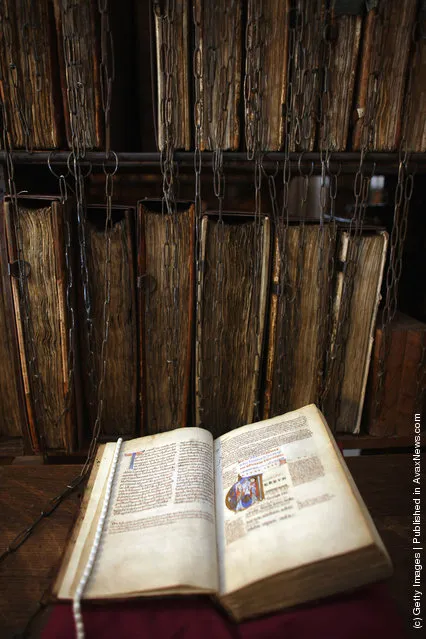
The Newly Cleaned And Extremely Rare Chained Library At Hereford Cathedral

A 12th century manuscript of The Old Testament sits in the Chained Library of Hereford Cathedral after it's annual spring clean on January 24, 2012 in Hereford, England. (Photo by Christopher Furlong/Getty Images)
Details
30 Jan 2012 09:58:00
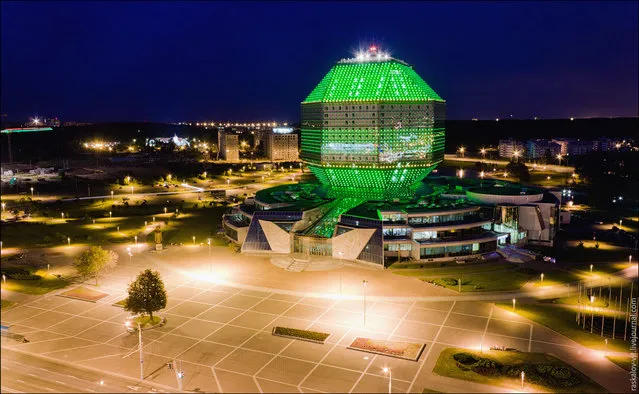
Minsk city

The earliest historic references to Minsk date to the 11th century 1067, when it was noted as a provincial city within the principality of Polotsk. The settlement developed on the rivers. In 1242, Minsk became a part of the Grand Duchy of Lithuania. It received town privileges in 1499.
Details
18 Jun 2012 12:00:00