Loading...
Done


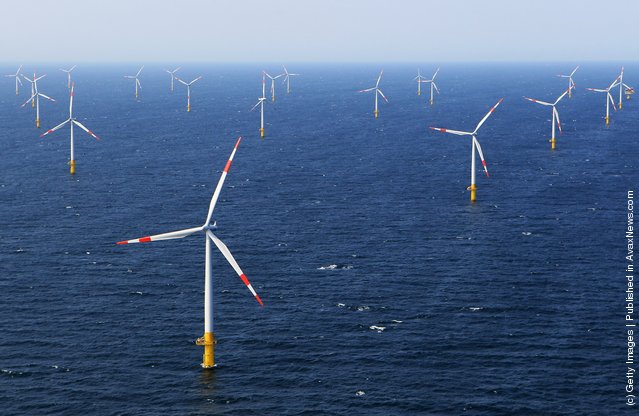
Wind turbines stand in the Baltic 1 offshore wind farm on April 29, 2011 in the Baltic Sea near Zingst, Germany. Baltic 1, a project of German energy utility EnBW that includes 21 turbines rated at 2.3 megawatts each, will be Germany's first commercial offshore wind farm once it officially begins operation on May 2. Germany has thus far lagged in offshore wind farm construction when compared to neighbors like Great Britain and Denmark, though German Chancellor Angela Merkel has vowed to invest heavily into offshore wind farms as part of an overall policy to encourage renewable energy production. (Photo by Joern Pollex/Getty Images)
Details
30 Apr 2011 12:54:00
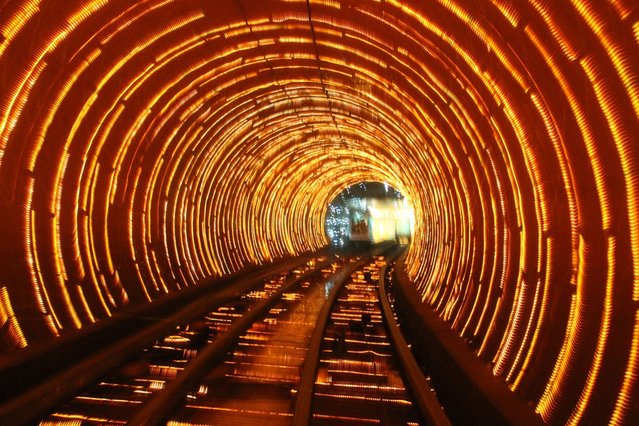
The Bund Sightseeing Tunnel In Shanghai

The Bund Sightseeing Tunnel is not an adventure for the light hearted. The trippy visuals and sound effects are rather bizarre and creepy. They look like something out of a nightmare or a psychedelic trip. Maybe the creators of this project did experiment with some illicit drugs to gain inspiration for this project. Moreover, it is more likely than not that some people tried going to this tourist attraction after “preparing” themselves beforehand. This trippy tunnel stretches from Pudong to Puxi in Shanghai, China, and is rated as one of the top five tourist attractions. We recommend visiting this place; just don’t take your kids along for the ride, since it might prove to be too scary for them.
Details
06 Feb 2015 12:27:00
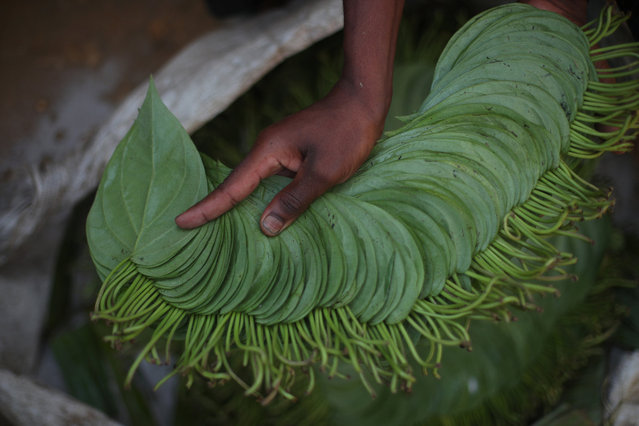
Faruk, 17, a Rohingya refugee trader holds betel leaves which are on sale at a stall in Palong Khali refugee camp near Cox's Bazar, Bangladesh, November 3, 2017. He left his village in Myanmar when the military opened fire towards the Rohingya. “I buy this betel leaf from Palong Khali market, in one bundle there are 160 pieces, I buy it for 80 taka and I sell it for 100 taka. Bangladeshi's and I sell for the same rate in the camp. Outside in the local market it is 80 taka per bundle. My problem is that I don't have money so I can't buy anything to eat, I can't buy fish to eat”, he said. (Photo by Hannah McKay/Reuters)

Faruk, 17, a Rohingya refugee trader holds betel leaves which are on sale at a stall in Palong Khali refugee camp near Cox's Bazar, Bangladesh, November 3, 2017. He left his village in Myanmar when the military opened fire towards the Rohingya. “I buy this betel leaf from Palong Khali market, in one bundle there are 160 pieces, I buy it for 80 taka and I sell it for 100 taka (1 Bangladeshi Taka = 0.012 US Dollar). Bangladeshi's and I sell for the same rate in the camp. Outside in the local market it is 80 taka per bundle. My problem is that I don't have money so I can't buy anything to eat, I can't buy fish to eat”, he said. (Photo by Hannah McKay/Reuters)
Details
27 Nov 2017 08:54:00
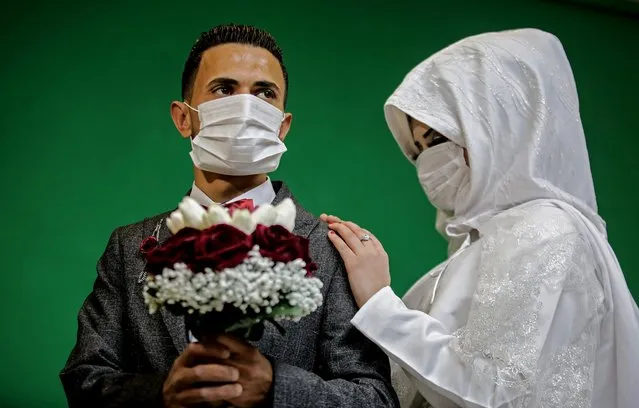
Palestinian groom Mohamed abu Daga and his bride Israa wear face masks amid the COVID-19 epidemic, during a photoshoot at a studio before their wedding ceremony in Khan Yunis in the southern Gaza Strip, on March 23, 2020. Authorities in Gaza confirmed on March 22 the first two cases of novel coronavirus, identifying them as Palestinians who had travelled to Pakistan and were being held in quarantine since their return, as the United Nations warned of potential disastrous outcomes to an outbreak given the high poverty rates and weak health system in the coastal strip, under Israeli blockade since 2007. (Photo by Said Khatib/AFP Photo)

Palestinian groom Mohamed abu Daga and his bride Israa wear face masks amid the COVID-19 epidemic, during a photoshoot at a studio before their wedding ceremony in Khan Yunis in the southern Gaza Strip, on March 23, 2020. Authorities in Gaza confirmed on March 22 the first two cases of novel coronavirus, identifying them as Palestinians who had travelled to Pakistan and were being held in quarantine since their return, as the United Nations warned of potential disastrous outcomes to an outbreak given the high poverty rates and weak health system in the coastal strip, under Israeli blockade since 2007. (Photo by Said Khatib/AFP Photo)
Details
27 Mar 2020 00:07:00
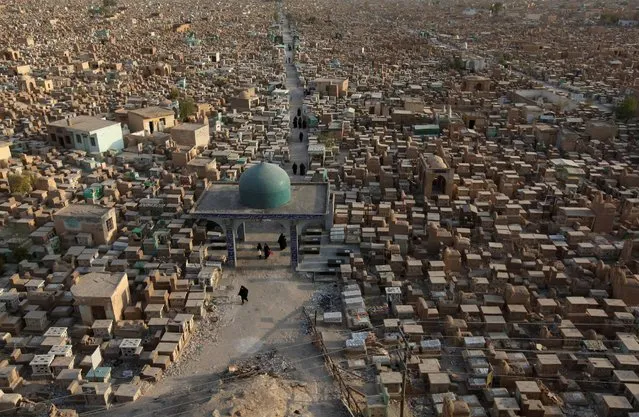
The Wadi al-Salam cemetery, Arabic for “Peace Valley”, is seen in Najaf, south of Baghdad, Iraq August 3, 2016. The world's largest cemetery, in Iraq's Shi'ite holy city of Najaf, is expanding at double its usual rate as Shi'ite militias bury their dead from the war against Islamic State. The Wadi al-Salam cemetery, Arabic for “Peace Valley” has a special place in the hearts of Shi'ite Muslims as it surrounds the Mausoleum of their first imam, Ali Bin Abi Talib, a cousin and son-in-law of Prophet Mohammad. (Photo by Alaa Al-Marjani/Reuters)

The Wadi al-Salam cemetery, Arabic for “Peace Valley”, is seen in Najaf, south of Baghdad, Iraq August 3, 2016. The world's largest cemetery, in Iraq's Shi'ite holy city of Najaf, is expanding at double its usual rate as Shi'ite militias bury their dead from the war against Islamic State. The Wadi al-Salam cemetery, Arabic for “Peace Valley” has a special place in the hearts of Shi'ite Muslims as it surrounds the Mausoleum of their first imam, Ali Bin Abi Talib, a cousin and son-in-law of Prophet Mohammad. (Photo by Alaa Al-Marjani/Reuters)
Details
24 Aug 2016 11:38:00
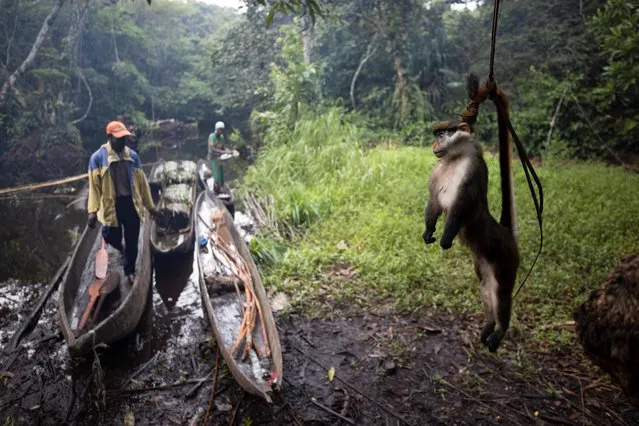
A dead red-tailed monkey hangs by its tail above the ground, in order to keep it away from ants, in the forest near the city of Mbandaka, Democratic Republic of the Congo, April 5, 2019. Bushmeat hunters are emptying Central Africa's forests at a high rate, researchers say. A growing appetite for wild meat in cities has ramped up the scale of hunting. Research shows around 6 million tonnes of bushmeat are sourced annually from the Congo Basin, whose forest spans across six countries and is second in size only to the Amazon. (Photo by Thomas Nicolon/Reuters)

A dead red-tailed monkey hangs by its tail above the ground, in order to keep it away from ants, in the forest near the city of Mbandaka, Democratic Republic of the Congo, April 5, 2019. Bushmeat hunters are emptying Central Africa's forests at a high rate, researchers say. A growing appetite for wild meat in cities has ramped up the scale of hunting. Research shows around 6 million tonnes of bushmeat are sourced annually from the Congo Basin, whose forest spans across six countries and is second in size only to the Amazon. (Photo by Thomas Nicolon/Reuters)
Details
14 Oct 2019 00:03:00
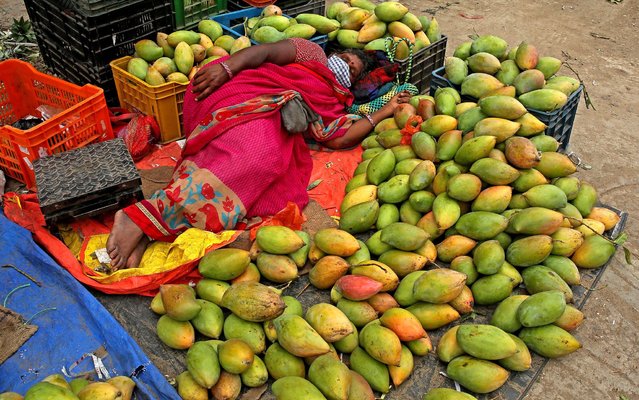
A woman taking a nap on mangoes at city market area after the city eased the lockdown in Bangalore, India 12 July 2021. The Karnataka government eases in covid-19 related lockdown restrictions in the wake of lower coronavirus cases and positivity rate falling below 5% percent. The Karnataka state government administering record 2.5-crore doses till date since the vaccination drive was launched across the state on January 16, Karnataka ranked first in South India in inoculating maximum number of its eligible population, said state Health Minister K. Sudhakar. (Photo by Jagadeesh N.V./EPA/EFE)

A woman taking a nap on mangoes at city market area after the city eased the lockdown in Bangalore, India 12 July 2021. The Karnataka government eases in covid-19 related lockdown restrictions in the wake of lower coronavirus cases and positivity rate falling below 5% percent. The Karnataka state government administering record 2.5-crore doses till date since the vaccination drive was launched across the state on January 16, Karnataka ranked first in South India in inoculating maximum number of its eligible population, said state Health Minister K. Sudhakar. (Photo by Jagadeesh N.V./EPA/EFE)
Details
19 Jul 2021 09:24:00


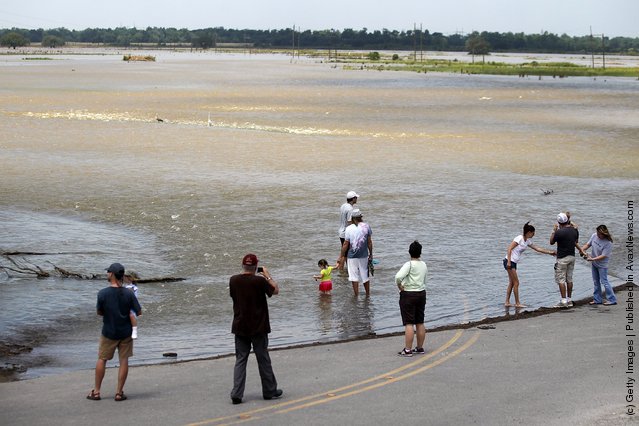
People look on as water from the rising Mississippi River is released through the Bonnet Carre Spillway while washing out a road May 9, 2011 in Norco, Louisiana. The Army Corps of Engineers began redirecting part of the Mississippi River through the spillway today to lower river levels and reduce pressure on levees in order to avoid a catastrophic failure. The water will flow nearly 6 miles north before emptying into Lake Pontchartrain as the Mississippi rises close to the highest level ever upriver in Memphis. (Photo by Mario Tama/Getty Images)
Details
11 May 2011 10:11:00