Loading...
Done
Son Doong Cave

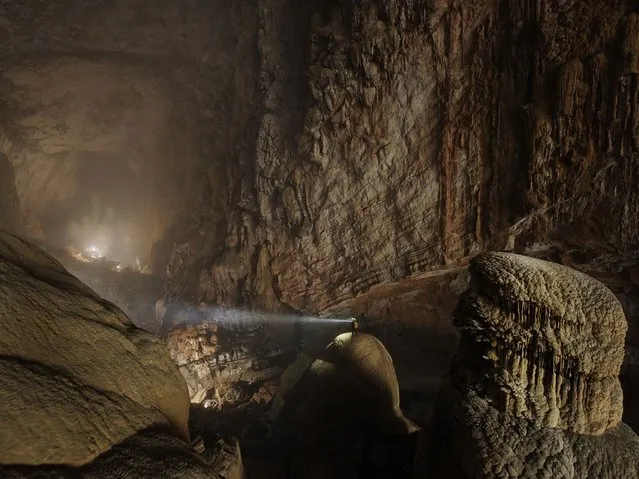
Son doong cave is a cave in Phong Nha-Kẻ Bàng National Park, Bố Trạch district, Quảng Bình Province, Vietnam. Currently the biggest known cave in the world, the cave is located near the Laos-Vietnam border. Inside is a large, fast-flowing underground river.
In early August 2013, the first tourist group explored the cave on a guided tour at a cost of US$3,000 each. The group had six members from Australia, Norway, Russia and USA and spent 7 days and 6 nights for the tour. Next exploration trips will be arranged.
Details
22 Sep 2013 12:30:00


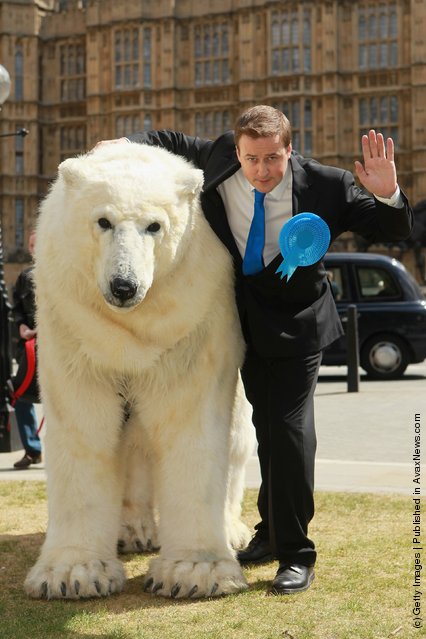
A David Cameron look-alike poses with a polar bear model outside the Houses of Parliament as part of a Greenpeace protest on May 13, 2011 in London, England. The environmental charity Greenpeace arranged the protest to highlight the first anniversary of David Cameron’s speech when he pledged to make his new government the greenest ever. In April 2006 Mr Cameron traveled by huskie-drawn sledge when he visited the island of Svalbard in Norway to witness the effects of climate change. (Photo by Oli Scarff/Getty Images)
Details
14 May 2011 13:59:00
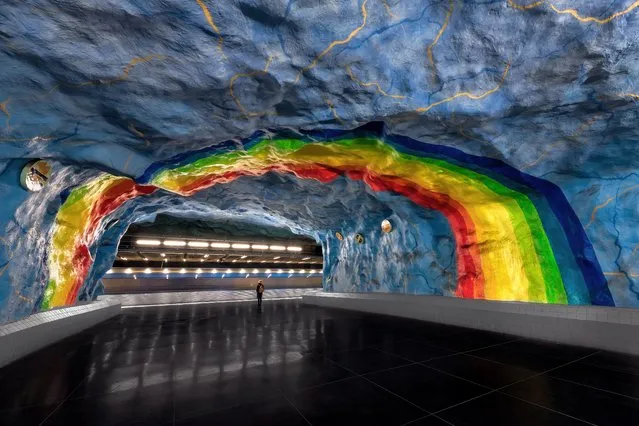
A rainbow arcs over a girl on the platform of Stadion station. (Photo by Conor MacNeill/The Observer)

Beneath the Swedish capital lies an intricate web of underground train lines. More than 90 of the 100 stations in the 110km tunnel system, sometimes referred to as “the world’s longest art gallery”, have been decorated with paintings, installations, mosaics and sculptures by 150 artists since the 1950s. After spending a couple of weeks exploring arctic Norway and Sweden, London-based travel photographer Conor MacNeill headed underground to capture images of the metro stations. Here: A rainbow arcs over a girl on the platform of Stadion station. (Photo by Conor MacNeill/The Observer)
Details
05 Jun 2016 13:21:00
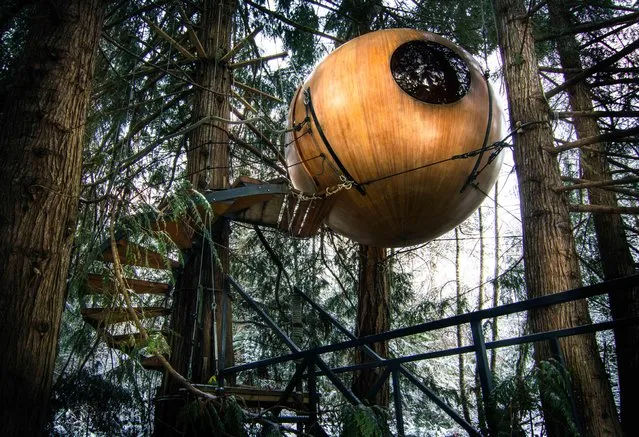
Eryn, owned by Tom Chudleigh in Canada. New global research has revealed that ‘shed-scapism’ is sweeping the world with more people than ever ditching their tools and transforming their sheds into zen dens. The research comes as the Cuprinol Shed of the Year competition joins forces with aspirational shed fan site, Cabin p*rn, to launch the first ever global category. We have a stunning suite of imagery of 9 sheds from across the world - from Norway to Slovenia, British Colombia to Colorado who have all submitted their sheds in the hopes of being crowned the first ever Global Shed of the Year. (Photo by Cuprinol/Rex Features/Shutterstock)

Eryn, owned by Tom Chudleigh in Canada. New global research has revealed that ‘shed-scapism’ is sweeping the world with more people than ever ditching their tools and transforming their sheds into zen dens. The research comes as the Cuprinol Shed of the Year competition joins forces with aspirational shed fan site, Cabin p*rn, to launch the first ever global category. We have a stunning suite of imagery of 9 sheds from across the world - from Norway to Slovenia, British Colombia to Colorado who have all submitted their sheds in the hopes of being crowned the first ever Global Shed of the Year. (Photo by Cuprinol/Rex Features/Shutterstock)
Details
15 Mar 2017 00:02:00
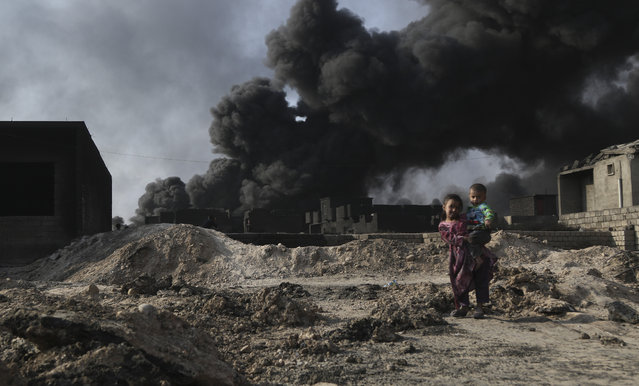
A girl holds her brother in her arm as black smoke rises after an oil well set on fire in the center of al-Kayyara town to the south of Daesh terror organization-held Mosul in Iraq on October 25, 2016. The oil well in the center of al-Kayyara town, which was set alight by retreating Daesh militants in advance of the Iraqi army's takeover of the town on August 24, 2016 has still not entirely been put out. The raw petrol which is still alight is creating black clouds above the city. The residents and wildlife beneath this polluting smoke cloud may find their health at risk. The effects of the fire in the town center on unprotected civilians' health can easily be seen on the hands and faces of children playing on the street. (Photo by dris Okuducu/Anadolu Agency/Getty Images)

A girl holds her brother in her arm as black smoke rises after an oil well set on fire in the center of al-Kayyara town to the south of Daesh terror organization-held Mosul in Iraq on October 25, 2016. The oil well in the center of al-Kayyara town, which was set alight by retreating Daesh militants in advance of the Iraqi army's takeover of the town on August 24, 2016 has still not entirely been put out. The raw petrol which is still alight is creating black clouds above the city. The residents and wildlife beneath this polluting smoke cloud may find their health at risk. The effects of the fire in the town center on unprotected civilians' health can easily be seen on the hands and faces of children playing on the street. (Photo by dris Okuducu/Anadolu Agency/Getty Images)
Details
27 Oct 2016 11:54:00
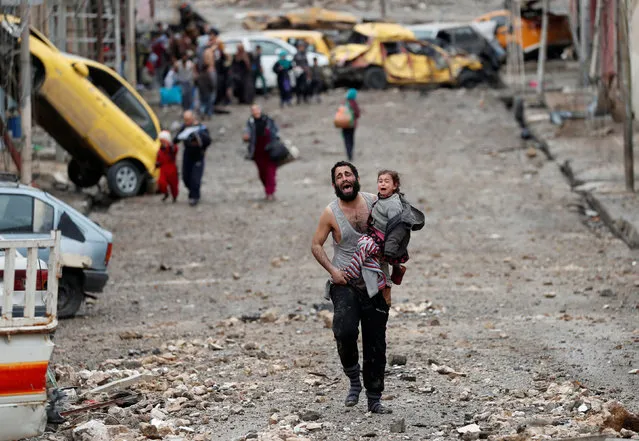
A man cries as he carries his daughter while walking from an Islamic State-controlled part of Mosul towards Iraqi special forces soldiers during a battle in Mosul, Iraq March 4, 2017. Reuters Photographer Goran Tomasevic: “Both screaming in terror, a father and the young daughter he cradled in his arm fled through the rubble-strewn streets of Wadi Hajar, transformed in a flash into a battleground between Islamic State fighters and Iraqi special forces. They and their neighbours – some wearing rubber sandals, some barefoot –  were running from an IS counter-attack in this part of Mosul, dodging gunfire as the militants closed in”. (Photo by Goran Tomasevic/Reuters)

A man cries as he carries his daughter while walking from an Islamic State-controlled part of Mosul towards Iraqi special forces soldiers during a battle in Mosul, Iraq March 4, 2017. Reuters Photographer Goran Tomasevic: “Both screaming in terror, a father and the young daughter he cradled in his arm fled through the rubble-strewn streets of Wadi Hajar, transformed in a flash into a battleground between Islamic State fighters and Iraqi special forces. They and their neighbours – some wearing rubber sandals, some barefoot – were running from an IS counter-attack in this part of Mosul, dodging gunfire as the militants closed in”. (Photo by Goran Tomasevic/Reuters)
Details
13 Mar 2017 00:02:00
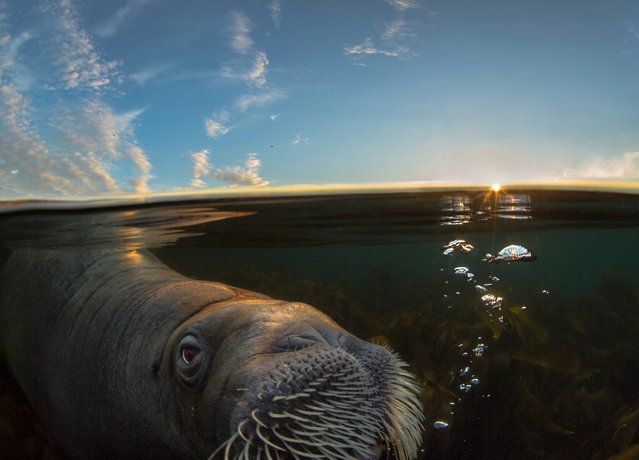
The Wildscreen festival is the world’s biggest celebration of screen-based natural history storytelling which takes place every two years in Bristol. Here: “Walrus in Midnight Sun”. Walrus feed mostly on bivalves in productive, shallow and often sandy habitats in the Arctic. This individual, though, arrived on a beach outside Tromsø, northern Norway, and found comfort on a stranded dead sperm whale. After two weeks he approached Audun, and only half a metre away he stretched his tusk forward and touched his hand gently. “This was one of the most memorable moments of my life”, Rikardsen says. He named the 500kg male Buddy. After two months, the dead whale was decomposed and Buddy suddenly disappeared. (Photo by Audun Rikardsen/Wildscreen 2016)

The Wildscreen festival is the world’s biggest celebration of screen-based natural history storytelling which takes place every two years in Bristol. Here: “Walrus in Midnight Sun”. Walrus feed mostly on bivalves in productive, shallow and often sandy habitats in the Arctic. This individual, though, arrived on a beach outside Tromsø, northern Norway, and found comfort on a stranded dead sperm whale. After two weeks he approached Audun, and only half a metre away he stretched his tusk forward and touched his hand gently. “This was one of the most memorable moments of my life”, Rikardsen says. He named the 500kg male Buddy. After two months, the dead whale was decomposed and Buddy suddenly disappeared. (Photo by Audun Rikardsen/Wildscreen 2016)
Details
07 Oct 2016 10:02:00
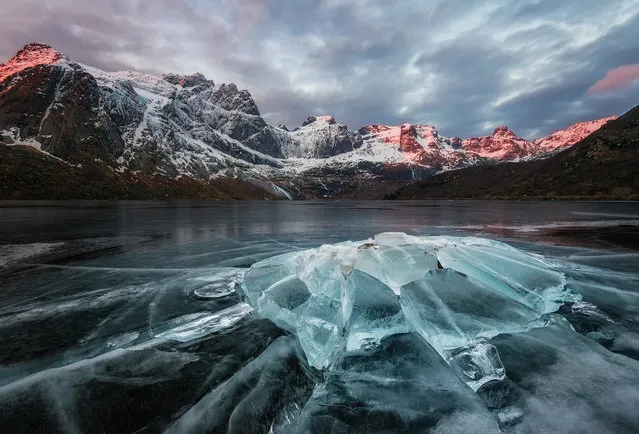
“Lofoten Glow”. I was desperately searching a good sunrise spot this particular morning. Normally Storvatnet Lake is completely covered in snow, so you can only imagine my surprise when I saw these crazy ice formations almost being shot out of the frozen lake. I put my crampons on and took a big risk walking out. Photo location: Storvatnet, Lofoten Islands in Northern Norway. (Photo and caption by Stian Klo/National Geographic Photo Contest)

“Lofoten Glow”. I was desperately searching a good sunrise spot this particular morning. Normally Storvatnet Lake is completely covered in snow, so you can only imagine my surprise when I saw these crazy ice formations almost being shot out of the frozen lake. I put my crampons on and took a big risk walking out. I could hear the ice cracking underneath my feet, and when you’re all alone in a fjord/canyon like this – the cracks are echoed and sound really frightening. Was it worth it? I sure think so! Photo location: Storvatnet, Lofoten Islands in Northern Norway. (Photo and caption by Stian Klo/National Geographic Photo Contest)
Details
08 Apr 2014 09:40:00