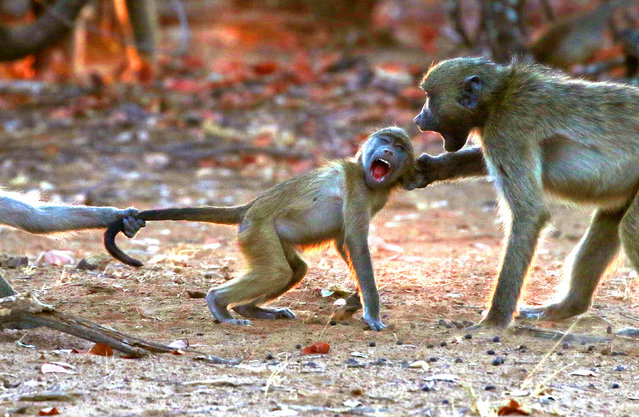
A young baboon receives an earful from an adult as another primate yanks its tail at Kruger National Park, South Africa in the first decade of July 2024. (Photo by John Mullineux/Solent News)
A reveller attends the “Amigos da Onça” street party on the second day of Carnival on February 10, 2024 in Rio de Janeiro, Brazil. (Photo by Buda Mendes/Getty Images)
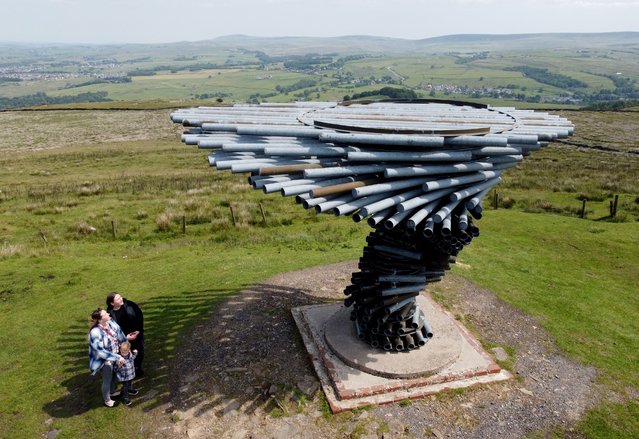
Migle Politike (left) with son Aaron and friend Goda Zubkaityte on Wednesday, June 11, 2025 stop to look at the Singing Ringing Tree, a musical sculpture designed to look like a windswept tree, at Crown Point overlooking Burnley, Lancashire, UK. The wind-powered musical sculpture emits a low, tuneful song when the wind blows. (Photo by Martin Rickett/PA Wire)
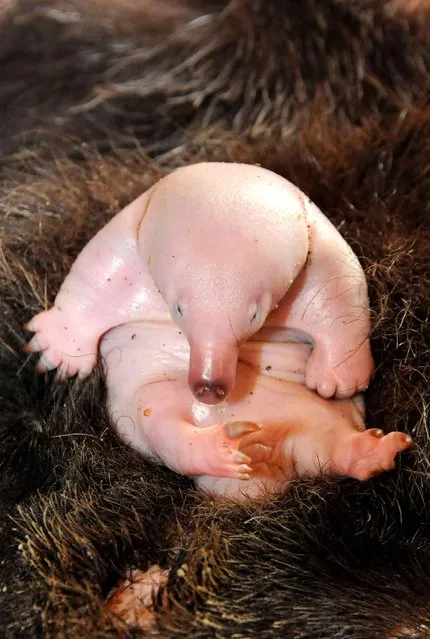
It's a 30-day-old Echidna baby, known as a “puggle” – one of only 24 ever bred in captivity. The proud parents are Tippy and Pickle of Australia Zoo. The tiny baby, whose s*x has not yet been identified, hatched from a soft egg and will continue to develop and nurse inside Tippy's warm pouch. (Photo by Australia Zoo/Rex/Sipa Press)
“Sniff out the Appenzell Cheese”. Alexander Hunter, 30, of Greenwich, Conn., took this photo in Appenzell, Switzerland, in September 2014. (Photo by Alexander Hunter)
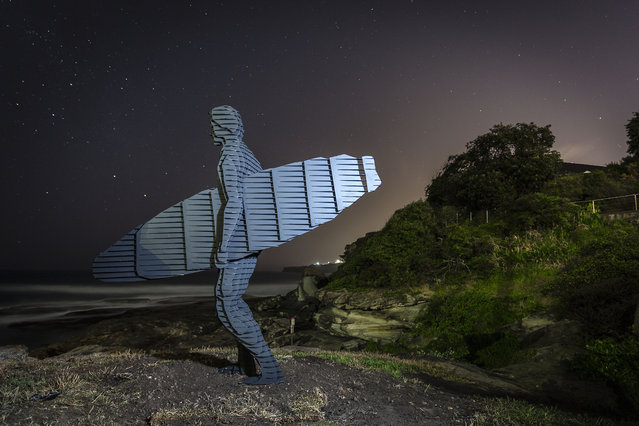
The work entitled “Trip 1, Trip II, Trip III” by April Pine is pictured before dawn at Sculpture By The Sea at Bondi Beach on October 19, 2017 in Sydney, Australia. This year the outdoor exhibition celebrates its 21st birthday with 104 exhibiting artists from Australia and around the world and runs from the 19th October-5th November 2017. (Photo by Brook Mitchell/Getty Images)
The sun rises this morning behind the 173ft spire of St Mary's church in the market town of Whittlesey in Cambridgeshire, UK on February 17, 2024. The church dates from the 13th century with the Ashlar faced tower added in the 15th century. (Photo by Andrew McCaren/London News Pictures)
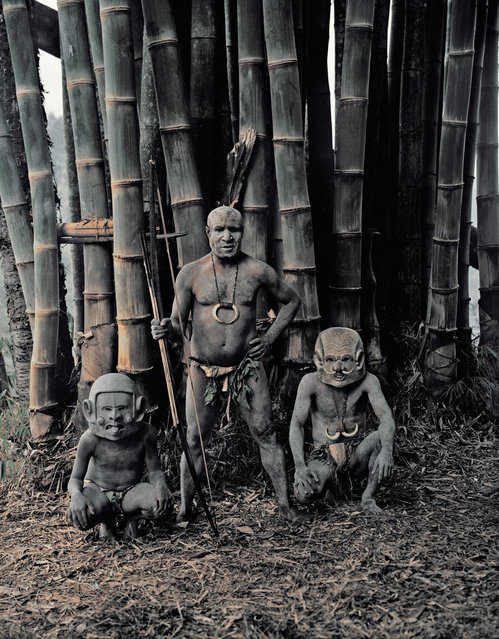
“Asaro from the Eastern Highlands”. The mudmen could not cover their faces with mud because the people of Papua New Guinea thought that the mud from the Asaro river was poisonous. So instead of covering their faces with this alleged poison, they made masks from pebbles that they heated and water from the waterfall, with unusual designs such as long or very short ears either going down to the chin or sticking up at the top, long joined eyebrows attached to the top of the ears, horns and sideways mouths. (Photo and caption by Jimmy Nelson)