Loading...
Done
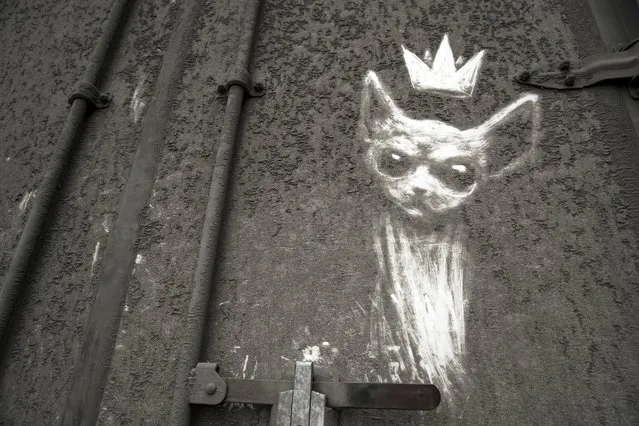
In this photo taken on Saturday, April 22, 2017, a drawing “King for a day” is made on the back of a muddy truck by artist Nikita Golubev in Moscow, Russia. The grimy trucks traversing the polluted and dusty streets of Moscow have inspired Golubev to use white vans and trucks as his canvas to create this ephemeral street art and signs his drawings Pro Boy Nick. (Photo by Pavel Golovkin/AP Photo)

In this photo taken on Saturday, April 22, 2017, a drawing “King for a day” is made on the back of a muddy truck by artist Nikita Golubev in Moscow, Russia. The grimy trucks traversing the polluted and dusty streets of Moscow have inspired Golubev to use white vans and trucks as his canvas to create this ephemeral street art and signs his drawings Pro Boy Nick. (Photo by Pavel Golovkin/AP Photo)
Details
30 Apr 2017 07:02:00
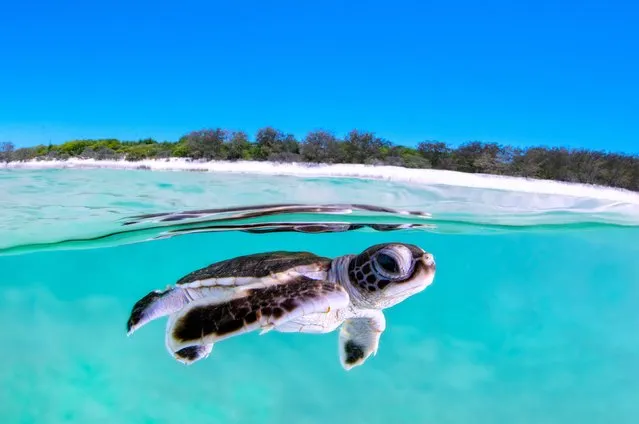
A baby turtle's perilous first moments are captured as it takes to the sea for the first time on Heron Island in Queensland, Australia in July 2022. Predators such as sharks, birds, and pollution mean that approximately only one out of every 1000 turtles that hatch make it to adulthood, with some not even reaching open ocean. Amateur photographer (Photo by Hannah Mitchell/Solent News & Photo Agency)

A baby turtle's perilous first moments are captured as it takes to the sea for the first time on Heron Island in Queensland, Australia in July 2022. Predators such as sharks, birds, and pollution mean that approximately only one out of every 1000 turtles that hatch make it to adulthood, with some not even reaching open ocean. Amateur photographer (Photo by Hannah Mitchell/Solent News & Photo Agency)
Details
06 Oct 2023 04:29:00
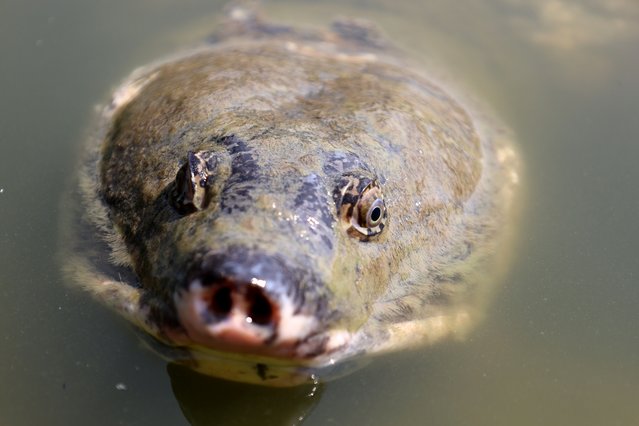
Black softshell turtle or Bostami turtle (Nilssonia nigricans), extremely rare and critically endangered species of tortoise is seen in a pond in Chittagong, Bangladesh on March 1, 2022. For decades, the breeding grounds have shrunk and their habitat has been threatened by habitat pollution. Through conservation methods and protection of the species, some of these turtles can be found today throughout the wild, and scientists and environmental biologists are continuing to work hard to preserve this endangered species and their natural habitat. (Photo by Mohammad Shajahan/Anadolu Agency via Getty Images)

Black softshell turtle or Bostami turtle (Nilssonia nigricans), extremely rare and critically endangered species of tortoise is seen in a pond in Chittagong, Bangladesh on March 1, 2022. For decades, the breeding grounds have shrunk and their habitat has been threatened by habitat pollution. (Photo by Mohammad Shajahan/Anadolu Agency via Getty Images)
Details
26 May 2024 04:02:00
Professor Xie Yong works on an art installation of a beaver, which is made out of plastic and around 300,000 needles, in Shenyang, Liaoning province, July 23, 2013. The needles, according to Xie, represent the pain felt by animals when their fur is taken off to produce clothing. (Photo by Reuters/Stringer)

Professor Xie Yong works on an art installation of a beaver, which is made out of plastic and around 300,000 needles, in Shenyang, Liaoning province, July 23, 2013. The needles, according to Xie, represent the pain felt by animals when their fur is taken off to produce clothing. (Photo by Reuters/Stringer)
Details
27 Jul 2013 09:15:00
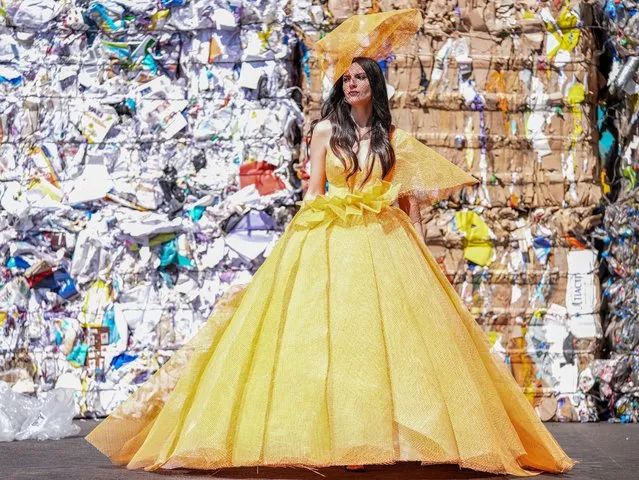
A model dressed in clothes made of waste products such as plastic bags, plaster nets, rope, paper and calendar leaves poses for a photo at a recycling facility in Diyarbakir, Turkiye on March 25, 2024. (Photo by Bestami Bodruk/Anadolu via Getty Images)

A model dressed in clothes made of waste products such as plastic bags, plaster nets, rope, paper and calendar leaves poses for a photo at a recycling facility in Diyarbakir, Turkiye on March 25, 2024. (Photo by Bestami Bodruk/Anadolu via Getty Images)
Details
05 Apr 2024 05:04:00
A fisherman boats in Chao Lake where thick cyanobacteria gather on the surface on August 5, 2015 in Chaohu, Anhui Province of China. As high temperature came in summar, part of water in Anhui Province's Chao Lake breeds large tracts of cyanobacteria which not only brought pollution to sense of smell, but also affected people's life. (Photo by ChinaFotoPress/ChinaFotoPress via Getty Images)

A fisherman boats in Chao Lake where thick cyanobacteria gather on the surface on August 5, 2015 in Chaohu, Anhui Province of China. As high temperature came in summar, part of water in Anhui Province's Chao Lake breeds large tracts of cyanobacteria which not only brought pollution to sense of smell, but also affected people's life. (Photo by ChinaFotoPress/ChinaFotoPress via Getty Images)
Details
06 Aug 2015 11:36:00
In this November 30, 2017 photo, Douglas scoops up mud from the bottom of the polluted Guaire River, in search of gold and anything valuable he can sell, in Caracas, Venezuela. Some stretches of the river smell of sewer while others emit a toxic odor of fuel, a stench that stays in ones nose for hours after leaving the water. (Photo by Ariana Cubillos/AP Photo)

In this November 30, 2017 photo, Douglas scoops up mud from the bottom of the polluted Guaire River, in search of gold and anything valuable he can sell, in Caracas, Venezuela. Some stretches of the river smell of sewer while others emit a toxic odor of fuel, a stench that stays in ones nose for hours after leaving the water. (Photo by Ariana Cubillos/AP Photo)
Details
11 Jan 2018 07:35:00
In this Wednesday, July 23, 2014 file photo, Omaha photographer Lane Hickenbottom photographs the night sky in a pasture near Callaway, Neb. With no moon in the sky, the Milky Way was visible to the naked eye. More than one-third of the world’s population can no longer see the Milky Way because of man-made lights, according to a scientific paper by Light Pollution Science and Technology Institute's Fabio Falchi and his team members, published on Friday, June 10, 2016. (Photo by Travis Heying/The Wichita Eagle via AP Photo)

In this Wednesday, July 23, 2014 file photo, Omaha photographer Lane Hickenbottom photographs the night sky in a pasture near Callaway, Neb. With no moon in the sky, the Milky Way was visible to the naked eye. More than one-third of the world’s population can no longer see the Milky Way because of man-made lights, according to a scientific paper by Light Pollution Science and Technology Institute's Fabio Falchi and his team members, published on Friday, June 10, 2016. (Photo by Travis Heying/The Wichita Eagle via AP Photo)
Details
11 Jun 2016 12:37:00