Loading...
Done
A Nepalese Hindu boy in festival attire walks in a procession during “Gai Jatra”, or Cow Festival in Kathmandu, Nepal, Friday, August 19, 2016. Members of Nepal's Newar Community celebrate the festival in memory of their family members who died the preceding year, believing that the cow will guide them in their journey to heaven. (Photo by Niranjan Shrestha/AP Photo)

A Nepalese Hindu boy in festival attire walks in a procession during “Gai Jatra”, or Cow Festival in Kathmandu, Nepal, Friday, August 19, 2016. Members of Nepal's Newar Community celebrate the festival in memory of their family members who died the preceding year, believing that the cow will guide them in their journey to heaven. (Photo by Niranjan Shrestha/AP Photo)
Details
20 Aug 2016 11:53:00
Exhibition's guides pose on a tank during the Army-2022 International Military-Technical Forum at the Russian Armed Forces' Patriot Park in Kubinka, outside Moscow, on August 16, 2022. (Photo by Natalia Kolesnikova/AFP Photo)

Exhibition's guides pose on a tank during the Army-2022 International Military-Technical Forum at the Russian Armed Forces' Patriot Park in Kubinka, outside Moscow, on August 16, 2022. (Photo by Natalia Kolesnikova/AFP Photo)
Details
20 Aug 2022 05:15:00
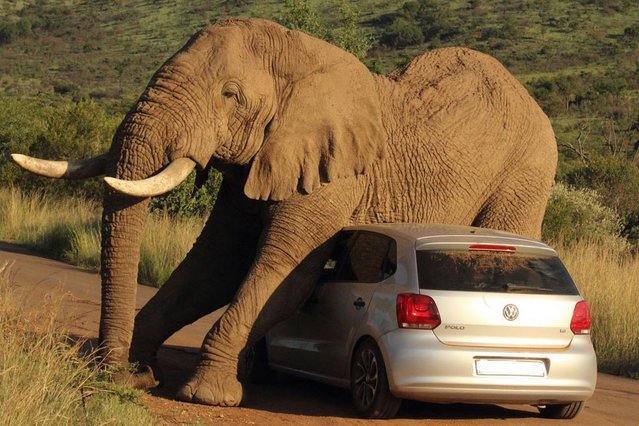
Two terrified occupants of a Volkswagen Polo found themselves in the wrong place at the wrong time as the giant animal stooped down to rub itself against the vehicle's roof and bonnet. The incredible scene was captured by field guide and lodge manager Armand Grobler, 21, at Pilanesburg National Park in South Africa. (Photo by Armand Grobler/Barcroft Media)

Two terrified occupants of a Volkswagen Polo found themselves in the wrong place at the wrong time as the giant animal stooped down to rub itself against the vehicle's roof and bonnet. The incredible scene was captured by field guide and lodge manager Armand Grobler, 21, at Pilanesburg National Park in South Africa. (Photo by Armand Grobler/Barcroft Media)
Details
07 Aug 2014 10:05:00
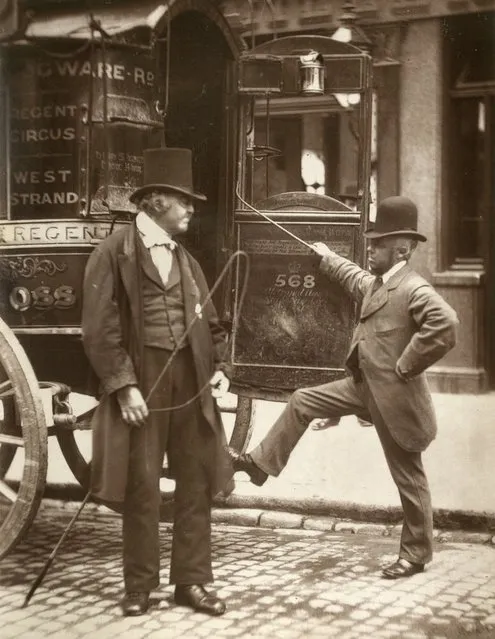
Ex Omnibus Driver. (Photo by John Thomson/LSE Digital Library)

“John Thomson (14 June 1837 – 29 September 1921) was a pioneering Scottish photographer, geographer and traveller. He was one of the first photographers to travel to the Far East, documenting the people, landscapes and artifacts of eastern cultures. Upon returning home, his work among the street people of London cemented his reputation, and is regarded as a classic instance of social documentary which laid the foundations for photojournalism. He went on to become a portrait photographer of High Society in Mayfair, gaining the Royal Warrant in 1881”. – Wikipedia. Photo: Ex Omnibus Driver. (Photo by John Thomson/LSE Digital Library)
Details
10 Feb 2013 17:30:00
History of Suspended Time By Gonzalo Lebrija

Guadalajara-based artist Gonzalo Lebrija created a public art installation in the parking lot (1430 Delgany Street, Denver, CO 80202) across from the Museum of Contemporary Art Denver (MCA Denver) in the summer of 2010. The installation, entitled History of Suspended Time: Monument for the Impossible, was developed as a dual collaboration with MCA Denver's museum-wide exhibition, Energy Effects: Art & Artifacts from the Landscape of Glorious Excess, as well as Denver's inaugural 2010 Biennial of the Americas, an international event that celebrated the culture, ideas and people of the Western Hemisphere.
Details
31 Aug 2014 13:37:00
Students exercise in body training at Bishan Vocational Education Center in Chongqing, southwest China, January 13, 2016. These students were trained to be stewardesses of the high-speed train. (Photo by Xie Jie/Xinhua)

Students exercise in body training at Bishan Vocational Education Center in Chongqing, southwest China, January 13, 2016. These students were trained to be stewardesses of the high-speed train. (Photo by Xie Jie/Xinhua)
Details
15 Jan 2016 12:49:00
A Cambodian tuk tuk driver and guide with a tarantula in his mouth shortly after is was dug from the ground on June 7, 2010 in Skuon, Kampong Cham Province, Cambodia. The trade for spiders and other insects as food and for medicinal purposes has been in effect since the 1970's in Cambodia but only very recently have tourists been finding a way to see where the spiders are hunted in the nearby countryside. One guide, who can be found in Kampong Cham Town has started offering tours to tourists who can find him. (Photo by Tim Whitby/Getty Images)

A Cambodian tuk tuk driver and guide with a tarantula in his mouth shortly after is was dug from the ground on June 7, 2010 in Skuon, Kampong Cham Province, Cambodia. The trade for spiders and other insects as food and for medicinal purposes has been in effect since the 1970's in Cambodia but only very recently have tourists been finding a way to see where the spiders are hunted in the nearby countryside. One guide, who can be found in Kampong Cham Town has started offering tours to tourists who can find him. (Photo by Tim Whitby/Getty Images)
Details
04 Sep 2016 09:27:00
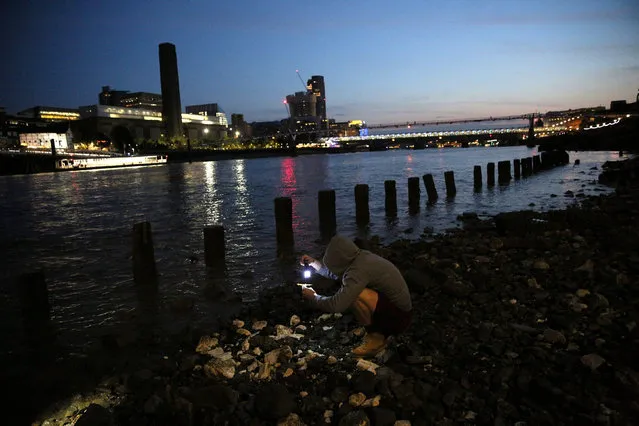
A mudlark uses a torch to look for items on the bank of the River Thames in London, Britain June 06, 2016. Mudlarking is believed to trace its origins to the 18th and 19th century, when scavengers searched the Thames' shores for items to sell. These days, history and archaeology fans are the ones hoping to find old relics such as coins, ceramics, artifacts or everyday items from across centuries. They wait for the low tide and then scour specific areas of exposed shores. "If you're in a field you could be out all day long, with the river you're restricted to about two or three hours," mudlark Nick Stevens said. While many just use the naked eye for their searches, others rely on metal detectors for which a permit from the Port of London Authority is needed. Digging also requires consent. (Photo by Neil Hall/Reuters)

A mudlark uses a torch to look for items on the bank of the River Thames in London, Britain June 06, 2016. Mudlarking is believed to trace its origins to the 18th and 19th century, when scavengers searched the Thames' shores for items to sell. These days, history and archaeology fans are the ones hoping to find old relics such as coins, ceramics, artifacts or everyday items from across centuries. their finds with the Portable Antiquities Scheme. Any item over 300 years old must be recorded. (Photo by Neil Hall/Reuters)
Details
27 Aug 2016 10:43:00