Loading...
Done
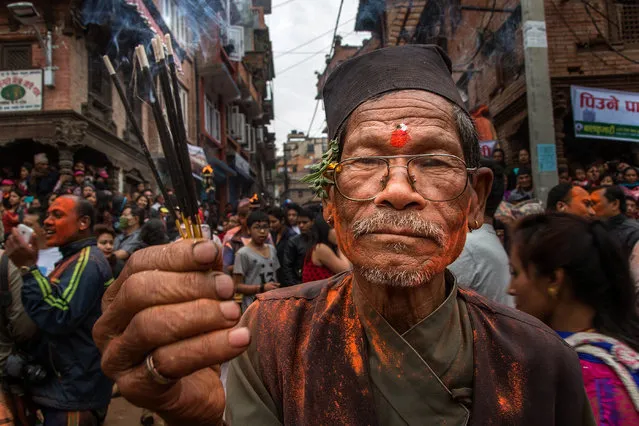
A devotee holds incense sticks while celebrating the Sindoor Jatra Festival on April 15, 2015 in Thimi, Nepal. Sindoor Jatra Festival is celebrated each year in Thimi, on the outskirts of Kathmandu, to welcome the Nepali New Year and celebrate the coming of spring. During the Festival, devotees are smeared with vermillion powder and 30 chariots containing the images of several gods and goddesses are carrying by the devotees around the town, while others sing, dance and play musical instruments. (Photo by Omar Havana/Getty Images)

A devotee holds incense sticks while celebrating the Sindoor Jatra Festival on April 15, 2015 in Thimi, Nepal. Sindoor Jatra Festival is celebrated each year in Thimi, on the outskirts of Kathmandu, to welcome the Nepali New Year and celebrate the coming of spring. During the Festival, devotees are smeared with vermillion powder and 30 chariots containing the images of several gods and goddesses are carrying by the devotees around the town, while others sing, dance and play musical instruments. (Photo by Omar Havana/Getty Images)
Details
18 Apr 2015 09:17:00
A man holds up for a picture a one hundred trillion Zimbabwean dollars note inside a shop in Harare, Zimbawe, June 12, 2015. (Photo by Philimon Bulawayo/Reuters)

A man holds up for a picture a one hundred trillion Zimbabwean dollars note inside a shop in Harare, Zimbawe, June 12, 2015. Hyperinflation in Zimbabwe was a period of currency instability that began in the late 1990s shortly after the confiscation of private farms from landowners, towards the end of Zimbabwean involvement in the Second Congo War. During the height of inflation from 2008 to 2009, it was difficult to measure Zimbabwe's hyperinflation because the government of Zimbabwe stopped filing official inflation statistics. However, Zimbabwe's peak month of inflation is estimated at 79.6 billion percent in mid-November 2008. (Photo by Philimon Bulawayo/Reuters)
Details
25 Oct 2016 10:08:00
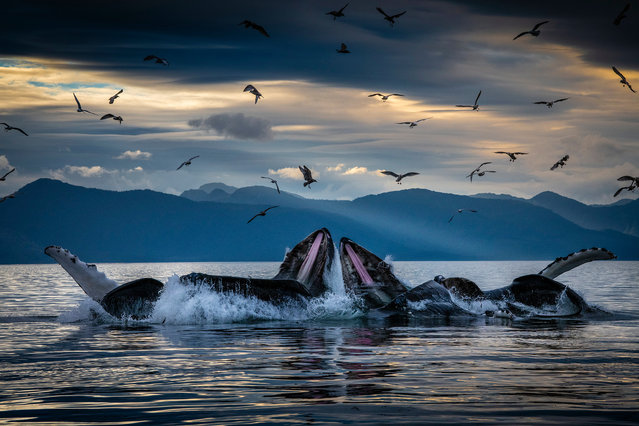
“Secrets of the Whales”. Skerry’s photographs celebrate the lives and culture of whales, illuminating recent research and their diverse behaviours. His latest work focuses on four key species: sperm whales, humpbacks, orca and beluga whales. Humpback whales bubble-net feeding off the coast of Alaska. They work cooperatively to feed on herring by blowing a perfect ring of bubbles underwater to form a net encircling the fish. The whales then swim up through the centre of the bubble net with their mouths open. (Photo by Brian Skerry/National Geographic Photo/Visa pour l'Image)

“Secrets of the Whales”. Skerry’s photographs celebrate the lives and culture of whales, illuminating recent research and their diverse behaviours. His latest work focuses on four key species: sperm whales, humpbacks, orca and beluga whales. Humpback whales bubble-net feeding off the coast of Alaska. They work cooperatively to feed on herring by blowing a perfect ring of bubbles underwater to form a net encircling the fish. The whales then swim up through the centre of the bubble net with their mouths open. (Photo by Brian Skerry/National Geographic Photo/Visa pour l'Image)
Details
04 Sep 2021 09:02:00
An athletes competes in a log carrying relay race event at Peruibe beach during the Indigenous Games, near the Tapirema community of Peruibe, Brazil, Sunday, April 23, 2023. Hundreds of Indigenous athletes gather this weekend in the south of Sao Paulo state to hold their version of the Olympic Games. They will compete for medals in archery, tug of war, athletics, Indigenous wrestling and other sports. (Photo by Andre Penner/AP Photo)

An athletes competes in a log carrying relay race event at Peruibe beach during the Indigenous Games, near the Tapirema community of Peruibe, Brazil, Sunday, April 23, 2023. Hundreds of Indigenous athletes gather this weekend in the south of Sao Paulo state to hold their version of the Olympic Games. They will compete for medals in archery, tug of war, athletics, Indigenous wrestling and other sports. (Photo by Andre Penner/AP Photo)
Details
19 Aug 2024 04:04:00
These black-and-white photos are taken from the new book “Armoured Warfare in the First World War 1916 – 1918” by Anthony Tucker-Jones and published by Pen & Sword Military. “Interestingly the British, French and Germans took completely different approaches with varying results”. The British military produced “Little Willie” in Autumn 1915 weighing 18 tonnes, which had a crew of two plus four gunners. “Inspired by a tracked artillery tractor “Little Willie” was referred to as a water tank – hence the name tank – to ensure secrecy”, said Anthony. “This led to the strange looking Mark I with its peculiar rhomboid shape, designed to cross trenches with guns in sponsons on either side. The Germans saw the tank as unchivalrous and were slow to grasp its utility. They favoured the Stormtrooper (specialist soldiers used to infiltrate enemy trenches) and artillery, not the tank”, said Anthony. “However, they didn’t hesitate to make use of captured British tanks. Although the tank helped secure victory and German soldiers dubbed it “Germany’s Downfall” the country was ultimately brought to its knees by the Allies blockade”. Here: British troops hitch a ride on a Mark IV after the massed tank fleet spearheading attack at Cambrai on November 20, 1917. (Photo by Anthony Tucker-Jones/Mediadrumworld.com)

These black-and-white photos are taken from the new book “Armoured Warfare in the First World War 1916 – 1918” by Anthony Tucker-Jones and published by Pen & Sword Military. Here: British troops hitch a ride on a Mark IV after the massed tank fleet spearheading attack at Cambrai on November 20, 1917. (Photo by Anthony Tucker-Jones/Mediadrumworld.com)
Details
23 Feb 2017 00:02:00
Cuban-American artist Jorge Rodriguez-Gerada's six-acre sand and soil “facescape” stretches across the JFK Hockey Field on the north side of the Reflecting Pool along the National Mall October 1, 2014 in Washington, DC. Titled “Out of Many, One” and composed of 2,500 tons of sand, 800 tons of top soil and eight miles of string, the piece is the artist's interpreative blending of 30 different men's faces. (Photo by Chip Somodevilla/Getty Images)

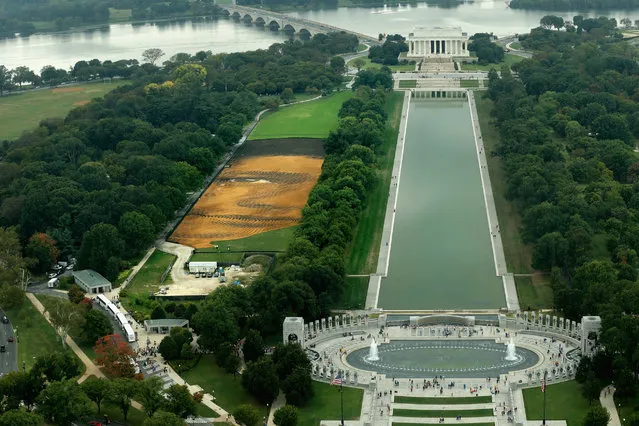
Cuban-American artist Jorge Rodriguez-Gerada's six-acre sand and soil “facescape” stretches across the JFK Hockey Field on the north side of the Reflecting Pool along the National Mall October 1, 2014 in Washington, DC. Titled “Out of Many, One” and composed of 2,500 tons of sand, 800 tons of top soil and eight miles of string, the piece is the artist's interpreative blending of 30 different men's faces. Rodriguez-Gereda used high-precision global positioning satellites to place 10,000 wood pegs as waypoints for the giant face. The piece will be open to the public beginning October 4 and will eventually be tilled back into the earth. (Photo by Chip Somodevilla/Getty Images)
Details
04 Oct 2014 11:39:00
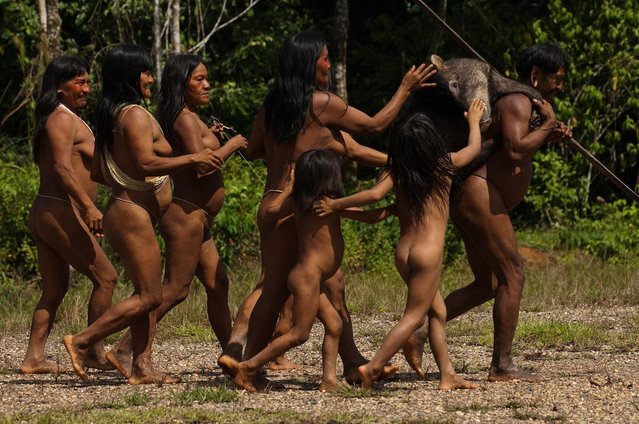
Spectacular images offering insight into the lives of the Huaorani people in the Ecuadorian Amazon have been revealed showing how they use traditional methods to hunt monkeys for food. The stunning pictures were taken by conservation photographer Pete Oxford from Torquay, Devon in the Ecuadorian Amazon. “The Huaorani Indians are a forest people highly in tune with their environment. Many are now totally acculturated since the 1950s by missionaries”, said Pete. “Today they face radical change to their culture to the proximity of oil exploration within their territory and the Yasuni National Park and Biosphere Reserve, they are vastly changed. Some still live very traditionally and for this shoot, through my Huaorani friend, a direct relative of those photographed he wanted to depict them as close to their original culture as possible. They still largely hunt with blow pipes and spears eating a lot of monkeys and peccaries”. The Huaorani are also known as the Waorani, Waodani or the Waos and are native Amerindians. Their lands are located between the Curaray and Napo rivers and speak the Huaorani language. Pete says that during his visit he was welcomed into the group and hopes that ancient cultures can be saved. Here: The tribe were seen celebrating after a hunter returned to camp with a wild pig. (Photo by Pete Oxford/Mediadrumworld.com)

Spectacular images offering insight into the lives of the Huaorani people in the Ecuadorian Amazon have been revealed showing how they use traditional methods to hunt monkeys for food. The stunning pictures were taken by conservation photographer Pete Oxford from Torquay, Devon in the Ecuadorian Amazon. Here: The tribe were seen celebrating after a hunter returned to camp with a wild pig. (Photo by Pete Oxford/Mediadrumworld.com)
Details
20 Jan 2017 07:58:00
Miss Universe contestant Carolina Duran of Costa Rica, center, reacts to a TV network's drone as others prepare to pose from the deck of the yacht Happy Life prior to cruising to a beach resort in Batangas province Thursday, January 19, 2017 at the Philippine Navy headquarters in Manila, Philippines. Eighty-six candidates from around the world are vying for the title to succeed Pia Wurtzbach from the Philippines. The competition takes place on Jan. 30. They are, from left, Cherell Williamson of Bahamas, Rebecca Rath of Belize, Hildur Maria of Iceland, and Chanelle de Lau of Curacao. (Photo by Bullit Marquez/AP Photo)

Miss Universe contestant Carolina Duran of Costa Rica, center, reacts to a TV network's drone as others prepare to pose from the deck of the yacht Happy Life prior to cruising to a beach resort in Batangas province Thursday, January 19, 2017 at the Philippine Navy headquarters in Manila, Philippines. Eighty-six candidates from around the world are vying for the title to succeed Pia Wurtzbach from the Philippines. The competition takes place on Jan. 30. They are, from left, Cherell Williamson of Bahamas, Rebecca Rath of Belize, Hildur Maria of Iceland, and Chanelle de Lau of Curacao. (Photo by Bullit Marquez/AP Photo)
Details
20 Jan 2017 07:53:00