People dance as they play with colored powder during celebrations marking Holi, the Hindu festival of colors, in Guwahati, India, Monday, March 25, 2024. (Photo by Anupam Nath/AP Photo)
An owl curiously peeks out from a tree hollow. The pictures of the spotted owlet were taken by Anuj Jain in Chandigarh, India in the second decade of November 2025. (Photo by Anuj Jain/Solent News & Photo Agency)
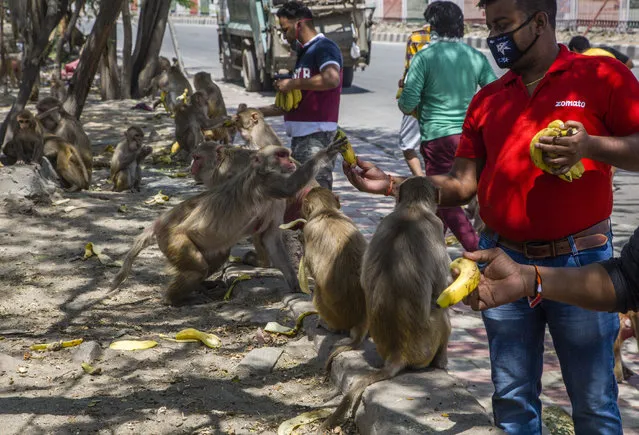
Men give bananas to monkeys gathered on the side of the road as India remains under an unprecedented lockdown over the highly contagious coronavirus (COVID-19) on April 08, 2020 in New Delhi, India. Wild animals, including monkeys, are roaming human settlements in India as people are staying indoors due to the 21-day lockdown. (Photo by Yawar Nazir/Getty Images)
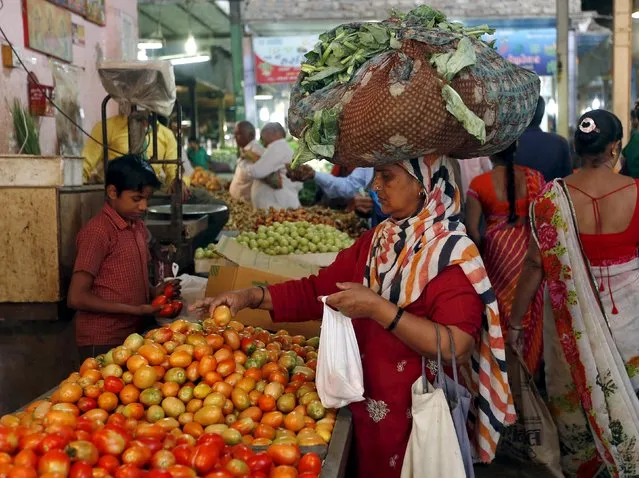
A woman carrying cabbage leaves on her head buys tomato at a market in Ahmedabad, India, November 9, 2015. India's villages face a sharp spike in food prices in 2016, as a second year of drought drives up the cost of ingredients such as sugar and milk, and poor transport infrastructure stops falling global prices from reaching rural areas. (Photo by Amit Dave/Reuters)
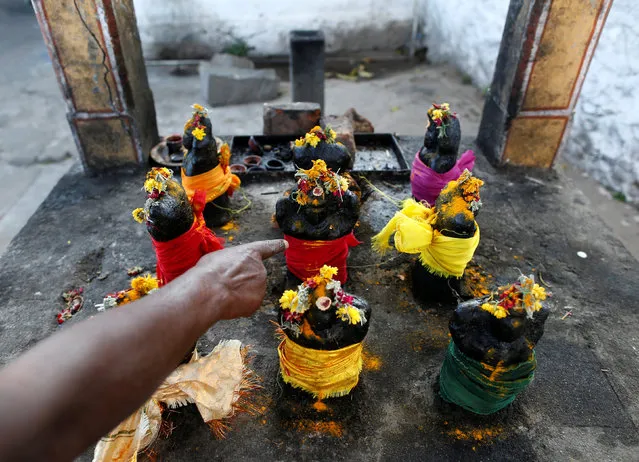
Paramasivan points to the statue of sun god Surya at a temple outside the Kodaikanal Solar Observatory, India, February 5, 2017. In the early morning darkness, Devendran P. walks up a hill to a solar observatory in India's southern hill town of Kodaikanal, trudging the same path his father and grandfather walked in a century-old family tradition of studying the sun. (Photo by Danish Siddiqui/Reuters)
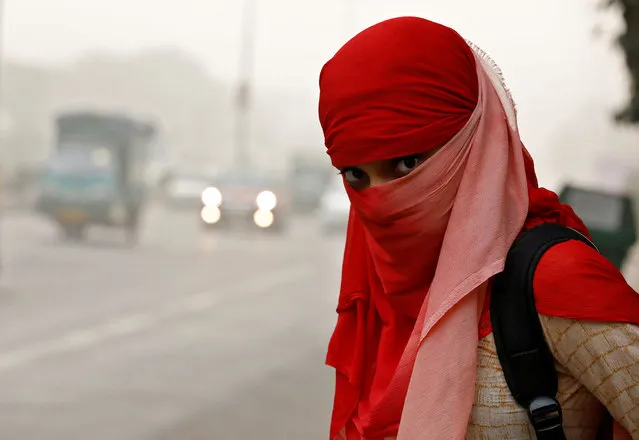
A woman wearing a scarf to cover her face looks on as she waits for a passenger bus on a smoggy morning in New Delhi, India, November 8, 2017. The Great Smog of Delhi is an ongoing severe air-pollution event in New Delhi and adjoining areas in the National Capital Territory of India, in November 2017. Air pollution at this time peaked on both PM 2.5 and PM 10 levels. It has been reported as one of the worst levels of air quality in Delhi since 1999. (Photo by Saumya Khandelwal/Reuters)
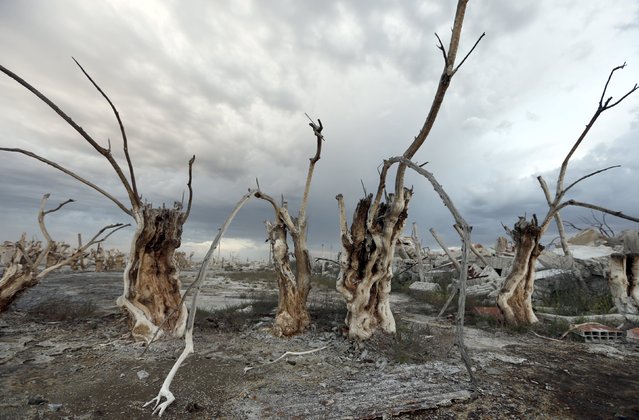
Deadwood is pictured in the onetime spa and resort town Epecuen, November 5, 2015. Over the past few years the town of Epecuen, located 550 km (341 miles) southwest of Buenos Aires, has been attracting tourists with its eerie apocalyptic atmosphere after a flood submerged it in salt water for more than two decades. Photo by Enrique Marcarian/Reuters)
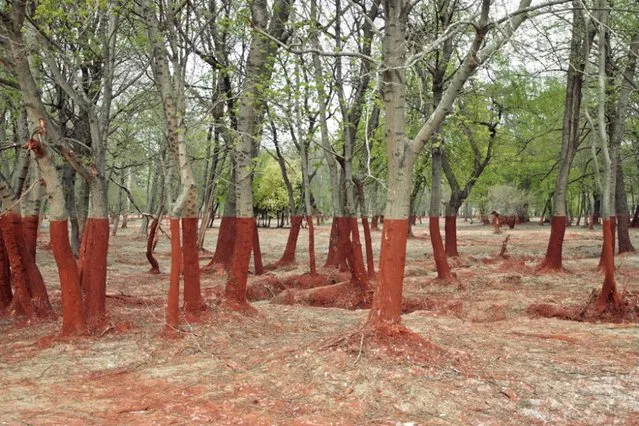
The photograph you see above isn’t the result of Photoshop or infrared photography. Captured by Spanish photographer Palíndromo Mészáros, it shows what the landscape of Ajka, Hungary looked like half a year after the Ajka alumina plant accident — an industrial disaster in which 35 million cubic feet of toxic waste flooded the land to a height of around 6.5 feet. Mészáros lined up the thick red line caused by the sludge with the horizon line to obtain this surreal image.