Loading...
Done
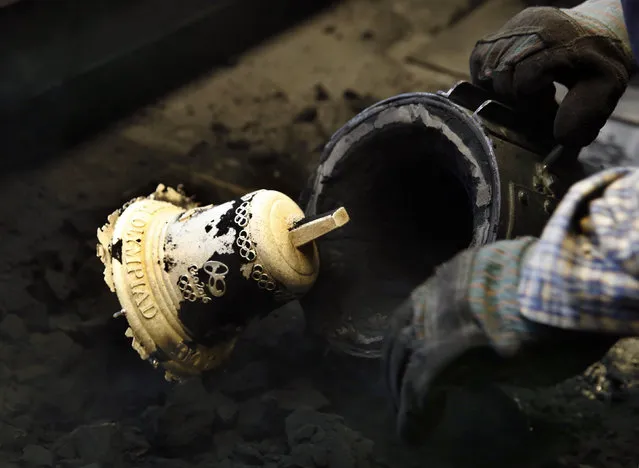
Serge Huguenin of the Blondeau foundry takes the newly melted bell out of the mould in La Chaux-de-Fonds, Switzerland January 21, 2016. At this year's Summer Olympics in Rio de Janeiro, no matter how elaborate the opening ceremony or how sophisticated the live broadcasts, the final lap of athletics races will be announced the traditional way by ringing an old-fashioned bell. (Photo by Denis Balibouse/Reuters)

Serge Huguenin of the Blondeau foundry takes the newly melted bell out of the mould in La Chaux-de-Fonds, Switzerland January 21, 2016. At this year's Summer Olympics in Rio de Janeiro, no matter how elaborate the opening ceremony or how sophisticated the live broadcasts, the final lap of athletics races will be announced the traditional way by ringing an old-fashioned bell. Omega, the official timekeeper of the event, has ordered 21 bells, forged almost entirely by hand by Blondeau's Bell Foundry in the Jura Mountains in Switzerland. Each last-lap bell is branded with the RIO 2016 logo and circled with the words “2016 GAMES OF THE XXXI OLYMPIAD”. (Photo by Denis Balibouse/Reuters)
Details
02 Feb 2016 13:51:00
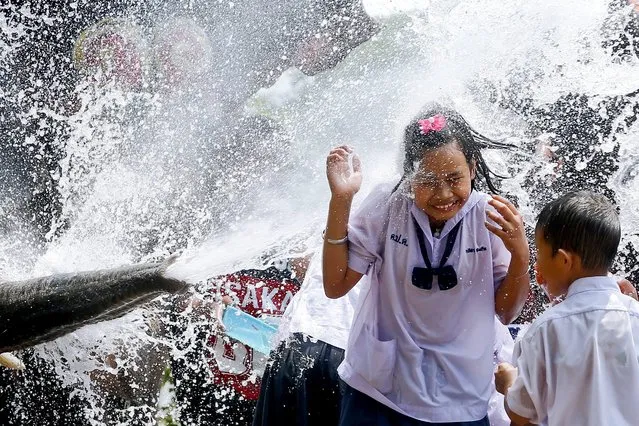
A schoolgirl is soaked with water thrown by an elephant in a preview of the upcoming Songkran Festival celebration, the Thai traditional New Year, also known as the water festival in the ancient world heritage city of Ayutthaya, Thailand, 11 April 2016. The annual elephant Songkran is held to promote the tourism industry prior the three-day Songkran Festival which starts on 13-15 April annually and is celebrated with splashing water and putting powder on each others faces as a symbolic sign of cleansing and washing away the sins from the old year. (Photo by Diego Azubel/EPA)

A schoolgirl is soaked with water thrown by an elephant in a preview of the upcoming Songkran Festival celebration, the Thai traditional New Year, also known as the water festival in the ancient world heritage city of Ayutthaya, Thailand, 11 April 2016. The annual elephant Songkran is held to promote the tourism industry prior the three-day Songkran Festival which starts on 13-15 April annually and is celebrated with splashing water and putting powder on each others faces as a symbolic sign of cleansing and washing away the sins from the old year. (Photo by Diego Azubel/EPA)
Details
12 Apr 2016 11:32:00
A view of traditional bolinhos de bacalhau (fried codfish balls) in Rio de Janeiro, Brazil, May 7, 2016. (Photo by Sergio Moraes/Reuters)

If the most popular foods of Rio de Janeiro have one thing in common, it is their informality. You can find fine restaurants in the city, but they do not set Rio apart from other places. What does set it apart, and what invariably brings its residents, known as "Cariocas," together is the unpretentious food they eat in bright, loud, crowded bars and restaurants, on busy street corners, or after a day at the beach. Here: A view of traditional bolinhos de bacalhau (fried codfish balls) in Rio de Janeiro, Brazil, May 7, 2016. (Photo by Sergio Moraes/Reuters)
Details
05 Aug 2016 13:20:00
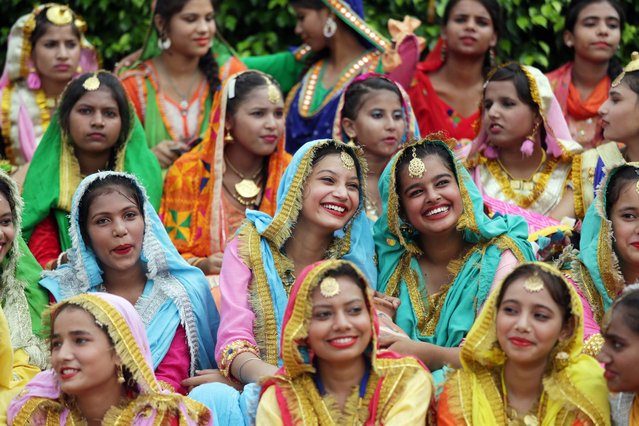
Indian school children wearing traditional Punjabi attire sit as they take part in the full and final dress rehearsal for India's Independence Day parade and celebrations in Amritsar, India, 13 August 2016. India's 70th Independence Day will be celebrated on 15 August, to commemorate its independence from British rule and its birth as a sovereign nation on that day in 1947. (Photo by Raminder Pal Singh/EPA)

Indian school children wearing traditional Punjabi attire sit as they take part in the full and final dress rehearsal for India's Independence Day parade and celebrations in Amritsar, India, 13 August 2016. India's 70th Independence Day will be celebrated on 15 August, to commemorate its independence from British rule and its birth as a sovereign nation on that day in 1947. (Photo by Raminder Pal Singh/EPA)
Details
14 Aug 2016 10:08:00
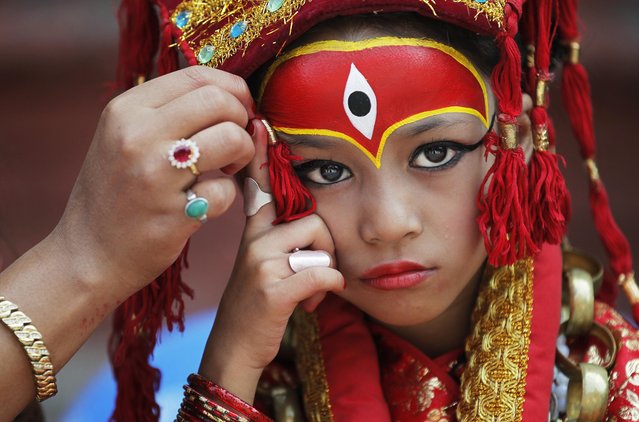
A Nepalese mother applies make up to her daughter dressed as the living goddess Kumari as they wait for Kumari puja to start at Hanuman Dhoka temple, in Kathmandu, Nepal, Wednesday, September 14, 2016. Girls under the age of nine gathered for the Kumari puja, a tradition of worshiping young prepubescent girls as manifestations of the divine female energy. The ritual holds a strong religious significance in the Newar community that seeks divine blessings to save small girls from diseases and bad luck in the years to come. (Photo by Niranjan Shrestha/AP Photo)

A Nepalese mother applies make up to her daughter dressed as the living goddess Kumari as they wait for Kumari puja to start at Hanuman Dhoka temple, in Kathmandu, Nepal, Wednesday, September 14, 2016. Girls under the age of nine gathered for the Kumari puja, a tradition of worshiping young prepubescent girls as manifestations of the divine female energy. The ritual holds a strong religious significance in the Newar community that seeks divine blessings to save small girls from diseases and bad luck in the years to come. (Photo by Niranjan Shrestha/AP Photo)
Details
15 Sep 2016 09:58:00
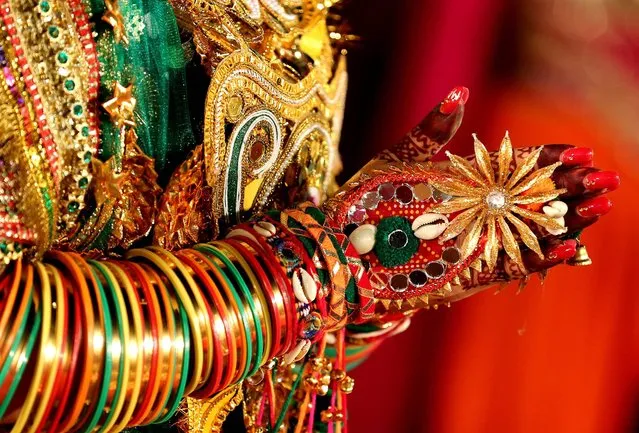
A photograph made available on 02 October 2016 showing Indian people dressed in traditional attire performing the Garba dance, a ritual performed to appease Goddess Durga, in a religious event named, “Abhivyakti 2016” during the nine-day long Navratri festival in Bhopal, India, 01 October 2016 Celebrated twice a year during the spring and the fall season, the Navratri festival is dedicated to the Hindu Goddess Durga. (Photo by Sanjeev Gupta/EPA)

A photograph made available on 02 October 2016 showing Indian people dressed in traditional attire performing the Garba dance, a ritual performed to appease Goddess Durga, in a religious event named, “Abhivyakti 2016” during the nine-day long Navratri festival in Bhopal, India, 01 October 2016 Celebrated twice a year during the spring and the fall season, the Navratri festival is dedicated to the Hindu Goddess Durga. (Photo by Sanjeev Gupta/EPA)
Details
07 Oct 2016 09:02:00
A woman poses for a picture as bunches of paprika hang on the walls of her house to dry in the village of Donja Lakosnica, Serbia October 6, 2016. Donja Lokosnica is the Serbian “capital of paprika”, since almost all of the 1300 inhabitants are involved in growing paprika. As autumn approaches, the whole village turns red, because of many threads of dried peppers, that hang around Lokosnica, waiting for their winter use. Each of these paprika threads is handmade, still dried according to traditional techniques, assisted solely by the sun and fresh air. (Photo by Marko Djurica/Reuters)

A woman poses for a picture as bunches of paprika hang on the walls of her house to dry in the village of Donja Lakosnica, Serbia October 6, 2016. Donja Lokosnica is the Serbian “capital of paprika”, since almost all of the 1300 inhabitants are involved in growing paprika. As autumn approaches, the whole village turns red, because of many threads of dried peppers, that hang around Lokosnica, waiting for their winter use. Each of these paprika threads is handmade, still dried according to traditional techniques, assisted solely by the sun and fresh air. (Photo by Marko Djurica/Reuters)
Details
08 Oct 2016 12:04:00
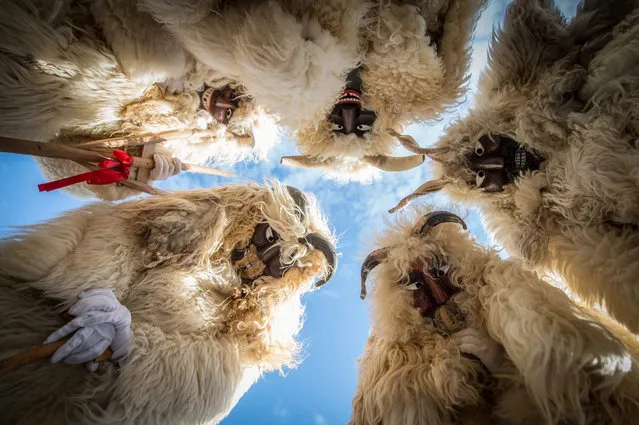
Participants wearing costumes and masks take part in the first day of the traditional carnival parade in Mohacs, Hungary, 23 February 2017. The carnival parade of so-called busos, dressed in costumes with frightening wooden masks and using various noisy wooden rattlers, is traditionally held on the seventh weekend before Easter to drive away winter. (Photo by Sandor Ujvari/EPA)

Participants wearing costumes and masks take part in the first day of the traditional carnival parade in Mohacs, Hungary, 23 February 2017. The carnival parade of so-called busos, dressed in costumes with frightening wooden masks and using various noisy wooden rattlers, is traditionally held on the seventh weekend before Easter to drive away winter. (Photo by Sandor Ujvari/EPA)
Details
25 Feb 2017 10:35:00