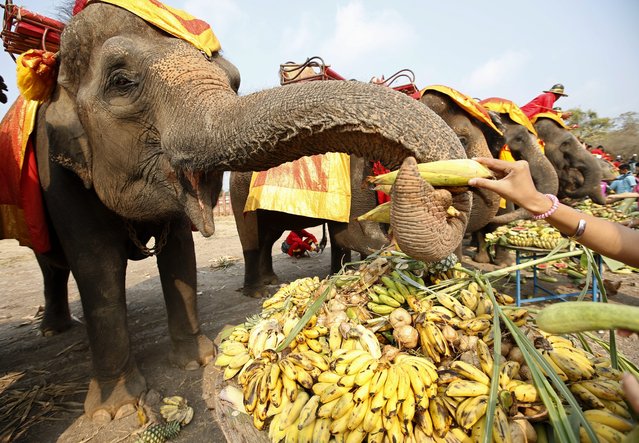
Elephants enjoy various kinds of fruits and vegetables during an all-you-can-eat elephant buffet held to mark the National Elephant Day at the ancient historical city of Ayutthaya, Thailand, 13 March 2014. The annual National Thai Elephant Day is held on 13 March to celebrate and drawing public attention for more concerted effort to save the species and protect its habitat. Thailand sees a severe decline with less than 3,000 wild elephants left in the kingdom. (Photo by Rungroj Yongrit/EPA)
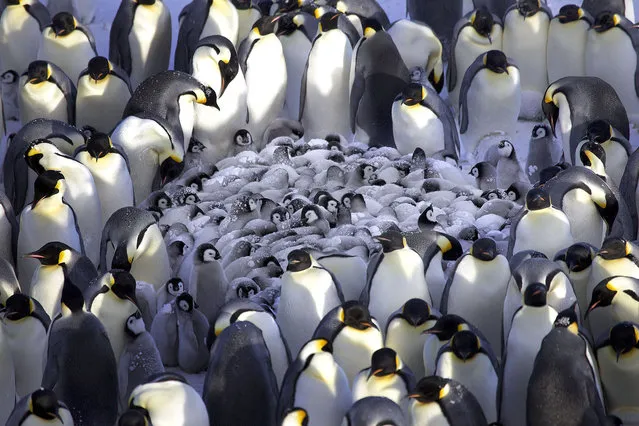
Emperor penguins gathered together to keep their chicks warm in these pictures. Marine scientist Frederique Oliver snapped the protective parents in Antarctica as they huddled against the huge winds.The adorable birds have to battle temperatures on -20 degrees Celsius as well as winds of up to 40 knots on the ice. (Photo by Frederique Oliver/Caters News)
On the second straight day of record-setting temperatures, Maddy Hacker is hoisted up by friend Jasmine Harper, both of McLean, Virgnia, as they attempt an acrobatic stunt in front of the U.S. Capitol in Washington, U.S., February 21, 2018. (Photo by Kevin Lamarque/Reuters)
A model is seen backstage before the Manish Arora Spring/Summer 2019 women's ready-to-wear collection show during Paris Fashion Week in Paris, France, September 27, 2018. (Photo by Stephane Mahe/Reuters)
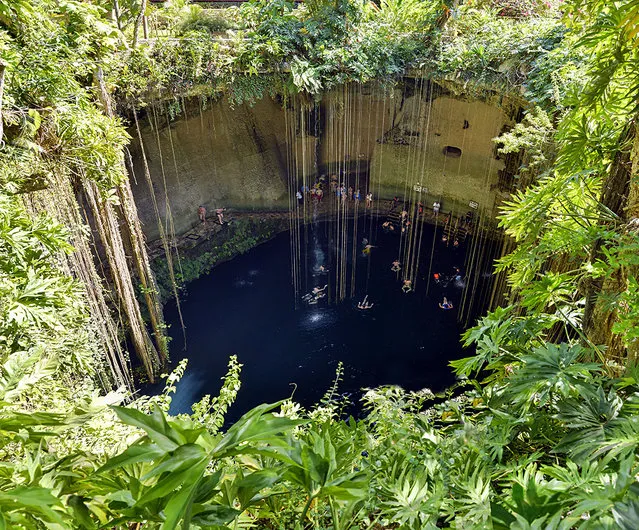
A cenote is a natural phenomenon, a sinkhole in the Earth’s surface. The Yucatan Peninsula in Mexico has an estimated 7,000 cenotes because it is primarily made up of porous limestone. For millions of years, rainfall slowly ate away at the limestone and a huge system of underground caves and caverns was formed. Many filled with water from rain or from the underground water table. When the roof of a water filled cave collapses, a cenote is born. The water found in a cenote may be fresh water, salt water, or both. Structurally it may be completely open, like a lake, almost completely closed with just a small opening at the top, or somewhere in between.