Loading...
Done
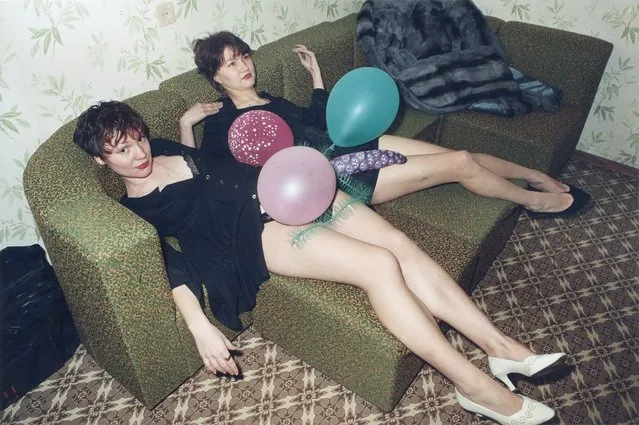
Yoshkar-Ola, Matrosova Street (1995). He turned his lens upon Russians – particularly young people – in the newly liberated state. (Photo by Sergey Chilikov)

Russian pop art photographer Sergey Chilikov captures a nation liberated from the social oppression of late-era Soviet rule – at parties, in the streets, and bouncing high. His exhibition, Photoprovocations, will be at Photo London, 19-22 May. Here: Yoshkar-Ola, Matrosova Street (1995). (Photo by Sergey Chilikov)
Details
20 May 2016 13:10:00
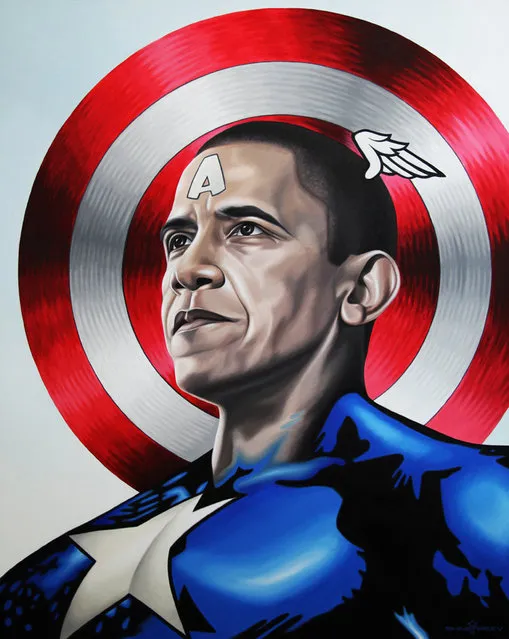
Iconography By Rinat Shingareev

Born in Russia where he was educated in fine arts from a young age, Rinat Shingareev took an early interest in the subject, for which he showed an affinity and talent. Later moving to Italy to attend the Fine Arts Academy he has been described by Italian Maxim as “one of the most talented artists in the world”. Now based in London Shingareev continues to paint vibrant and thought provoking pieces.
Details
20 Jan 2014 13:22:00
“Lover of the Light”, Red Union Jack Mini Cooper, Bern, Switzerland, October 2012. (Photo by Kim Leuenberger)

Kim Leuenberger is a Swiss photographer with a love for travel. She believes we are all explorers and is currently studying photography at University of the Arts London. These photos are from her series, “Traveling Cars Adventures”. Photo: “Lover of the Light”, Red Union Jack Mini Cooper, Bern, Switzerland, October 2012. (Photo by Kim Leuenberger)
Details
30 Apr 2014 09:14:00
“Walking six feet tall”. (Photo by Photocillin)

“Photocillin is the pseudonym of Dr Andy Teo, physician and people photographer based in the Surrey/Hampshire borders near London in the UK. My style is about showing the beauty of people and the world in which they live in a retro-utopian way”. – Andy Teo. Photo: “Walking six feet tall”. (Photo by Photocillin)
Details
04 May 2014 11:26:00
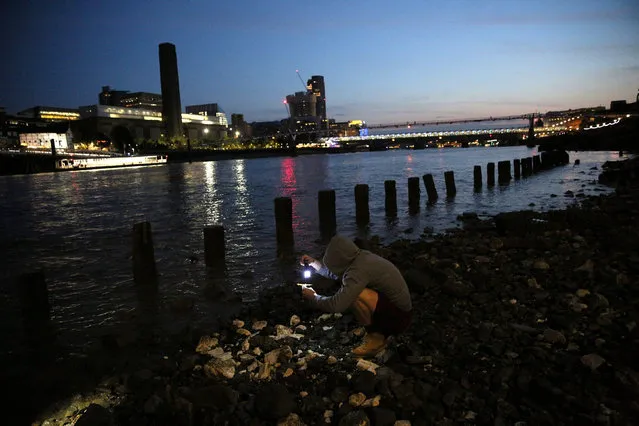
A mudlark uses a torch to look for items on the bank of the River Thames in London, Britain June 06, 2016. Mudlarking is believed to trace its origins to the 18th and 19th century, when scavengers searched the Thames' shores for items to sell. These days, history and archaeology fans are the ones hoping to find old relics such as coins, ceramics, artifacts or everyday items from across centuries. They wait for the low tide and then scour specific areas of exposed shores. "If you're in a field you could be out all day long, with the river you're restricted to about two or three hours," mudlark Nick Stevens said. While many just use the naked eye for their searches, others rely on metal detectors for which a permit from the Port of London Authority is needed. Digging also requires consent. (Photo by Neil Hall/Reuters)

A mudlark uses a torch to look for items on the bank of the River Thames in London, Britain June 06, 2016. Mudlarking is believed to trace its origins to the 18th and 19th century, when scavengers searched the Thames' shores for items to sell. These days, history and archaeology fans are the ones hoping to find old relics such as coins, ceramics, artifacts or everyday items from across centuries. their finds with the Portable Antiquities Scheme. Any item over 300 years old must be recorded. (Photo by Neil Hall/Reuters)
Details
27 Aug 2016 10:43:00
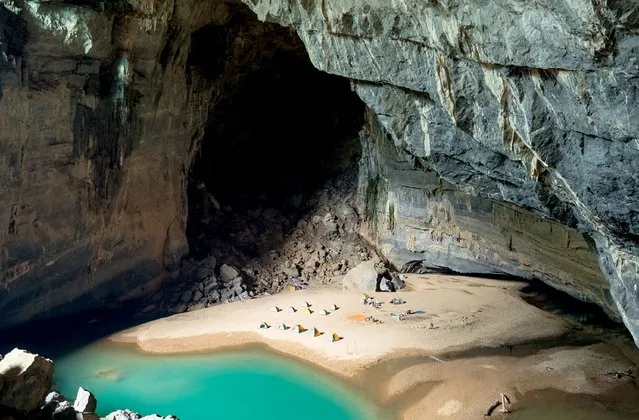
These breathtaking images capture the hidden depths of one of the worlds largest caves, which is so big its home to a beach, a river and a jungle. At more than 130m high, and 150m across, the imposing cave is so big as high as the London Eye and wider than one-and-a-half football pitches. (Photo by Lars Krux/Caters News)

These breathtaking images capture the hidden depths of one of the worlds largest caves, which is so big its home to a beach, a river and a jungle. At more than 130m high, and 150m across, the imposing cave is so big as high as the London Eye and wider than one-and-a-half football pitches. Here: The campers set up inside the cave on the beach. (Photo by Lars Krux/Caters News)
Details
07 May 2015 12:25:00
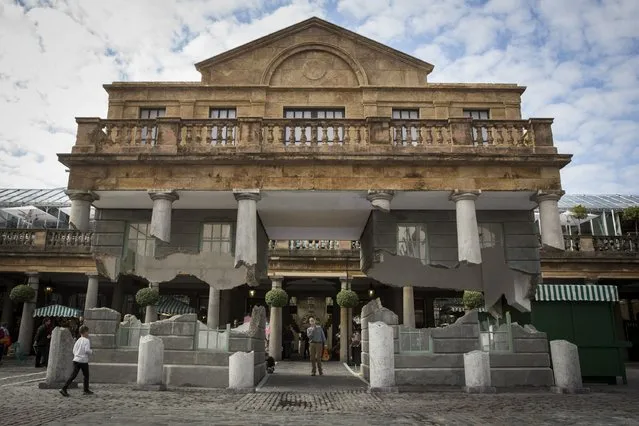
An installation entitled “Take my lightning but don't steal my thunder” by British artist Alex Chinneck stands in Covent Garden on October 2, 2014 in London, England.  The installation is intended to cast the illusion that a 40-foot section of the Covent Garden's 184-year old market building is floating. “Take my lightning but don't steal my thunder” will be on display from 2nd to 24th October 2014. (Photo by Rob Stothard/Getty Images)

An installation entitled “Take my lightning but don't steal my thunder” by British artist Alex Chinneck stands in Covent Garden on October 2, 2014 in London, England. The installation is intended to cast the illusion that a 40-foot section of the Covent Garden's 184-year old market building is floating. “Take my lightning but don't steal my thunder” will be on display from 2nd to 24th October 2014. (Photo by Rob Stothard/Getty Images)
Details
03 Oct 2014 11:40:00
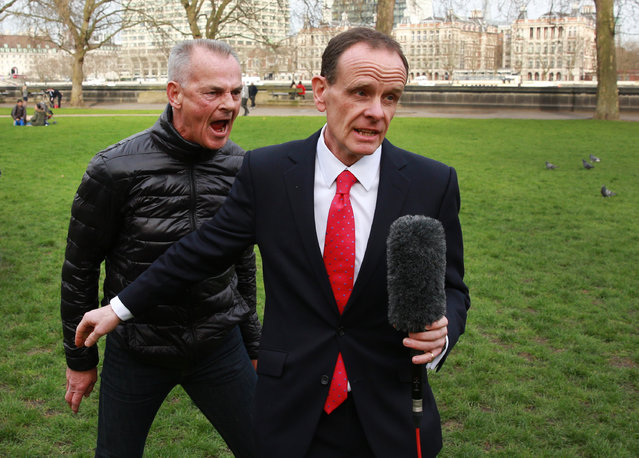
Protestor Bill Maloney (L) shouts during a live TV broadcast by BBC News Channel chief political correspondent Norman Smith after earlier forcing Deputy Prime Minister Nick Clegg to abandon a photocall near Parliament on March 19, 2014 in London, England. The Chancellor of the Exchequer, George Osborne has delivered his Budget statement to Members of Parliament in the House of Commons. (Photo by Peter Macdiarmid/Getty Images)

Protestor Bill Maloney (L) shouts during a live TV broadcast by BBC News Channel chief political correspondent Norman Smith after earlier forcing Deputy Prime Minister Nick Clegg to abandon a photocall near Parliament on March 19, 2014 in London, England. The Chancellor of the Exchequer, George Osborne has delivered his Budget statement to Members of Parliament in the House of Commons. (Photo by Peter Macdiarmid/Getty Images)
Details
22 Mar 2014 14:05:00