Loading...
Done
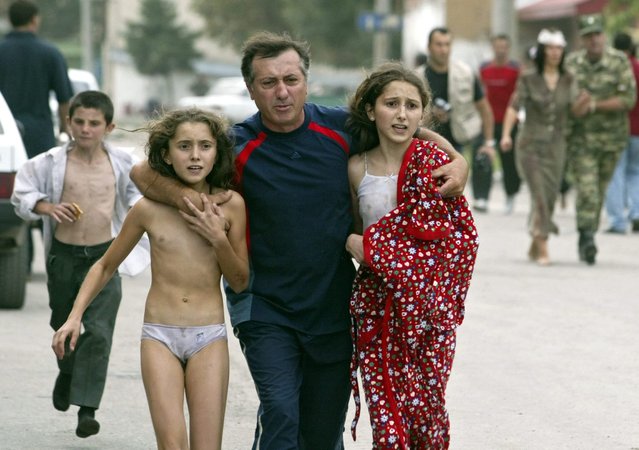
A man assists two young hostages who managed to escape from the school building after special forces entered the school in Beslan, North Ossetia, Friday 03 September 2004. Streams of hostages fled the besieged school in Beslan in southern Russia Friday amid intensive shooting and a series of powerful explosions that signalled a bloody end to the three-day stand-off with terrorists. (Photo by Yuri Kochetkov/EPA)

On September 1, 2004, Chechen militants stormed an elementary school in the town of Beslan in the Russian republic of North Ossetia. They took 1,100 teachers, children, and their relatives hostage, demanding the withdrawal of federal forces from Chechnya as a condition for their release. On September 3, 2004, Russian security forces stormed the building, resulting in a battle in which more than 330 hostages died, including 186 children. Here: A man assists two young hostages who managed to escape from the school building after special forces entered the school in Beslan, North Ossetia, Friday 03 September 2004. (Photo by Yuri Kochetkov/EPA)
Details
25 Sep 2017 06:41:00
The Dark Side of Sochi Olympics by Vasily Slonov

“Exactly one year before the long awaited Sochi Olympics, Vladimir Putin went to Sochi personally to see how the construction is going. After receiving a report saying the ski jumps that were supposed to be ready in 2011, are not completed still, while their price has sky-rocketed from 1.2 billion to 8 billion roubles, he commented, “Good for you. Good job”, and then fired the vice president of the Olympic committee. Russian artist Vasily Slonov painted his view of the upcoming games, giving a new interpretation to the adored Russian mascot Cheburashka, and combining officially endorsed stereotypes of Russia with grimmer and less accepted ones”. – Ruskie.info. (Photo by Vasily Slonov)
Details
07 Jun 2013 10:24:00
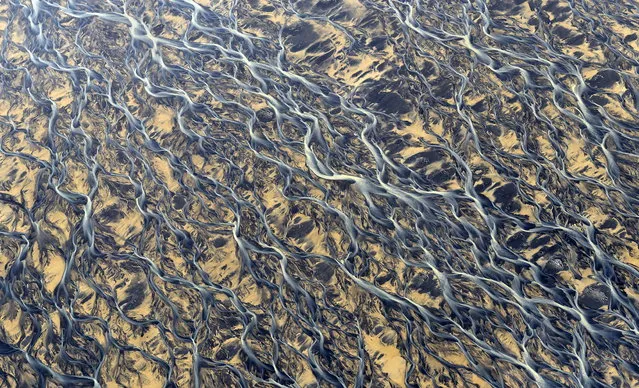
These pictures look like an artist has painted abstract patterns on canvas – but in fact they are natural rivers captured on camera. The spectacular rivers in Iceland's central highlands and southern parts originate from glaciers, which is why the water is a milky colour. (Photo by Andrey Ermolaev/Solent News)

These picture look like an artist has painted abstract patterns on canvas – but in fact they are natural rivers captured on camera. The spectacular rivers in Iceland's central highlands and southern parts originate from glaciers, which is why the water is a milky colour. They are shallow rivers and the water spreads quickly over a flat and sandy surface, creating random and beautiful patterns. Photographer Andrey Ermolaev from Moscow, Russia, flew 500ft above the unique sight in a small plane. (Photo by Andrey Ermolaev/Solent News)
Details
05 May 2014 10:57:00
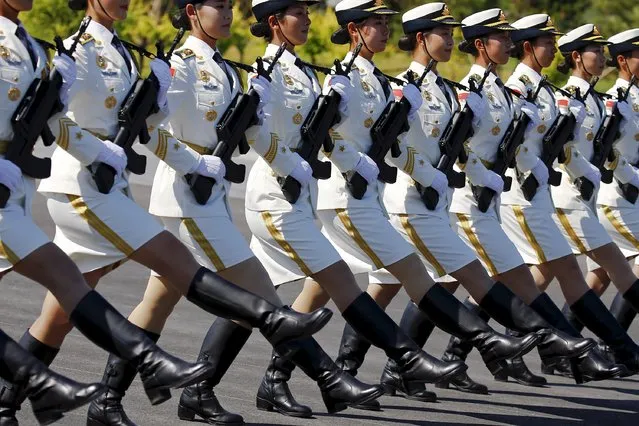
Soldiers of China's People's Liberation Army march with their weapons during a training session for a military parade to mark the 70th anniversary of the end of World War Two, at a military base in Beijing, China, August 22, 2015. (Photo by Damir Sagolj/Reuters)

Soldiers of China's People's Liberation Army march with their weapons during a training session for a military parade to mark the 70th anniversary of the end of World War Two, at a military base in Beijing, China, August 22, 2015. Troops from at least 10 countries including Russia and Kazakhstan will join an unprecedented military parade in Beijing next month to commemorate China's victory over Japan during World War Two, Chinese officials said. The parade on September 3 will involve about 12,000 Chinese troops and 200 aircraft, Qi Rui, deputy director of the government office organizing the parade, told reporters in Beijing on Friday. (Photo by Damir Sagolj/Reuters)
Details
23 Aug 2015 10:06:00
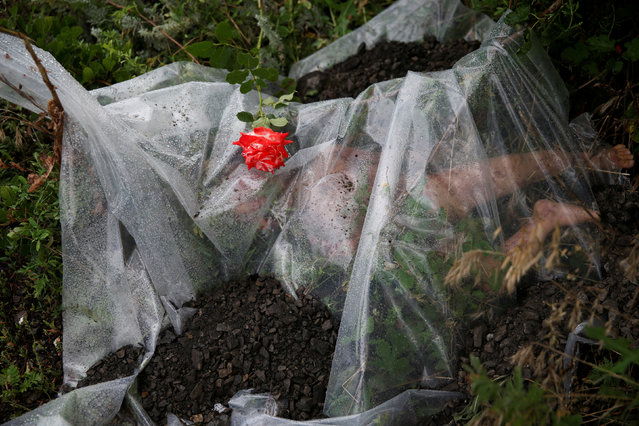
A rose lies on a plastic sheet covering a victim of a Malaysian Airlines Boeing 777 plane which was downed on Thursday near the village of Rozsypne, in the Donetsk region July 18, 2014. (Photo by Maxim Zmeyev/Reuters)

A rose lies on a plastic sheet covering a victim of a Malaysian Airlines Boeing 777 plane which was downed on Thursday near the village of Rozsypne, in the Donetsk region July 18, 2014. International prosecutors investigating the downing of flight MH17 over eastern Ukraine in 2014 say the missile that hit the plane was fired from territory controlled by Russian-backed rebels. They said the missile launcher was brought into Ukraine from Russia. All 298 people on board the Boeing 777 died when it broke apart in midair flying from Amsterdam to Kuala Lumpur. The JIT investigation's findings are meant to prepare the ground for a criminal trial. (Photo by Maxim Zmeyev/Reuters)
Details
28 Sep 2016 11:13:00
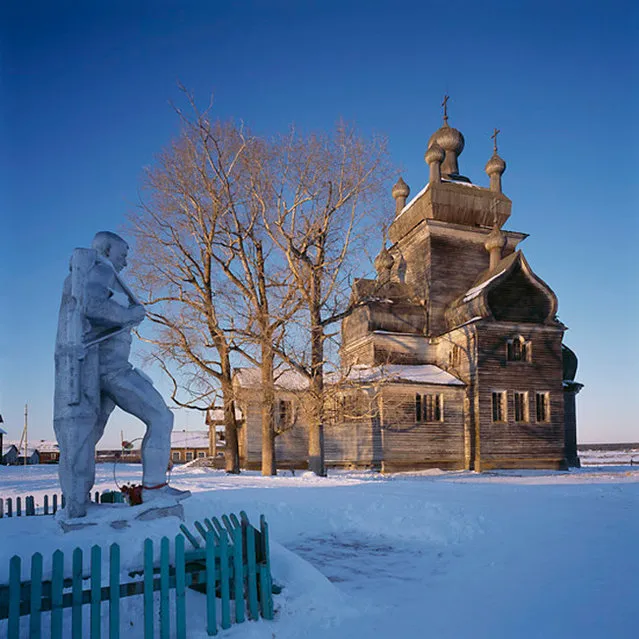
Wooden Churches - Travelling In The Russian North By Richard Davies Part 2

While communism, collectivism, worms, dry rot and casual looting failed to destroy the majestic wooden churches of Russia, it may be ordinary neglect that finally does them in. Dwindled now to several hundred remaining examples, these glories of vernacular architecture lie scattered amid the vastness of the world’s largest country. Just over a decade ago, Richard Davies, a British architectural photographer, struck out on a mission to record the fragile and poetic structures. Austerely beautiful and haunting, “Wooden Churches: Traveling in the Russian North” (White Sea Publishing; $132) is the result. Covering thousands of miles, Mr. Davies described how he and the writer Matilda Moreton tracked down the survivors from among the thousands of onion-domed structures built after Prince Vladimir converted to Christianity in 988.

See also: Wooden Churches Part1
Details
28 Nov 2013 12:13:00
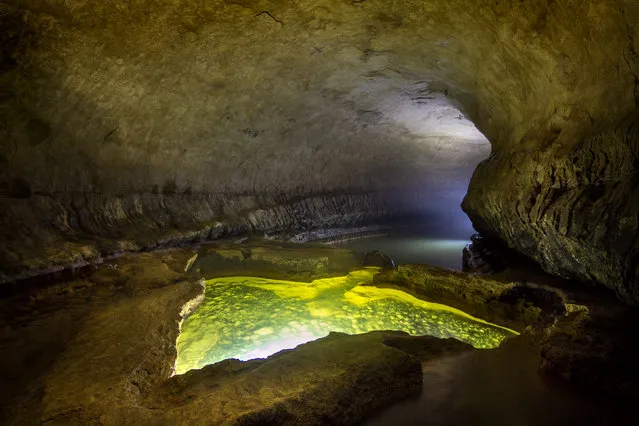
A large pool of water inside one of the tunnels. (Photo by Vladimir Mulde/Caters News)

These otherworldly images give a rare glimpse inside caves barely ever seen by the human eye. With its peculiar pools of water and strange colored sediments, the bizarre looking tunnels of the Shakuranskaya cave could be a set straight out of a science fiction film. Found in the disputed region of Abkhazia, around 75 miles outside of Sochi, Russia, it is rumored the incredible underground chambers were formed after a huge earthquake struck the area in 1892. After causing part of a nearby mountain to collapse into the Amtkel River, it is thought the dam-like affect has created a series of interconnecting underground tunnels. Here: a large pool of water inside one of the tunnels. (Photo by Vladimir Mulde/Caters News)
Details
07 Nov 2014 12:45:00
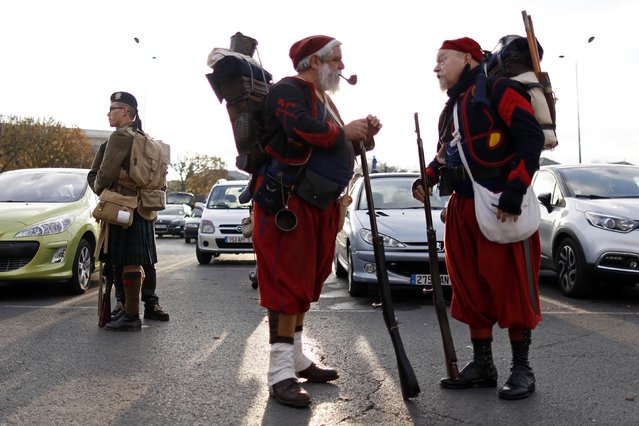
History enthusiasts of French association “Arquebusiers de l'Est”, dressed as soldiers of 3rd regiment of Zouave, attend an Armistice Day ceremony to commemorate the end of World War One at Epernay, eastern France, November 11, 2014. (Photo by Charles Platiau/Reuters)

History enthusiasts of French association “Arquebusiers de l'Est”, dressed as soldiers of 3rd regiment of Zouave, attend an Armistice Day ceremony to commemorate the end of World War One at Epernay, eastern France, November 11, 2014. More than a hundred volunteers from France, Romania, England, Belgium, Russia and Italy took part in the parade. The year 2014 marks the centennial commemoration for the soldiers who fought in the First World War (WWI). (Photo by Charles Platiau/Reuters)
Details
13 Nov 2014 13:41:00