Loading...
Done
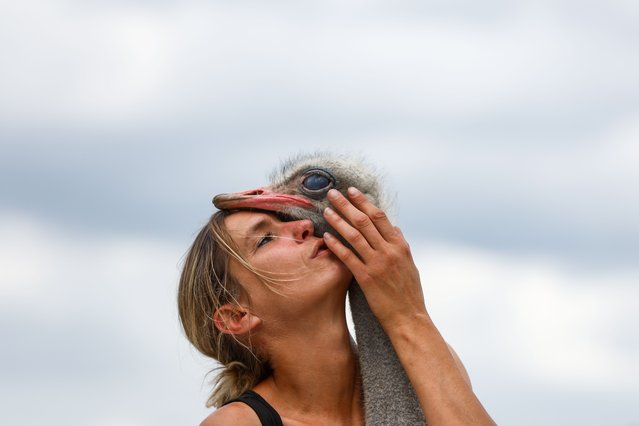
Wendy Adriaens, owner of animal rescue farm “De Passiehoeve” and nicknamed the Ostrich Whisperer, poses for a photo with three-year-old male ostrich Flodder, in Kalmthout, Belgium, 25 July 2022. Flodder and Wendy were separated for seven months since Wendy moved to a bigger farm in January. Flodder spent the seven months at another farm in order to ease the tension between the two ostriches Flodder and Blue who were fighting to the death and had to be separated. Wendy Adriaens has been taking in all kinds of animals that have been mistreated or neglected for some four years at her farm located in the Province of Antwerp. She lives mainly from donations from people who have known her via social networks. An entrance fee to the farm is requested if visitors want to spend some time there. This makes it possible to buy the necessary for the convalescence of the animals. (Photo by Stephanie Lecocq/EPA/EFE/Rex Features/Shutterstock)

Wendy Adriaens, owner of animal rescue farm “De Passiehoeve” and nicknamed the Ostrich Whisperer, poses for a photo with three-year-old male ostrich Flodder, in Kalmthout, Belgium, 25 July 2022. (Photo by Stephanie Lecocq/EPA/EFE/Rex Features/Shutterstock)
Details
31 Jul 2022 06:16:00
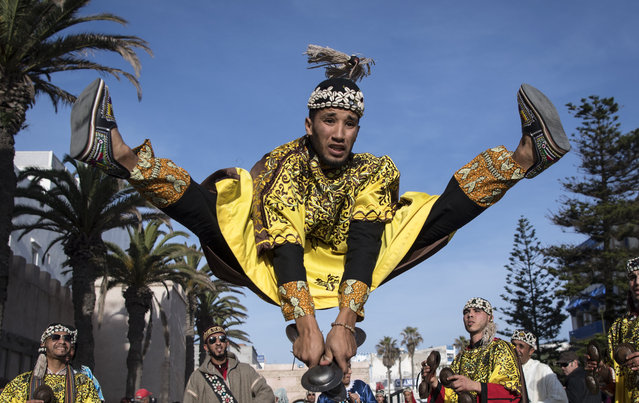
A Gnawa traditional group performs in the city of Essaouira on December 14, 2019, to celebrate the decision of adding the Gnawa culture to UNESCO's list of Intangible Cultural Heritage of Humanity. Gnawa culture, a centuries-old Moroccan practice rooted in music, African rituals and Sufi traditions, was added to UNESCO's list of Intangible Cultural Heritage of Humanity earlier in the week. Gnawa refers to a “set of musical productions, fraternal practices and therapeutic rituals where the secular mixes with the sacred”, according to the nomination submitted by Morocco. Often dressed in colourful outfits, Gnawa musicians play the guenbri, a type of lute with three strings, accompanied by steel castanets called krakebs. (Photo by Fadel Senna/AFP Photo)

A Gnawa traditional group performs in the city of Essaouira on December 14, 2019, to celebrate the decision of adding the Gnawa culture to UNESCO's list of Intangible Cultural Heritage of Humanity. Gnawa culture, a centuries-old Moroccan practice rooted in music, African rituals and Sufi traditions, was added to UNESCO's list of Intangible Cultural Heritage of Humanity earlier in the week. Gnawa refers to a “set of musical productions, fraternal practices and therapeutic rituals where the secular mixes with the sacred”, according to the nomination submitted by Morocco. Often dressed in colourful outfits, Gnawa musicians play the guenbri, a type of lute with three strings, accompanied by steel castanets called krakebs. (Photo by Fadel Senna/AFP Photo)
Details
18 Dec 2019 00:05:00
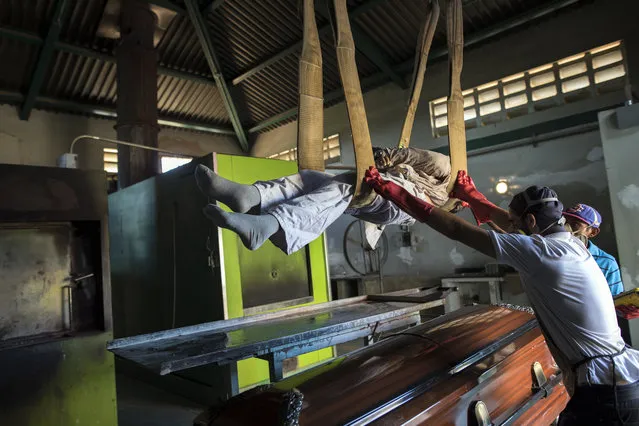
Cemetery workers lift a corpse from a coffin to a metal plate as they prepare the body for cremation at a cemetery in Maracaibo, Venezuela, November 27, 2019. Some overcome the financial burden of a relative's death by renting caskets, a cheaper option than buying one. (Photo by Rodrigo Abd/AP Photo)

Cemetery workers lift a corpse from a coffin to a metal plate as they prepare the body for cremation at a cemetery in Maracaibo, Venezuela, November 27, 2019. Some overcome the financial burden of a relative's death by renting caskets, a cheaper option than buying one. (Photo by Rodrigo Abd/AP Photo)
Details
28 Dec 2019 00:01:00
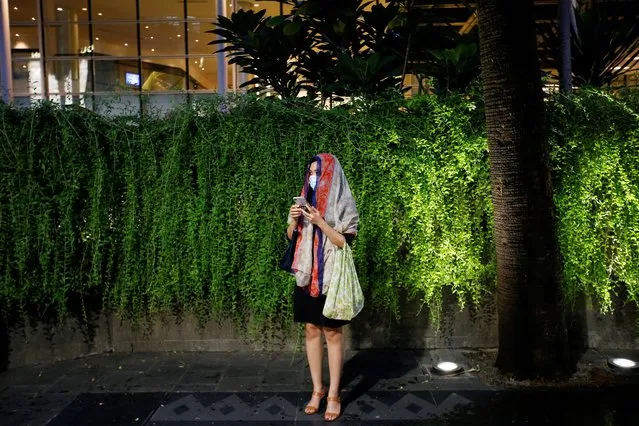
A woman wearing a protective mask stands as she waits for the bus at the sidewalk, after Indonesia confirmed its first cases of coronavirus, in Jakarta, Indonesia, March 4, 2020. (Photo by Willy Kurniawan/Reuters)

A woman wearing a protective mask stands as she waits for the bus at the sidewalk, after Indonesia confirmed its first cases of coronavirus, in Jakarta, Indonesia, March 4, 2020. (Photo by Willy Kurniawan/Reuters)
Details
20 Mar 2020 00:01:00
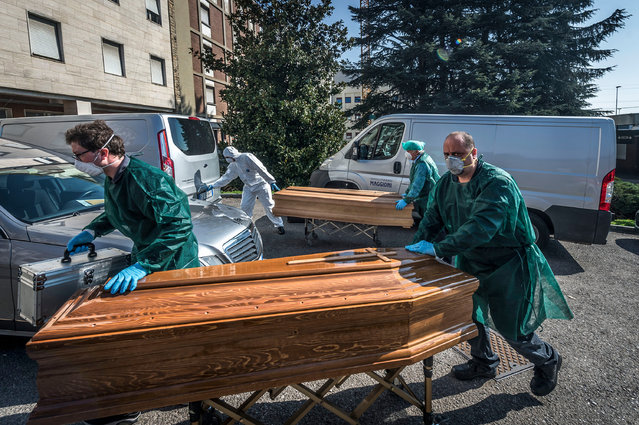
Mortuary Chamber of the Ponte San Pietro Hospital in the Province of Bergamo on March 18, 2020 – the area in Italy where the highest number of infections was recorded by COVID19 Coronavirus. (Photo by Carlo Cozzoli/IPA/SIPA Press/Rex Features/Shutterstock)

Mortuary Chamber of the Ponte San Pietro Hospital in the Province of Bergamo on March 18, 2020 – the area in Italy where the highest number of infections was recorded by COVID19 Coronavirus. (Photo by Carlo Cozzoli/IPA/SIPA Press/Rex Features/Shutterstock)
Details
21 Mar 2020 00:07:00
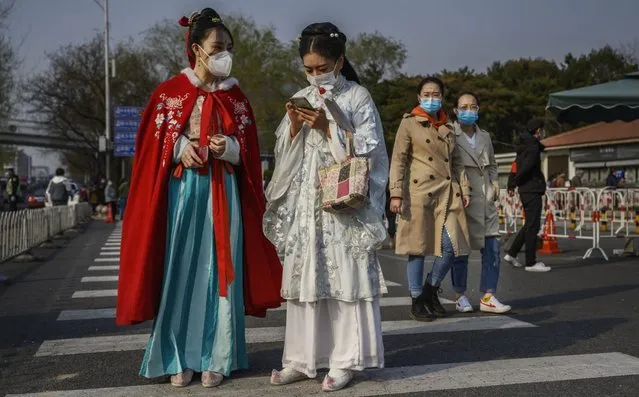
Chinese women wear protective masks as they are dressed in traditional clothing from the Qing Dynasty era outside a park on March 29, 2020 in Beijing, China. A limited section of the iconic tourist site was re-opened to the public this week allowing a smaller number of visitors to reserve tickets online in advance and to enter after passing health screening. With the pandemic hitting hard across the world, China recorded its first day with no new domestic cases of the coronavirus last week, since the government imposed sweeping measures to keep the disease from spreading. For two months, millions of people across China have been restricted in how they move from their homes, while other cities have been locked down in ways that appeared severe at the time but are now being replicated in other countries trying to contain the virus. Officials believe the worst appears to be over in China, though there are concerns of another wave of infections as the government attempts to reboot the worlds second largest economy. In Beijing, it is mandatory to wear masks outdoors, retail stores operate on reduced hours, restaurants employ social distancing among patrons, and tourist attractions at risk of drawing large crowds remain closed. Monitoring and enforcement of virus-related measures and the quarantine of anyone arriving to Beijing is carried out by neighborhood committees and a network of Communist Party volunteers who wear red arm bands. A primary concern for Chinese authorities remains the arrival of flights from Europe and elsewhere, given the exposure of passengers in regions now regarded as hotbeds for transmission. Since January, China has recorded more than 81,000 cases of COVID-19 and at least 3200 deaths, mostly in and around the city of Wuhan, in central Hubei province, where the outbreak first started. (Photo by Kevin Frayer/Getty Images)

Chinese women wear protective masks as they are dressed in traditional clothing from the Qing Dynasty era outside a park on March 29, 2020 in Beijing, China. A limited section of the iconic tourist site was re-opened to the public this week allowing a smaller number of visitors to reserve tickets online in advance and to enter after passing health screening. (Photo by Kevin Frayer/Getty Images)
Details
01 Apr 2020 00:05:00
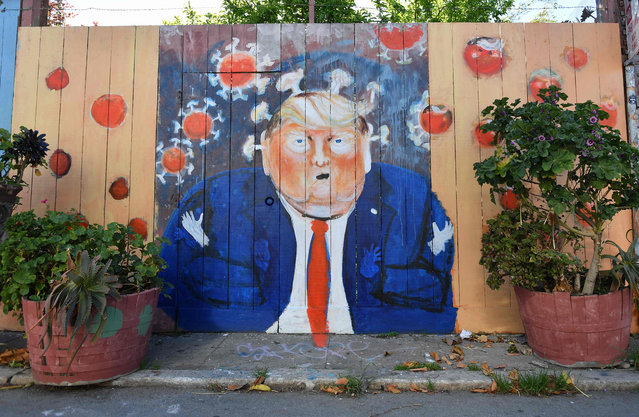
A mural painted on a fence depicts US President Donald Trump as the Coronavirus in San Francisco, California on April, 01, 2020. All 40 million residents of California were Thursday ordered to stay at home indefinitely in a bid to battle the coronavirus pandemic in the nation's most populous state. (Photo by Josh Edelson/AFP Photo)

A mural painted on a fence depicts US President Donald Trump as the Coronavirus in San Francisco, California on April, 01, 2020. All 40 million residents of California were Thursday ordered to stay at home indefinitely in a bid to battle the coronavirus pandemic in the nation's most populous state. (Photo by Josh Edelson/AFP Photo)
Details
07 Apr 2020 00:05:00
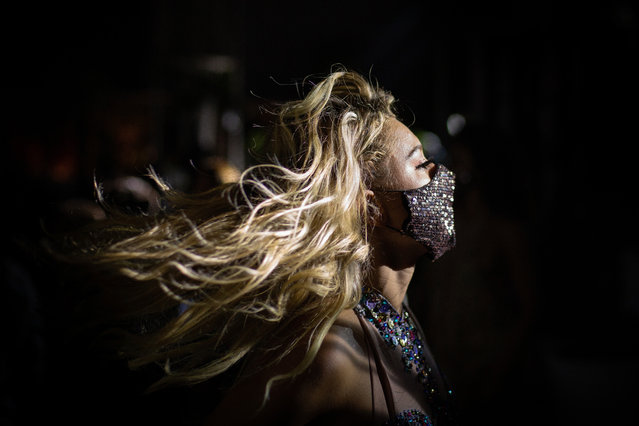
A woman in a face mask dances inside the club on the opening of the summer season for “Villa delle Rose”, one of the most famous clubs on the Adriatic Coast on June 20, 2020 in Rimini, Italy. The Villa delle Rose is among the first dance clubs to reopen in the Adriatic Riviera after the Covid-19 pandemic. (Photo by Max Cavallari/Getty Images)

A woman in a face mask dances inside the club on the opening of the summer season for “Villa delle Rose”, one of the most famous clubs on the Adriatic Coast on June 20, 2020 in Rimini, Italy. The Villa delle Rose is among the first dance clubs to reopen in the Adriatic Riviera after the Covid-19 pandemic. (Photo by Max Cavallari/Getty Images)
Details
23 Jun 2020 00:03:00