Loading...
Done
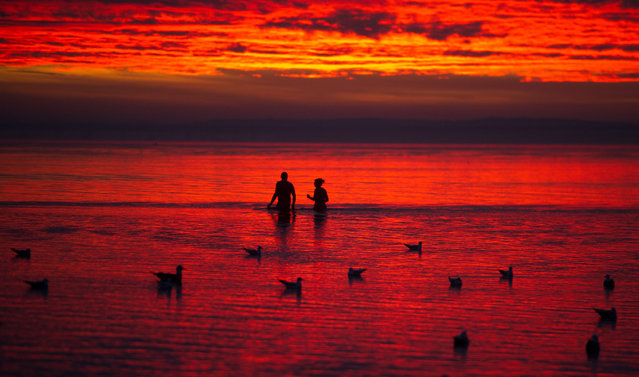
People and sea-gulls bathe in the sea as the sun goes up with red colors in Stralsund close to the baltic sea island of Rügen, on early November 23, 2016. (Photo by Stefan Sauer/AFP Photo/DPA)

People and sea-gulls bathe in the sea as the sun goes up with red colors in Stralsund close to the baltic sea island of Rügen, on early November 23, 2016. (Photo by Stefan Sauer/AFP Photo/DPA)
Details
07 Feb 2017 00:01:00
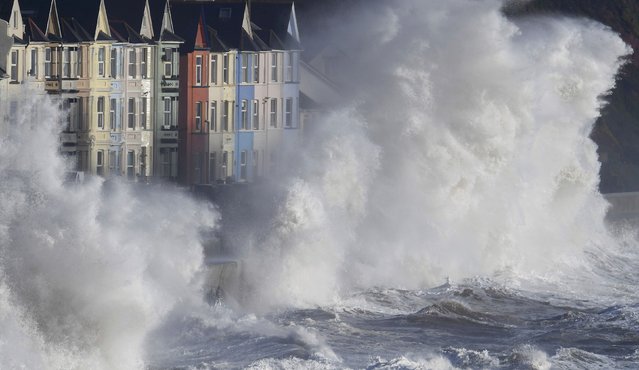
Waves hit the seawall during heavy seas and high winds in Dawlish in south west Britain, February 2, 2017. (Photo by Toby Melville/Reuters)

Waves hit the seawall during heavy seas and high winds in Dawlish in south west Britain, February 2, 2017. (Photo by Toby Melville/Reuters)
Details
08 Feb 2017 00:05:00
Cheerleaders let their hair fly as they perform prior to a German first division Bundesliga soccer match between 1. FC Cologne and Bayern Munich in Cologne, Germany, March 4, 2017. (Photo by Michael Probst/AP Photo)

Cheerleaders let their hair fly as they perform prior to a German first division Bundesliga soccer match between 1. FC Cologne and Bayern Munich in Cologne, Germany, March 4, 2017. (Photo by Michael Probst/AP Photo)
Details
05 Mar 2017 07:45:00
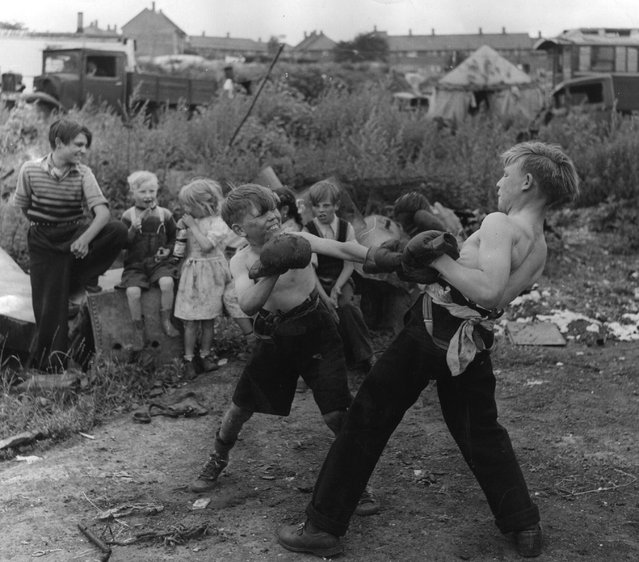
The unromantic gypsies. Children boxing in a gypsy camp in Kent, England on July 1, 1951. Like all boys these gypsy lads like to try their hand at boxing. Encouraged by their friends they fight it out on Corke's Meadow. Few Romanies now live a life of wandering romance. Most are like the three hundred squatters of Corke's Meadow, Kent, which is part of a “gypsy problem” that involves about 100,000 today. Of those about 25,000 can be rightly called gypsies, the rest are Mumpers and Posh-rats and Hobos. Corke's Meadow has both kinds. “Picture Post” cameraman Bert Hardy photographs the Corke's Meadow gypsies in their encampment. (Photo by Hulton-Deutsch Collection/Corbis via Getty Images)

The unromantic gypsies. Children boxing in a gypsy camp in Kent, England on July 1, 1951. Like all boys these gypsy lads like to try their hand at boxing. Encouraged by their friends they fight it out on Corke's Meadow. Few Romanies now live a life of wandering romance. Most are like the three hundred squatters of Corke's Meadow, Kent, which is part of a “gypsy problem” that involves about 100,000 today. Of those about 25,000 can be rightly called gypsies, the rest are Mumpers and Posh-rats and Hobos. Corke's Meadow has both kinds. “Picture Post” cameraman Bert Hardy photographs the Corke's Meadow gypsies in their encampment. (Photo by Hulton-Deutsch Collection/Corbis via Getty Images)
Details
12 Mar 2017 00:01:00
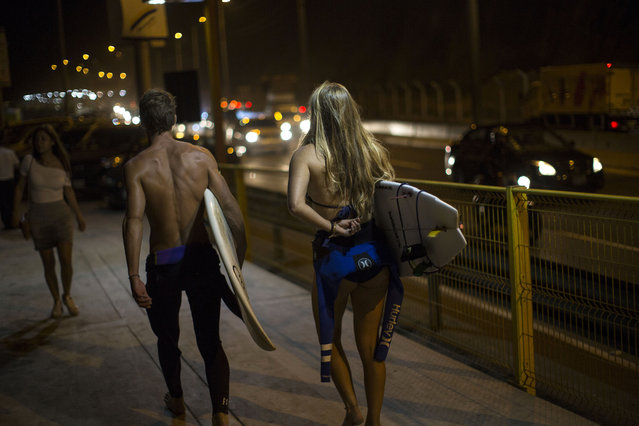
In this Feb. 17, 2017 photo, surfers walk to La Pampilla beach in Lima, Peru. Night surfing apparently came about in Lima because of a dispute with the capital municipality that in 2015 increased the width of a road that runs along the coast. The surfers protested the construction for months by camping on the asphalted beach area, but in the end the municipality prevailed, with support from the police. At the end of 2016, perhaps to win over the surfers, Lima's mayor set up beach lights that allows for night surfing. (Photo by Rodrigo Abd/AP Photo)

In this Feb. 17, 2017 photo, surfers walk to La Pampilla beach in Lima, Peru. Night surfing apparently came about in Lima because of a dispute with the capital municipality that in 2015 increased the width of a road that runs along the coast. The surfers protested the construction for months by camping on the asphalted beach area, but in the end the municipality prevailed, with support from the police. At the end of 2016, perhaps to win over the surfers, Lima's mayor set up beach lights that allows for night surfing. (Photo by Rodrigo Abd/AP Photo)
Details
04 May 2017 09:23:00
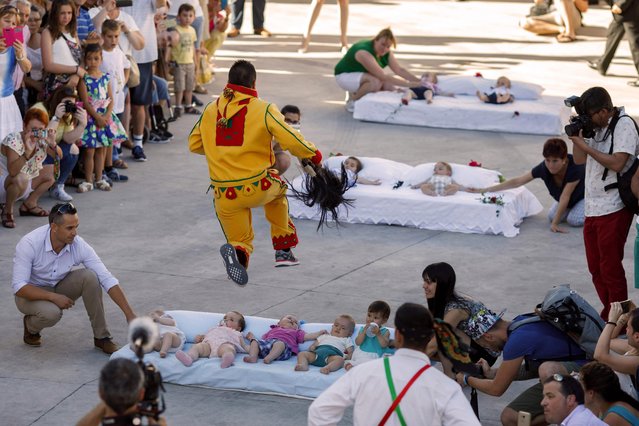
A man dressed up as the devil jumps over babies lying on a mattress in the street during “El Colacho”, the “baby jumping festival” in the village of Castrillo de Murcia, near Burgos on June 18, 2017. Baby jumping (El Colacho) is a traditional Spanish practice dating back to 1620 that takes place annually to celebrate the Catholic feast of Corpus Christi. During the act – known as El Salto del Colacho (the devil's jump) or simply El Colacho – men dressed as the Devil jump over babies born in the last twelve months of the year who lie on mattresses in the street. (Photo by Cesar Manso/AFP Photo)

A man dressed up as the devil jumps over babies lying on a mattress in the street during “El Colacho”, the “baby jumping festival” in the village of Castrillo de Murcia, near Burgos on June 18, 2017. Baby jumping (El Colacho) is a traditional Spanish practice dating back to 1620 that takes place annually to celebrate the Catholic feast of Corpus Christi. During the act – known as El Salto del Colacho (the devil's jump) or simply El Colacho – men dressed as the Devil jump over babies born in the last twelve months of the year who lie on mattresses in the street. (Photo by Cesar Manso/AFP Photo)
Details
20 Jun 2017 07:29:00
In a photo taken on July 6, 2017 soldiers of the Korean People' s Army (KPA) watch a fireworks display as part of celebrations marking the July 4 launch of the Hwasong-14 intercontinental ballistic missile, in Pyongyang Fireworks lit up the sky over Pyongyang' s Juche Tower as North Korea celebrated its launch of intercontinental ballistic missile, a milestone in its decades- long weapons drive. On July 4 – the United States' Independence Day – it launched a Hwasong-14 rocket that analysts and overseas officials said had a range of up to 8,000 kilometres, which would put Alaska and Hawaii within reach. (Photo by Kim Won-Jin/AFP Photo)

In a photo taken on July 6, 2017 soldiers of the Korean People' s Army (KPA) watch a fireworks display as part of celebrations marking the July 4 launch of the Hwasong-14 intercontinental ballistic missile, in Pyongyang Fireworks lit up the sky over Pyongyang' s Juche Tower as North Korea celebrated its launch of intercontinental ballistic missile, a milestone in its decades- long weapons drive. On July 4 – the United States' Independence Day – it launched a Hwasong-14 rocket that analysts and overseas officials said had a range of up to 8,000 kilometres, which would put Alaska and Hawaii within reach. (Photo by Kim Won-Jin/AFP Photo)
Details
14 Jul 2017 07:17:00
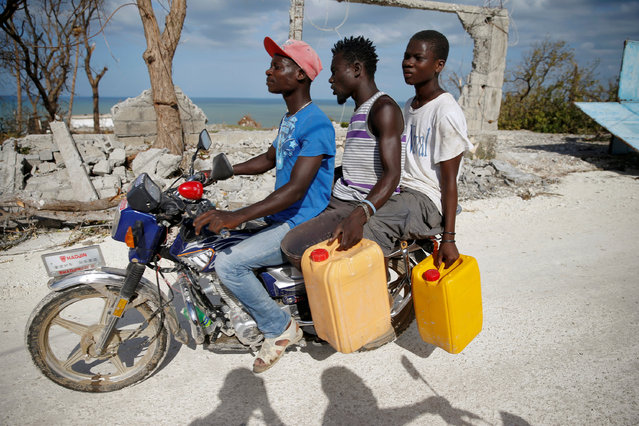
Men ride a motorcycle in front of destroyed houses after Hurricane Matthew passes Jeremie, Haiti, October 7, 2016. (Photo by Carlos Garcia Rawlins/Reuters)

Men ride a motorcycle in front of destroyed houses after Hurricane Matthew passes Jeremie, Haiti, October 7, 2016. (Photo by Carlos Garcia Rawlins/Reuters)
Details
12 Oct 2016 10:31:00