Loading...
Done
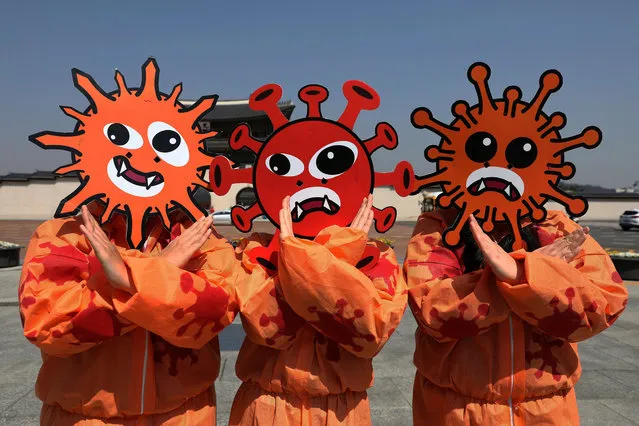
South Korean environmental activists wearing masks symbolizing the coronavirus attend a prevention campaign as South Koreans take measures to protect themselves against the spread of coronavirus (COVID-19) on March 30, 2020 in Seoul, South Korea. South Korea has called for expanded public participation in social distancing, as the country witnesses a wave of community spread and imported infections leading to a resurgence in new cases of COVID-19. According to the Korea Center for Disease Control and Prevention on Monday, 78 new cases were reported. The total number of infections in the nation tallies at 9,661. (Photo by Chung Sung-Jun/Getty Images)

South Korean environmental activists wearing masks symbolizing the coronavirus attend a prevention campaign as South Koreans take measures to protect themselves against the spread of coronavirus (COVID-19) on March 30, 2020 in Seoul, South Korea. South Korea has called for expanded public participation in social distancing, as the country witnesses a wave of community spread and imported infections leading to a resurgence in new cases of COVID-19. According to the Korea Center for Disease Control and Prevention on Monday, 78 new cases were reported. The total number of infections in the nation tallies at 9,661. (Photo by Chung Sung-Jun/Getty Images)
Details
01 Apr 2020 00:07:00
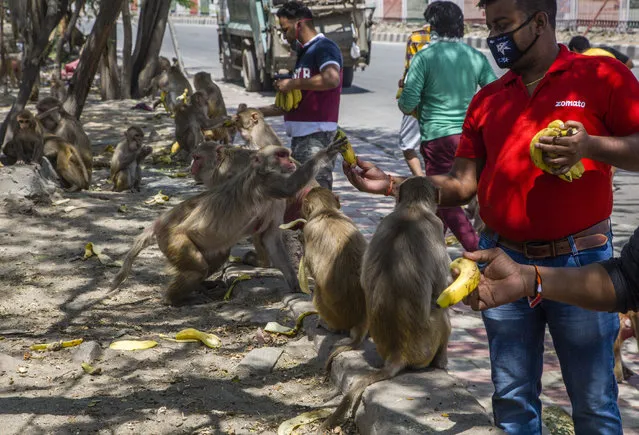
Men give bananas to monkeys gathered on the side of the road as India remains under an unprecedented lockdown over the highly contagious coronavirus (COVID-19) on April 08, 2020 in New Delhi, India. Wild animals, including monkeys, are roaming human settlements in India as people are staying indoors due to the 21-day lockdown. With India's 1.3 billion population and tens of millions of cars off the roads, wildlife is moving towards areas inhabited by humans. Wild animals in many countries have been seen roaming streets. A study says some 60 percent of the new diseases found around the globe every year are zoonotic, meaning they originate in animals and are passed on to humans. COVID-19 is a zoonotic disease that is suspected to have come from the wet markets of Wuhan, China. (Photo by Yawar Nazir/Getty Images)

Men give bananas to monkeys gathered on the side of the road as India remains under an unprecedented lockdown over the highly contagious coronavirus (COVID-19) on April 08, 2020 in New Delhi, India. Wild animals, including monkeys, are roaming human settlements in India as people are staying indoors due to the 21-day lockdown. (Photo by Yawar Nazir/Getty Images)
Details
12 Apr 2020 00:05:00
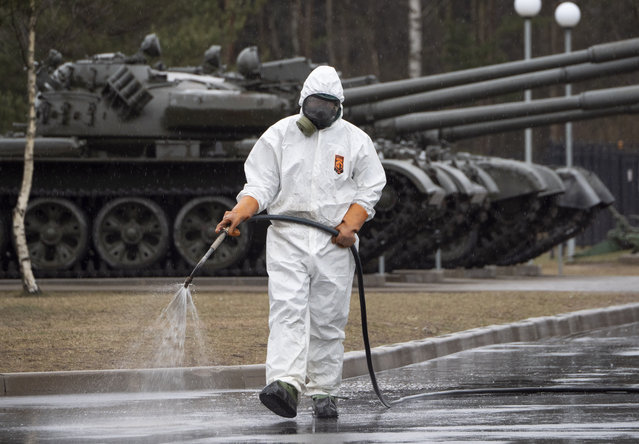
A specialist from a local veterinary service wears a protective suit as sprays disinfectant near Russian tanks displayed at area near Proryv (The Breakthrough) museum dedicated to the breakthrough of the Siege of Leningrad during World WarII near Kirovsk, about 30 kilometres (19 miles) east of St.Petersburg, Russia, Thursday, April 2, 2020. (Photo by Dmitri Lovetsky/AP Photo)

A specialist from a local veterinary service wears a protective suit as sprays disinfectant near Russian tanks displayed at area near Proryv (The Breakthrough) museum dedicated to the breakthrough of the Siege of Leningrad during World WarII near Kirovsk, about 30 kilometres (19 miles) east of St.Petersburg, Russia, Thursday, April 2, 2020. (Photo by Dmitri Lovetsky/AP Photo)
Details
13 Apr 2020 00:01:00
A robot, developed by start-up firm Asimov Robotics, holds a tray with face masks and sanitizer after the two robots were launched to spread awareness about the coronavirus, in Kochi, India, March 17, 2020. (Photo by Sivaram V/Reuters)

A robot, developed by start-up firm Asimov Robotics, holds a tray with face masks and sanitizer after the two robots were launched to spread awareness about the coronavirus, in Kochi, India, March 17, 2020. (Photo by Sivaram V/Reuters)
Details
16 Apr 2020 00:01:00
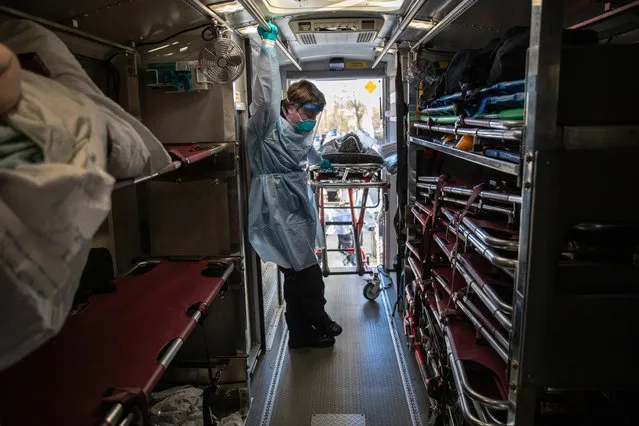
EMT Christian Amoroso, wearing personal protective equipment (PPE), pauses while unloading COVID-19 patients at the Montefiore Medical Center Wakefield Campus on April 06, 2020 in the Bronx borough of New York City. A specialized bus known as a Medical Evacuation Transport Unit (METU), caries infected patients on stretchers and benches between hospitals. The patient transfers are designed to help overwhelmed hospitals even out caseloads in Westchester County and New York City at the epicenter of the U.S. coronavirus pandemic. The patients were being transferred from the Einstein Campus, Wyler Hospital, also a Bronx Montefiore hospital. The transfers are staffed by Empress EMS, Yonkers police and hospital staff on both ends wearing PPE. (Photo by John Moore/Getty Images)

EMT Christian Amoroso, wearing personal protective equipment (PPE), pauses while unloading COVID-19 patients at the Montefiore Medical Center Wakefield Campus on April 06, 2020 in the Bronx borough of New York City. A specialized bus known as a Medical Evacuation Transport Unit (METU), caries infected patients on stretchers and benches between hospitals. (Photo by John Moore/Getty Images)
Details
19 Apr 2020 00:01:00
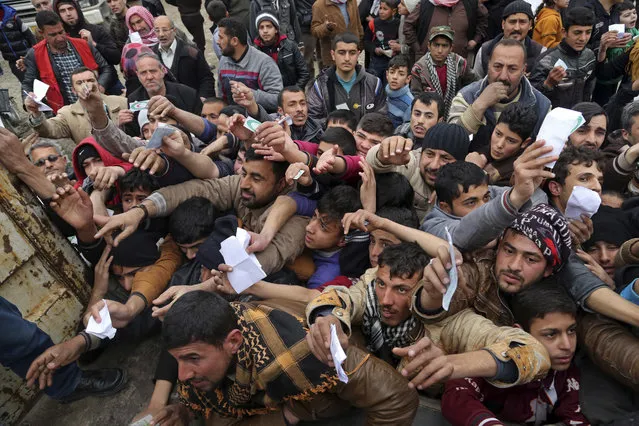
Civilians present their rations cards in order to receive humanitarian food aid being distributed by the Iraqi Red Crescent, in the eastern side of Mosul, Iraq, Tuesday, January 31, 2017. Iraqi forces declared Mosul's eastern half fully liberated, just over three months after the operation to retake the city from IS was formally launched in October. (Photo by Khalid Mohammed/AP Photo)

Civilians present their rations cards in order to receive humanitarian food aid being distributed by the Iraqi Red Crescent, in the eastern side of Mosul, Iraq, Tuesday, January 31, 2017. Iraqi forces declared Mosul's eastern half fully liberated, just over three months after the operation to retake the city from IS was formally launched in October. (Photo by Khalid Mohammed/AP Photo)
Details
06 Feb 2017 01:00:00
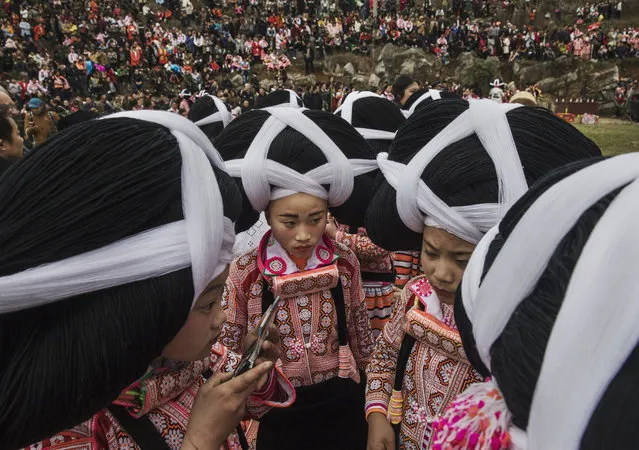
Girls of the Long Horn Miao ethnic minority group wear headdresses as they prepare gather for Tiaohua or Flower Festival as part of the Lunar New Year on February 6, 2017 in Longga village, Guizhou province, southern China. The Long Horn Miao are recognized for their declining practice of wrapping a blend of linen, wool, and the hair of their ancestors around animal horns or a wooden clip to make headdresses. Many young women say they now wear the headdresses only for special occasions and festivals, as the ornaments, which are attached by the horns to their real hair, have proved impractical for modern daily life in a fast changing world. China officially recognizes 56 different ethnic minorities, and statistics show over 7 million Chinese identifying themselves as Miao. But the small Long Horn Miao community counts only around 5000 people living in 12 villages, whose age-old traditions, language, and culture are fading. It is increasingly difficult in a modernizing China, as young people are drawn from remote rural villages to opportunities in bigger cities amongst wide-scale urbanization. Farming and labour remain the mainstays of life for the Long Horn Miao, leaving the area relatively poor in comparison with many parts of China. The government has invested significant amounts into local infrastructure and the tourism industry to try to bolster the local economy. (Photo by Kevin Frayer/Getty Images)

Girls of the Long Horn Miao ethnic minority group wear headdresses as they prepare gather for Tiaohua or Flower Festival as part of the Lunar New Year on February 6, 2017 in Longga village, Guizhou province, southern China. (Photo by Kevin Frayer/Getty Images)
Details
13 Feb 2017 00:01:00
French mounted bullfighter Lea Vicens is gored by her first bull and falls off her horse during the 31st day of the San Isidro bullfighting festival at Las Ventas bullring in Madrid, Spain, 10 June 2017. (Photo by Victor Lerena/EPA)

French mounted bullfighter Lea Vicens is gored by her first bull and falls off her horse during the 31st day of the San Isidro bullfighting festival at Las Ventas bullring in Madrid, Spain, 10 June 2017. (Photo by Victor Lerena/EPA)
Details
12 Jun 2017 09:27:00