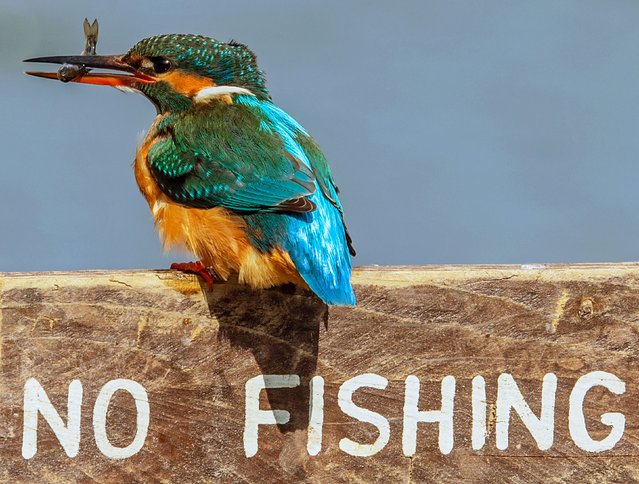
A kingfisher ignores the “no fishing” sign after catching food at Teddesley Park in Staffordshire, England, on Saturday, April 5, 2025. (Photo by Stuart Brock/Anadolu/Getty Images)
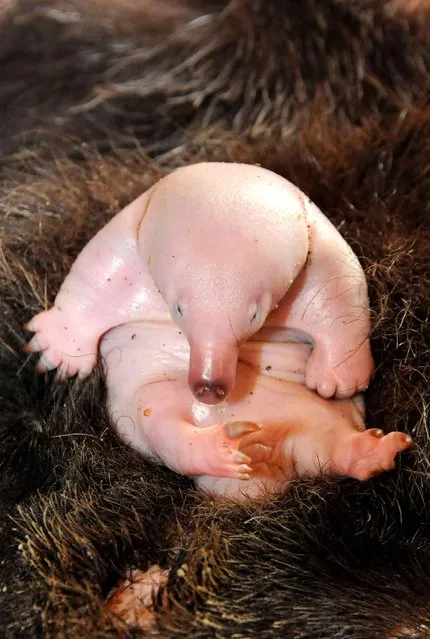
It's a 30-day-old Echidna baby, known as a “puggle” – one of only 24 ever bred in captivity. The proud parents are Tippy and Pickle of Australia Zoo. The tiny baby, whose s*x has not yet been identified, hatched from a soft egg and will continue to develop and nurse inside Tippy's warm pouch. (Photo by Australia Zoo/Rex/Sipa Press)
A French soldier stands near a military combat command vehicle on display at The Defence and Security Exhibition on September 13, 2011 in London, England. ExCeL London is hosting the exhibition with hundreds of manufacturers from all over the world displaying their hardware. (Photo by Peter Macdiarmid/Getty Images)
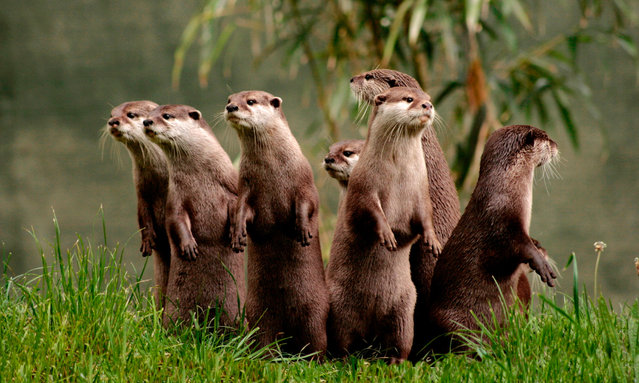
These Eurasian Otters seem ready for any danger as they all stand up on thier hind legs alert to any threats near to the English river bank. Amateur photographer and retired MOD worker Tony Moir, 57, spotted the otters whilst looking for kingfishers to photograph near the river Trent in East Yorkshire, UK. He was able to take just a couple of pictures before the excited animals spotted the photographer and ran away. (Photo by Tony Moir/Solent News)
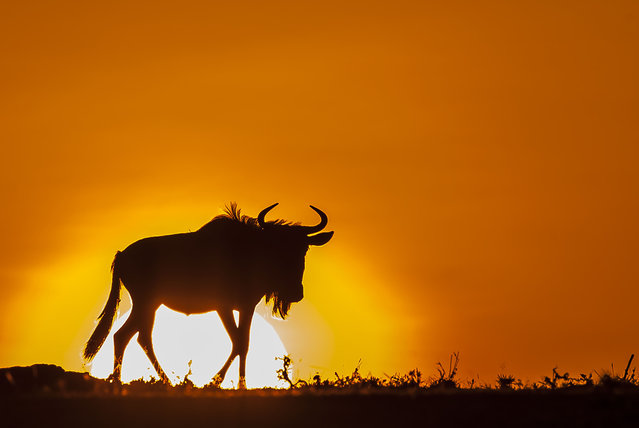
These images show off some of the world's most majestic creatures silhouetted against the beautiful rising and setting sun. The vibrant pictures feature a variety of animals in the wild and were taken by a host of photographers at locations around the world. The striking images all have one thing in common: the photographers' awe-inspiring ability to perfectly capture the silhouettes of earth's beautiful creatures. Here: a blue wildebeest moves through grassland at dawn with the sun in the background in Mara Naboisho Conservancy, Kenya, Africa. (Photo by Renato Granieri/Caters News/Ardea)
Doris Dean of Chicago, Ill., sits with her gun shortly after she won a 50 meter, 40-shot event for women with a perfect 400 score at the National Rifle Association (NRA) matches at Camp Perry, near Toledo, Ohio, September 7, 1941. (Photo by AP Photo/DW)
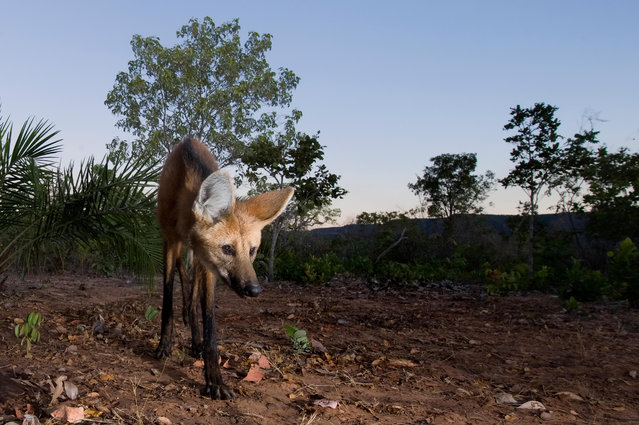
Global wildlife populations will decline by 67% by 2020 unless urgent action is taken to reduce human impact on species and ecosystems, warns the biennial Living Planet Index report from WWF (World Wide Fund for Nature) and ZSL (Zoological Society of London). From elephants to eels, here are some of the wildlife populations most affected by human activity. Here: The maned wolf is among the large mammals in the Brazilian Cerrado that are threatened by the increasing conversion of grasslands into farmland for grazing and growing crops. (Photo by Ben Cranke/Nature Picture Library/Alamy Stock Photo)
Cute sеxy caucasian brunette young woman dressed as Mrs. Santa Claus, smiling with joy, biting a candy cane with eyes closed, Christmas or New Years Eve 2022 concept. (Photo by Cryptographer/Rex Features/Shutterstock)