Loading...
Done


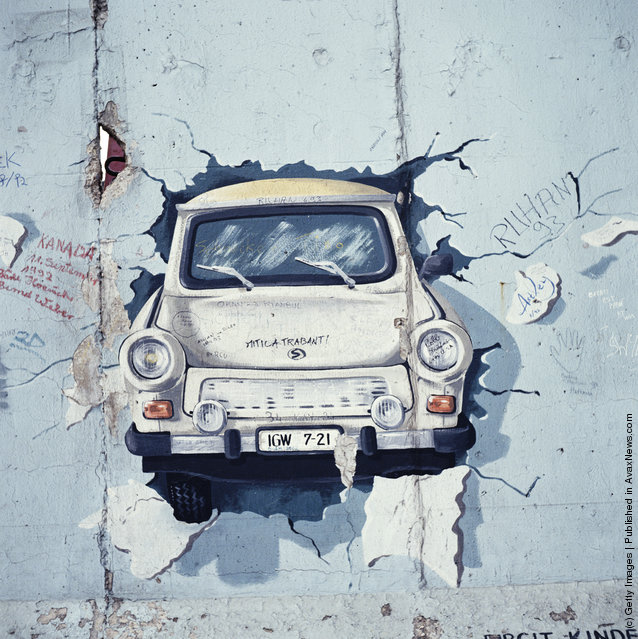
A painting of a Trabant car bursting through a wall in post unification Berlin, August 1993. (Photo by Steve Eason/Hulton Archive/Getty Images)
Details
27 Mar 2011 11:02:00
Artists watch burning an effigy of Lady Maslenitsa as they celebrate Maslenitsa, or Pancake Week, in Baikonur, Kazakhstan, March 13, 2016. (Photo by Shamil Zhumatov/Reuters)

Artists watch burning an effigy of Lady Maslenitsa as they celebrate Maslenitsa, or Pancake Week, in Baikonur, Kazakhstan, March 13, 2016. Maslenitsa is widely viewed as a pagan holiday marking the end of winter and is celebrated with pancake eating and shows of strength, while the Orthodox Church considers it as the week of feasting before Lent. (Photo by Shamil Zhumatov/Reuters)
Details
14 Mar 2016 10:37:00
“The ripening crops eloquently signify that the scarecrow’s work is done. Few remain to see their task fulfilled because if they become entangled in the harvesting machinery it causes serious damage”. (Photo by Colin Garratt)

When Colin Garratt went to photograph the traditional sentinels of the British countryside, he found they ranged from the dapper to the downright sinister. “They are not from the anaesthetised world of the craft fair”, says Colin Garratt, “but are the direct descendants of the ancient spectres which have haunted the landscape for centuries”. The Scarecrow Exhibition is at Geddes Gallery, London, from 25 to 30 March. (Photo by Colin Garratt)
Details
29 Mar 2016 11:46:00
Italian artist Maurizio Cattelan poses with his creation “Him” (2001) prior to the opening of the exhibition “Not Afraid of Love” at the Hotel de la Monnaie in Paris, France, October 17, 2016. (Photo by Philippe Wojazer/Reuters)

Italian artist Maurizio Cattelan poses with his creation “Him” (2001) prior to the opening of the exhibition “Not Afraid of Love” at the Hotel de la Monnaie in Paris, France, October 17, 2016. From October 21, 2016 to January 8, 2017, “Not Afraid of Love”, curated by Chiara Parisi, director of Cultural Programs, sets Maurizio Cattelan’s “comeback at work” in one of the most beautiful Palaces on the river Seine. (Photo by Philippe Wojazer/Reuters)
Details
18 Oct 2016 12:17:00
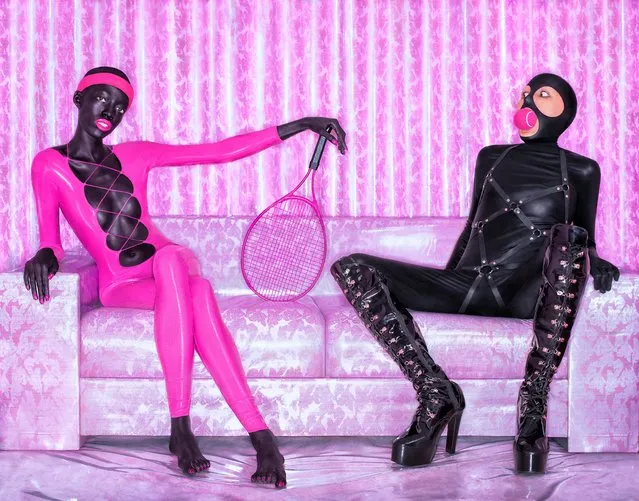
Black women in Brazil sit at the intersection of racism and misogyny, and have in recent years been at the forefront of a movement that challenges issues ranging from sexual and domestic violence to police brutality and stereotyping. Kolor Collective considers itself to be a part of this movement and questions expectations imposed on black women with satirical and subversive images, as seen here. (Photo by Kolor Art Collective/The Guardian)

Photographer Pol Kurucz’s vivid collection of photos explores issues faced by black Brazilian women, from political misrepresentation to unrealistic beauty standards. Kolor Collective is a Rio de Janeiro-based creative group that challenges the struggle faced by black women in Brazil through theatrical and provocative art. It was founded in 2015 by Franco-Hungarian photographer Pol Kurucz, who often touches on his own experiences of discrimination to call out sensitive social problems. (Photo by Kolor Art Collective/The Guardian)
Details
28 Dec 2016 07:24:00
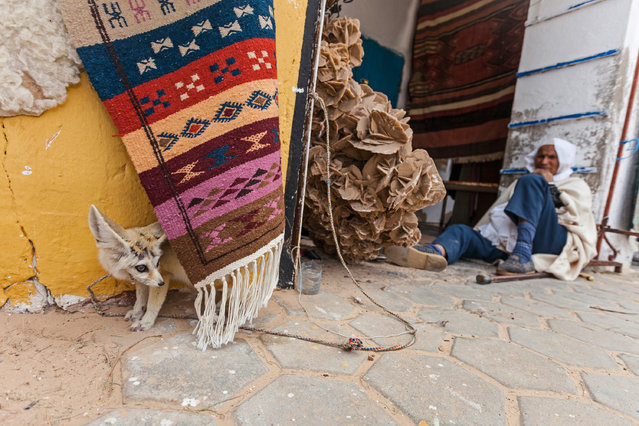
Sultan, a famous captive fennec that is displayed tied on a rope in front of a tourist shop, is the main attraction in the souk of Douz, a desert town in Tunisia. By the display of such a charismatic animal, tourists are often lured to buy things or pay for pictures. On inquiry, although Sultan has been caught as a pup in the wild, the owners of the shop reassure the foreigners stating that the animal is ‘domestic’. (Photo by Bruno D’Amicis/Fritz Pölking Prize/GDT EWPY 2015)

Sultan, a famous captive fennec that is displayed tied on a rope in front of a tourist shop, is the main attraction in the souk of Douz, a desert town in Tunisia. By the display of such a charismatic animal, tourists are often lured to buy things or pay for pictures. On inquiry, although Sultan has been caught as a pup in the wild, the owners of the shop reassure the foreigners stating that the animal is ‘domestic’. (Photo by Bruno D’Amicis/Fritz Pölking Prize/GDT EWPY 2015)
Details
23 Nov 2015 08:02:00
A racegoers cheers on her horse in Race 4 ahead of the race of the Melbourne Cup at Flemington Racecourse in Melbourne, Australia, Tuesday, November 7, 2017. (Photo by Andy Brownbill/AP Photo)

A racegoers cheers on her horse in Race 4 ahead of the race of the Melbourne Cup at Flemington Racecourse in Melbourne, Australia, Tuesday, November 7, 2017. (Photo by Andy Brownbill/AP Photo)
Details
07 Nov 2017 08:17:00
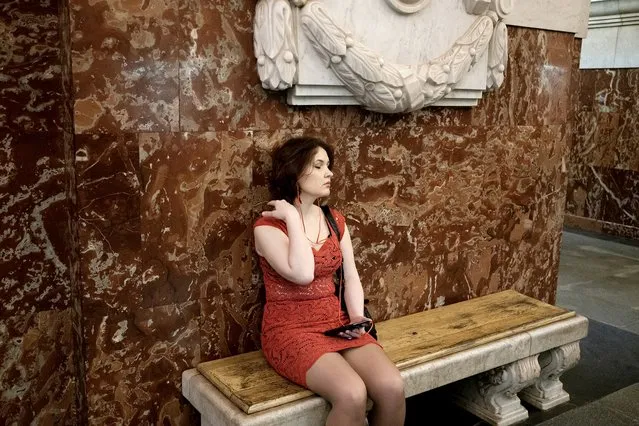
At the Krasnopresnenskaya station, the benches come from the Cathedral of Christ-Sauveur, which was built from 1839 to 1883 in memory of the victory of Russia against the army of Napoleon I. The cathedral was destroyed under Stalin in 1931, but the benches remained intact. Metro architects decided to install them in some stations. (Photo by Didier Bizet/The Washington Post)

At the Krasnopresnenskaya station, the benches come from the Cathedral of Christ-Sauveur, which was built from 1839 to 1883 in memory of the victory of Russia against the army of Napoleon I. The cathedral was destroyed under Stalin in 1931, but the benches remained intact. Metro architects decided to install them in some stations. (Photo by Didier Bizet/The Washington Post)
Details
24 Jan 2018 06:23:00