Loading...
Done
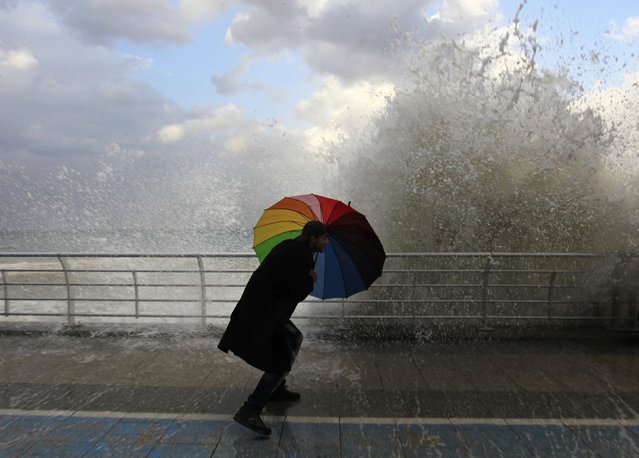
A man plays in front of a wave crashing into Beirut's Corniche, a seaside promenade, as high winds sweep through Lebanon ahead of an impending storm January 6, 2015. (Photo by Jamal Saidi/Reuters)

A man plays in front of a wave crashing into Beirut's Corniche, a seaside promenade, as high winds sweep through Lebanon ahead of an impending storm January 6, 2015. (Photo by Jamal Saidi/Reuters)
Details
02 Feb 2015 11:11:00
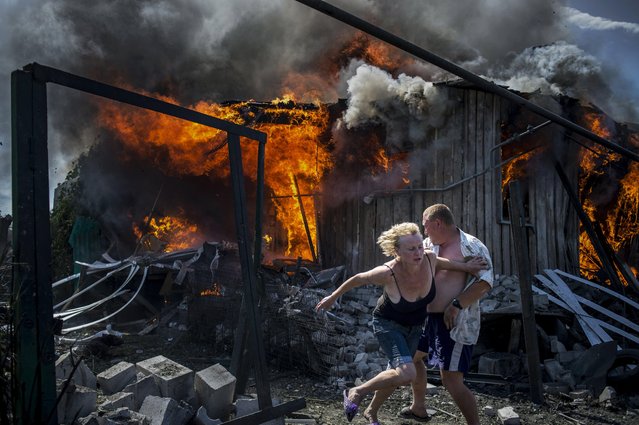
A handout photo made available by the World Press Photo (WPP) organization on 13 February 2017 shows a picture by Rossiya Segodnya photographer Valery Melnikov that won the Long-Term Projects – First Prize award of the 60th annual World Press Photo Contest, it was announced by the WPP Foundation in Amsterdam, The Netherlands on 13 February 2017. Caption: Civilians escape from a fire at a house destroyed by an air attack in the Luhanskaya village. Story: Ordinary people became victims of the conflict between self-proclaimed republics and the official Ukrainian authorities from 2014 onwards in the region of Donbass. Disaster came into their lives unexpectedly. These people were involved in the military confrontation against their will. They experienced the most terrible things: the death of their friends and relatives, destroyed homes and the ruined lives of thousands of people. (Photo by Valery Melnikov/EPA/Rossiya Segodnya/World Press Photo)

A handout photo made available by the World Press Photo (WPP) organization on 13 February 2017 shows a picture by Rossiya Segodnya photographer Valery Melnikov that won the Long-Term Projects – First Prize award of the 60th annual World Press Photo Contest, it was announced by the WPP Foundation in Amsterdam, The Netherlands on 13 February 2017. Caption: Civilians escape from a fire at a house destroyed by an air attack in the Luhanskaya village. (Photo by Valery Melnikov/EPA/Rossiya Segodnya/World Press Photo)
Details
15 Feb 2017 00:06:00
A student uses a ruler to measure the distance between forks before a formal dinner at The International Butler Academy China on September 16, 2014 in Chengdu, China. (Photo by Taylor Weidman/Getty Images)

A student uses a ruler to measure the distance between forks before a formal dinner at The International Butler Academy China on September 16, 2014 in Chengdu, China. Over the last several years, there has been a surge in demand among China's wealthy for Western-trained butlers, with many academies seeing large portions of their graduating classes hired by Chinese families or companies. (Photo by Taylor Weidman/Getty Images)
Details
18 Sep 2014 11:13:00
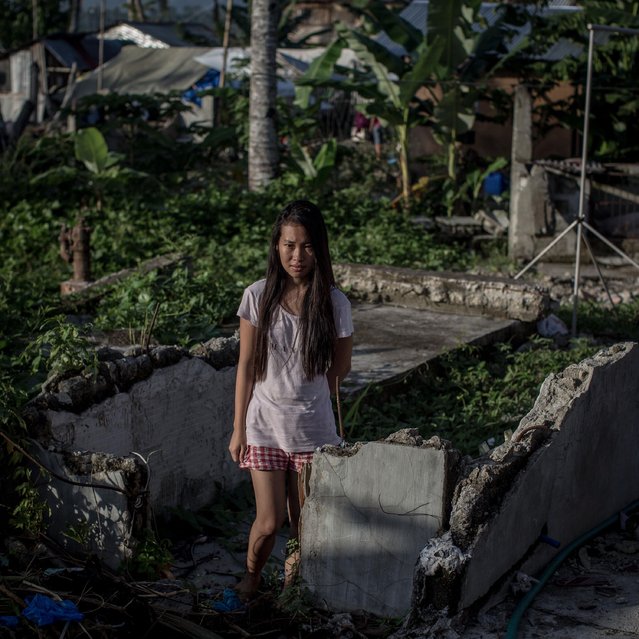
Typhoon Haiyan survivor Mariena Delacueva stands amongst the ruins of her families home on November 6, 2014 in San Antonio, Samar, Philippines. Mariena's looks after the property after her parents moved to Manila to find work so they can save enough money to rebuild the house. (Photo by Chris McGrath/Getty Images)

Typhoon Haiyan survivor Mariena Delacueva stands amongst the ruins of her families home on November 6, 2014 in San Antonio, Samar, Philippines. Mariena's looks after the property after her parents moved to Manila to find work so they can save enough money to rebuild the house. Residents of Leyte and surrounds are preparing for the 1-year anniversary since Super Typhoon Yolanda struck the coast on November 8, 2013, leaving more than 6000 dead and many more homeless. (Photo by Chris McGrath/Getty Images)
Details
11 Nov 2014 11:59:00
Seljalandsfoss waterfall, located in Iceland. (Photo by HotSpot Media)

Seljalandsfoss waterfall, located in Iceland. Seljalandsfoss is one of the most famous waterfalls of Iceland. This waterfall of the river Seljalandsá drops 60 metres (200 ft) over the cliffs of the former coastline. It's possible to go behind the waterfall. (Photo by HotSpot Media)
Details
16 Apr 2014 12:54:00
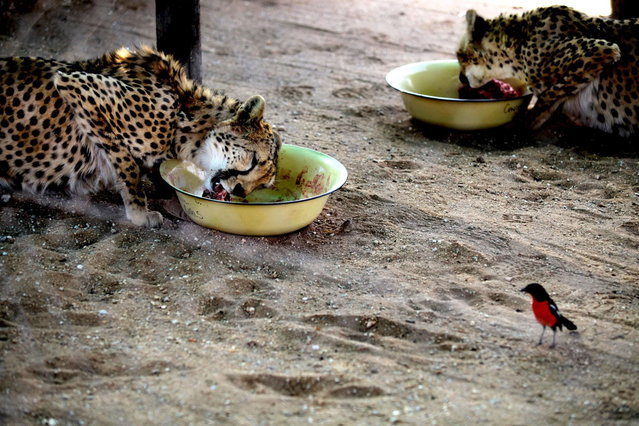
Young cheetahs eat meat at The Cheetah Conservation Fund (CCF) center in Otjiwarongo, Namibia, on August 13, 2013. The CCF started breeding Anatolian livestock dogs to promote cheetah-friendly farming after some 10,000 big cats – the current total worldwide population – were killed or moved off farms in the 1980s.  Up to 1,000 cheetahs were being killed a year, mostly by farmers who saw them as livestock killers. But the use of dogs has slashed losses for sheep and goat farmers and led to less retaliation against the vulnerable cheetah. (Photo by Jennifer Bruce/AFP Photo)

Young cheetahs eat meat at The Cheetah Conservation Fund (CCF) center in Otjiwarongo, Namibia, on August 13, 2013. The CCF started breeding Anatolian livestock dogs to promote cheetah-friendly farming after some 10,000 big cats – the current total worldwide population – were killed or moved off farms in the 1980s. Up to 1,000 cheetahs were being killed a year, mostly by farmers who saw them as livestock killers. But the use of dogs has slashed losses for sheep and goat farmers and led to less retaliation against the vulnerable cheetah. (Photo by Jennifer Bruce/AFP Photo)
Details
29 Aug 2013 10:56:00
Uranjargal, a leader of the Mongolian neo-Nazi group Tsagaan Khass, stands next to a statue of Chingunjav, a Mongolian national hero, in Ulan Bator June 22, 2013. (Photo by Carlos Barria/Reuters)

Uranjargal, a leader of the Mongolian neo-Nazi group Tsagaan Khass, stands next to a statue of Chingunjav, a Mongolian national hero, in Ulan Bator June 22, 2013. The group has rebranded itself as an environmentalist organisation fighting pollution by foreign-owned mines, seeking legitimacy as it sends Swastika-wearing members to check mining permits. Over the past years, ultra-nationalist groups have expanded in the country and among those garnering attention is Tsagaan Khass, which has recently shifted its focus from activities such as attacks on women it accuses of consorting with foreign men to environmental issues, with the stated goal of protecting Mongolia from foreign mining interests. This ultra-nationalist group was founded in the 1990s and currently has 100-plus members. (Photo by Carlos Barria/Reuters)
Details
09 Jul 2013 07:23:00


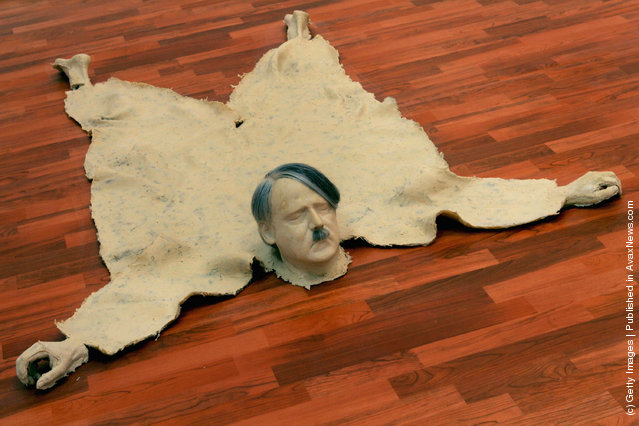
A silicon rug in the form of Adolph Hitler on display during an exhibition by Israeli artist Boaz Arad, at the Center for Contemporary Art February 22, 2007 in Tel Aviv, Israel. Arad is an Israeli artist who is dealing with the Holocaust in a provocative way. He uses the Holocaust to discuss human evil and contemporary Israel, which he says is torn and crumbling. (Photo by David Silverman/Getty Images)
Details
29 Mar 2011 11:51:00