Loading...
Done
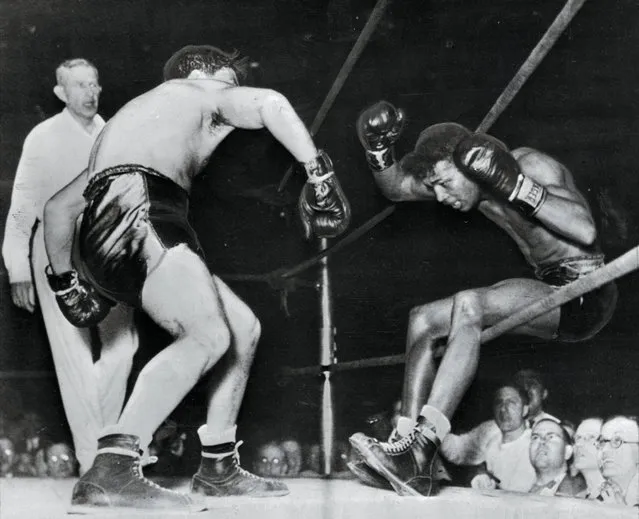
Victorious in 129 successive fights, including 40 as a pro, Ray Robinson falls through the ropes of a ring, under the impact of Jake LaMotta's fists on Olympia Stadium, Detroit, Michigan on February 5, 1943. Robinson got back in the ring, but lost the decision in ten rounds. LaMotta pummelled him for the rest of the fight, winning via a unanimous decision, giving Robinson the first defeat of his career.They fought again just 21 days later when Robinson regained his mantle winning in another 10-round fight, Robinson won the close fight by a unanimous decision. LaMotta stated the bout was gifted to Robinson because he would be inducted into the army the next day. (Photo by Bettmann Archive/Getty Images)

Victorious in 129 successive fights, including 40 as a pro, Ray Robinson falls through the ropes of a ring, under the impact of Jake LaMotta's fists on Olympia Stadium, Detroit, Michigan on February 5, 1943. Robinson got back in the ring, but lost the decision in ten rounds. LaMotta pummelled him for the rest of the fight, winning via a unanimous decision, giving Robinson the first defeat of his career.They fought again just 21 days later when Robinson regained his mantle winning in another 10-round fight, Robinson won the close fight by a unanimous decision. LaMotta stated the bout was gifted to Robinson because he would be inducted into the army the next day. (Photo by Bettmann Archive/Getty Images)
Details
21 Sep 2017 09:11:00
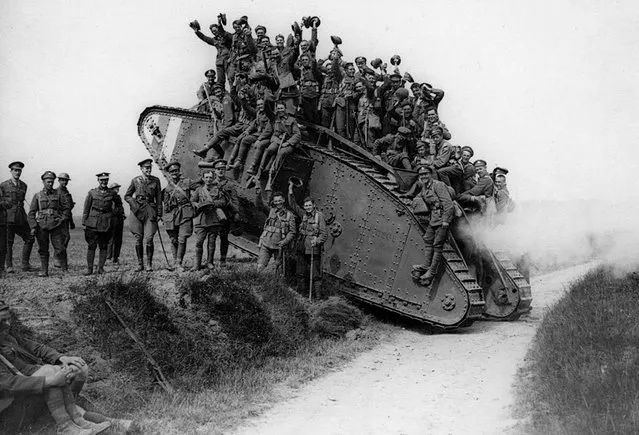
These black-and-white photos are taken from the new book “Armoured Warfare in the First World War 1916 – 1918” by Anthony Tucker-Jones and published by Pen & Sword Military. “Interestingly the British, French and Germans took completely different approaches with varying results”. The British military produced “Little Willie” in Autumn 1915 weighing 18 tonnes, which had a crew of two plus four gunners. “Inspired by a tracked artillery tractor “Little Willie” was referred to as a water tank – hence the name tank – to ensure secrecy”, said Anthony. “This led to the strange looking Mark I with its peculiar rhomboid shape, designed to cross trenches with guns in sponsons on either side. The Germans saw the tank as unchivalrous and were slow to grasp its utility. They favoured the Stormtrooper (specialist soldiers used to infiltrate enemy trenches) and artillery, not the tank”, said Anthony. “However, they didn’t hesitate to make use of captured British tanks. Although the tank helped secure victory and German soldiers dubbed it “Germany’s Downfall” the country was ultimately brought to its knees by the Allies blockade”. Here: British troops hitch a ride on a Mark IV after the massed tank fleet spearheading attack at Cambrai on November 20, 1917. (Photo by Anthony Tucker-Jones/Mediadrumworld.com)

These black-and-white photos are taken from the new book “Armoured Warfare in the First World War 1916 – 1918” by Anthony Tucker-Jones and published by Pen & Sword Military. Here: British troops hitch a ride on a Mark IV after the massed tank fleet spearheading attack at Cambrai on November 20, 1917. (Photo by Anthony Tucker-Jones/Mediadrumworld.com)
Details
23 Feb 2017 00:02:00
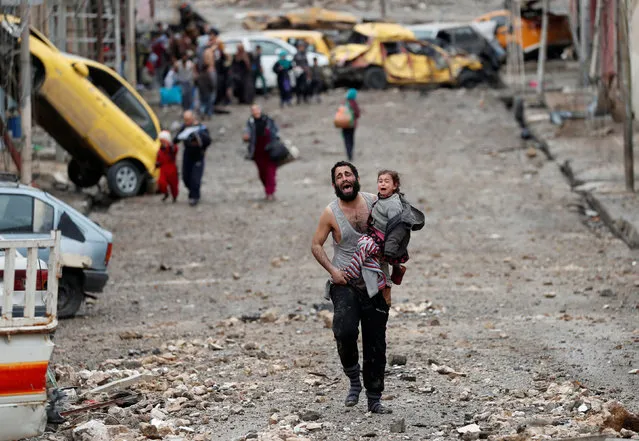
A man cries as he carries his daughter while walking from an Islamic State-controlled part of Mosul towards Iraqi special forces soldiers during a battle in Mosul, Iraq March 4, 2017. Reuters Photographer Goran Tomasevic: “Both screaming in terror, a father and the young daughter he cradled in his arm fled through the rubble-strewn streets of Wadi Hajar, transformed in a flash into a battleground between Islamic State fighters and Iraqi special forces. They and their neighbours – some wearing rubber sandals, some barefoot –  were running from an IS counter-attack in this part of Mosul, dodging gunfire as the militants closed in”. (Photo by Goran Tomasevic/Reuters)

A man cries as he carries his daughter while walking from an Islamic State-controlled part of Mosul towards Iraqi special forces soldiers during a battle in Mosul, Iraq March 4, 2017. Reuters Photographer Goran Tomasevic: “Both screaming in terror, a father and the young daughter he cradled in his arm fled through the rubble-strewn streets of Wadi Hajar, transformed in a flash into a battleground between Islamic State fighters and Iraqi special forces. They and their neighbours – some wearing rubber sandals, some barefoot – were running from an IS counter-attack in this part of Mosul, dodging gunfire as the militants closed in”. (Photo by Goran Tomasevic/Reuters)
Details
13 Mar 2017 00:02:00
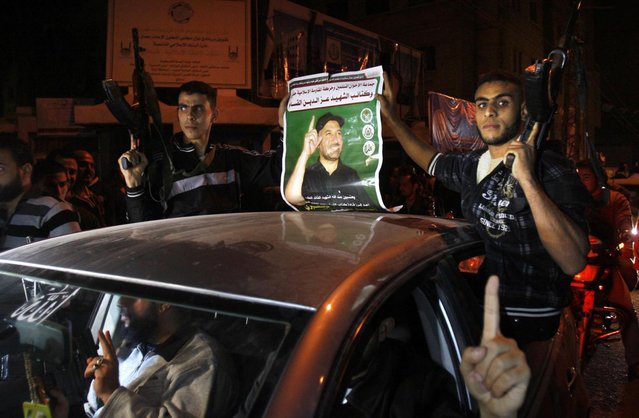
Palestinian gunmen hold a poster of late Ahmed Jabari, head of the Hamas military wing in Gaza City, while they celebrate the cease-fire agreement between Israel and Hamas in Gaza City, Wednesday, November 21, 2012. Israel and the Hamas militant group agreed to a cease-fire Wednesday to end eight days of the fiercest fighting in nearly four years, promising to halt attacks on each other and ease an Israeli blockade constricting the Gaza Strip. (Photo by Adel Hana/AP)

“News of a ceasefire is greeted by wild celebrations on the streets of Gaza, whilst Israeli residents of Jerusalem and Tel Aviv are more cautious in their support for the peace deal”. – Reuters

Photo: Palestinian gunmen hold a poster of late Ahmed Jabari, head of the Hamas military wing in Gaza City, while they celebrate the cease-fire agreement between Israel and Hamas in Gaza City, Wednesday, November 21, 2012. Israel and the Hamas militant group agreed to a cease-fire Wednesday to end eight days of the fiercest fighting in nearly four years, promising to halt attacks on each other and ease an Israeli blockade constricting the Gaza Strip. (Photo by Adel Hana/AP)
Details
22 Nov 2012 10:59:00


A five-month-old female slender loris waits to be given her first health check by the veterinary team at London Zoo on July 21, 2011 in London, England. Two female baby slender lorises, who are yet to be named, were given health checks, their s*x determined and micro-chipped. Slender Loris is the common name for the strepsirrhine primates who are nocturnal and originate from India, Sri Lanka, and southeast Asia. London Zoo supports conservation of lorises in Sri Lanka, where populations are thought to be under threat from deforestation. (Photo by Christopher Furlong/Getty Images)
Details
22 Jul 2011 11:38:00
Honorable Mention by Emre Can Alagöz, Istanbul, Turkey: The eyes of a jumping spider, magnified 6x. (Photo by Emre Can Alagöz/2017 Nikon Small World Photomicrography Competition)

A competition, now in its 43rd year, dedicated to showcasing the beautiful and bizarre as seen under a light microscope attracted over 2,000 entries from 88 countries. Here: Honorable Mention by Emre Can Alagöz, Istanbul, Turkey: The eyes of a jumping spider, magnified 6x. (Photo by Emre Can Alagöz/2017 Nikon Small World Photomicrography Competition)
Details
09 Oct 2017 07:52:00
A guest poses for photographs at the infinity pool of the newly-inaugurated Dolce Hanoi Golden Lake hotel, the world's first gold-plated hotel, in Hanoi on July 2, 2020. (Photo by Manan Vatsyayana/AFP Photo)

A guest poses for photographs at the infinity pool of the newly-inaugurated Dolce Hanoi Golden Lake hotel, the world's first gold-plated hotel, in Hanoi on July 2, 2020. It even has a gold-plated infinity pool on the roof. The 400-room, 25-storey property will operate under the American Wyndham Hotels brand. Prices start at $300 a night for rooms, or there are apartments to rent costing from $6400 per square metre. (Photo by Manan Vatsyayana/AFP Photo)
Details
04 Jul 2020 00:05:00
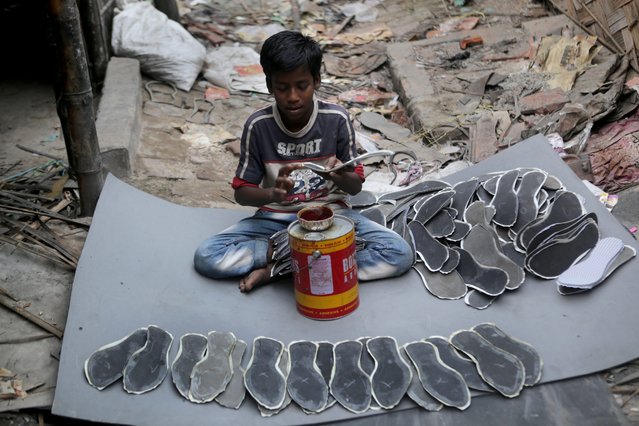
Indian boy Hassan Malik works in a leather shoe factory at Topsia in Calcutta, eastern India, 19 November 2013. (Photo by Piyal Adhikary/EPA)

Indian boy Hassan Malik works in a leather shoe factory at Topsia in Calcutta, eastern India, 19 November 2013. The leather industry occupies an important place in the Indian economy. It is an employment intensive sector with a vast potential for growth and exports but also a pollution intensive industry that relies on cheap labor. One of the major production centers for leather and leather products is located in Calcutta, West Bengal. Hundreds of tanneries are operated in the city’s Tiljala, Topsia and Tangra districts. They are mostly run by local families living and working under poor conditions. (Photo by Piyal Adhikary/EPA)
Details
20 Mar 2014 09:40:00