Loading...
Done
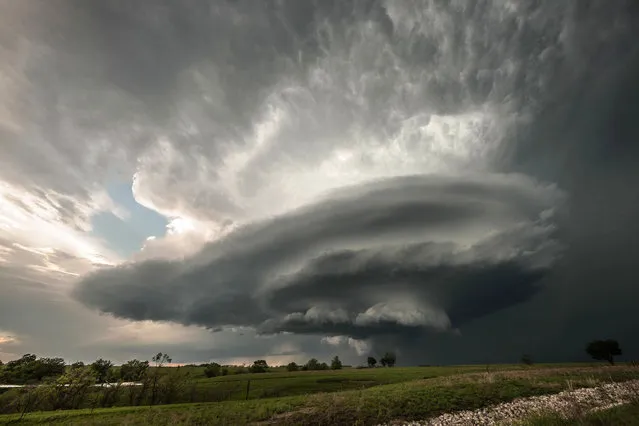
The rotating updraft base of a supercell thunderstorm, and a rear flank downdraft containing rain and hail, backlit by the setting sun, on May 10, 2014, in Climax, Kansas, United States. To most of us, dark clouds on the horizon usually means rain – but here in Kansas, they can also signal the start of a supercell. The huge formations, also known as rotating thunderstorms, are among the most powerful weather phenomenon found over land. (Photo by Stephen Locke/Barcroft Media)

The rotating updraft base of a supercell thunderstorm, and a rear flank downdraft containing rain and hail, backlit by the setting sun, on May 10, 2014, in Climax, Kansas, United States. To most of us, dark clouds on the horizon usually means rain – but here in Kansas, they can also signal the start of a supercell. The huge formations, also known as rotating thunderstorms, are among the most powerful weather phenomenon found over land. They can occur anywhere where the conditions are right, but are normally found in more arid climates. These awe-inspiring supercells were captured south of Climax city by storm chaser Stephen Locke. (Photo by Stephen Locke/Barcroft Media)
Details
18 Jul 2014 12:01:00
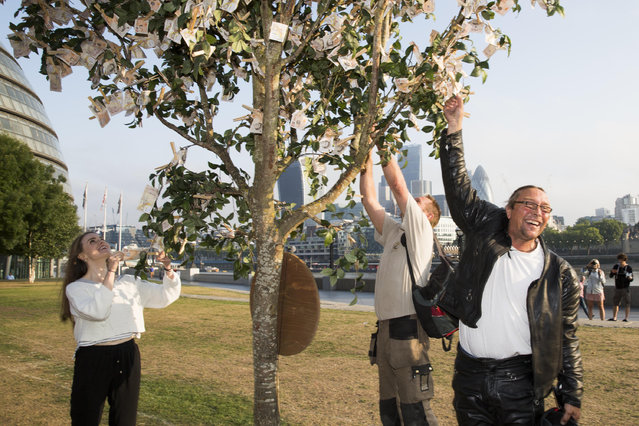
Londoners walking through Potters Field Park were surprised to see a “money tree” blooming with £9820 in £10 notes, the average amount a working British family has in savings, on July 24, 2014 in London, England. The tree was planted by Sunlife to encourage the nation to start saving at least £10 a month for a brighter future. (Photo by Tristan Fewings/Getty Images for SunLife)

Londoners walking through Potters Field Park were surprised to see a “money tree” blooming with £9820 in £10 notes, the average amount a working British family has in savings, on July 24, 2014 in London, England. The tree was planted by Sunlife to encourage the nation to start saving at least £10 a month for a brighter future. (Photo by Tristan Fewings/Getty Images for SunLife)
Details
25 Jul 2014 11:50:00
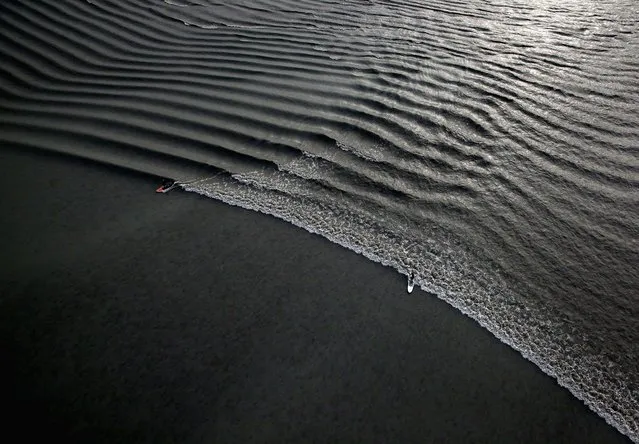
A group of surfers ride the Bore Tide at Turnagain Arm on July 15, 2014 in Anchorage, Alaska. Alaskas most famous Bore Tide, occurs in a spot on the outside of Anchorage in the lower arm of the Cook Inlet, Turnagain Arm, where wave heights can reach 6-10 feet tall, move at 10-15 mph and the water temperature stays around 40 degrees farenheit. This years Supermoon substantially increased the size of the normal wave and made it a destination for surfers. (Photo by Streeter Lecka/Getty Images)

A group of surfers ride the Bore Tide at Turnagain Arm on July 15, 2014 in Anchorage, Alaska. Alaskas most famous Bore Tide, occurs in a spot on the outside of Anchorage in the lower arm of the Cook Inlet, Turnagain Arm, where wave heights can reach 6-10 feet tall, move at 10-15 mph and the water temperature stays around 40 degrees farenheit. This years Supermoon substantially increased the size of the normal wave and made it a destination for surfers. (Photo by Streeter Lecka/Getty Images)
Details
05 Aug 2014 12:08:00
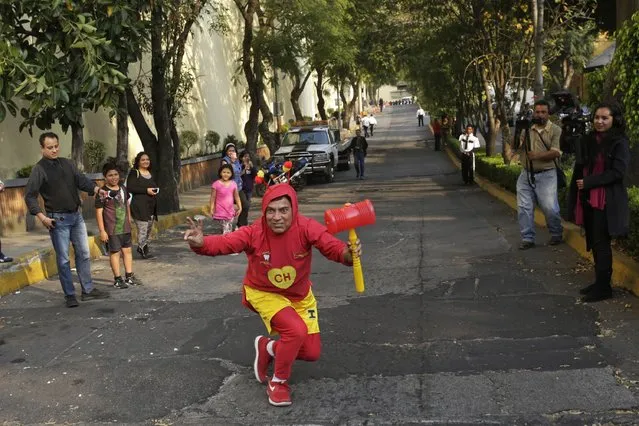
A man dressed as “El Chapulin Colorado”, a character by screenwriter Roberto Gomez Bolanos, performs for fans and media as they wait for the arrival of the funeral van carrying the body of Bolanos, at Mexican media company Televisa in Mexico City November 29, 2014. (Photo by Carlos Jasso/Reuters)

A man dressed as “El Chapulin Colorado”, a character by screenwriter Roberto Gomez Bolanos, performs for fans and media as they wait for the arrival of the funeral van carrying the body of Bolanos, at Mexican media company Televisa in Mexico City November 29, 2014. Mexican actor and screenwriter Roberto Gomez Bolanos, one of Latin America's most beloved comedians, whose slapstick acts charmed fans from Spain to Argentina for over four decades, died on Friday at the age 85. Known as “Chespirito”, a word play on “Little Shakespeare” for his diminutive stature and his prolific scripts, Gomez Bolanos created some of the region's most enduring comic characters. (Photo by Carlos Jasso/Reuters)
Details
01 Dec 2014 13:50:00
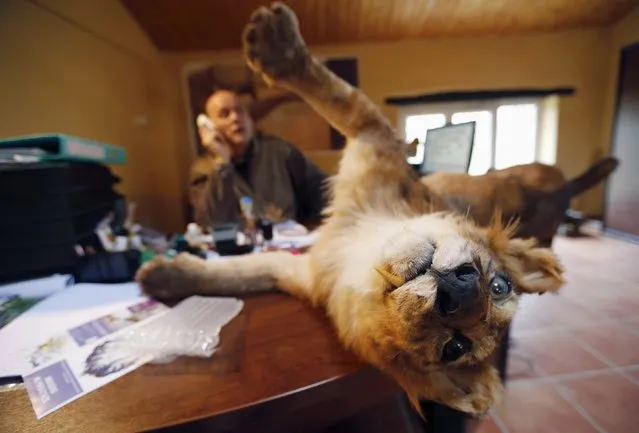
Belgian animal sculptor Emmanuel Janssens Casteels works at his desk next to a replica of a Smilodon, an extinct genus of machairodont felid, in his workshop in Prayssas December 3, 2014. Casteels' company OPHYS specializes in life-size reconstructions and the sculpting or moulding reproductions of animals and hyper-realist fossils. His reconstructions are exhibited in museums and theme parks. (Photo by Regis Duvignau/Reuters)

Belgian animal sculptor Emmanuel Janssens Casteels works at his desk next to a replica of a Smilodon, an extinct genus of machairodont felid, in his workshop in Prayssas December 3, 2014. Casteels' company OPHYS specializes in life-size reconstructions and the sculpting or moulding reproductions of animals and hyper-realist fossils. His reconstructions are exhibited in museums and theme parks. (Photo by Regis Duvignau/Reuters)
Details
05 Dec 2014 13:02:00
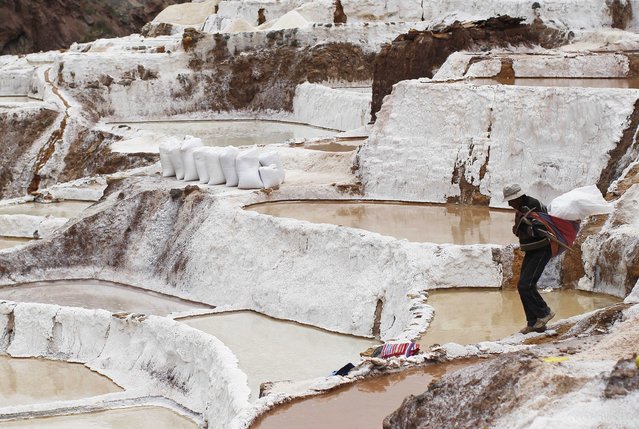
A worker carries a bag of salt after collecting it from a pond at the Maras mines in Cuzco December 3, 2014. Salt has been obtained in Maras since pre-Incan times by evaporating highly salty local subterranean stream water. The water is intricately channelled through constructions, flowing gradually down onto several hundred ancient terraced ponds. (Photo by Enrique Castro-Mendivil/Reuters)

A worker carries a bag of salt after collecting it from a pond at the Maras mines in Cuzco December 3, 2014. Salt has been obtained in Maras since pre-Incan times by evaporating highly salty local subterranean stream water. The water is intricately channelled through constructions, flowing gradually down onto several hundred ancient terraced ponds. From each pond, a local member of the mine cooperative can produce 150 to 200 kilos per month which can be sold in the markets at $0.34 per kilogram, according to miners. (Photo by Enrique Castro-Mendivil/Reuters)
Details
05 Dec 2014 13:36:00
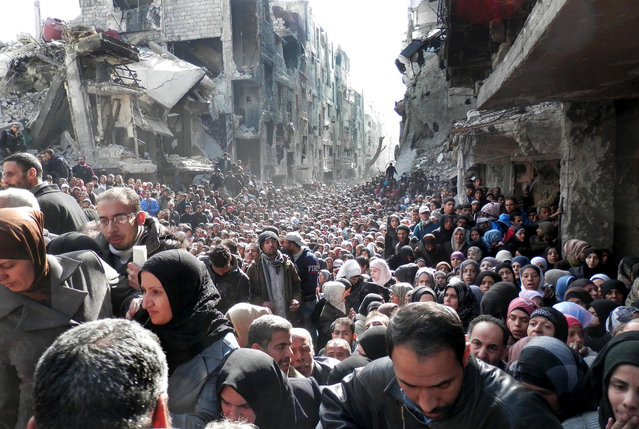
In this January 31, 2014 file photo released by the United Nations Relief and Works Agency for Palestine Refugees in the Near East (UNRWA), shows residents of the besieged Palestinian camp of Yarmouk, queuing to receive food supplies, in Damascus, Syria. That year, the U.N. was able to deliver food to about five percent of people in besieged areas including Yarmouk, while today estimates show the organization is reaching less than one percent. (Photo by UNRWA via AP Photo)

In this January 31, 2014 file photo released by the United Nations Relief and Works Agency for Palestine Refugees in the Near East (UNRWA), shows residents of the besieged Palestinian camp of Yarmouk, queuing to receive food supplies, in Damascus, Syria. That year, the U.N. was able to deliver food to about five percent of people in besieged areas including Yarmouk, while today estimates show the organization is reaching less than one percent. (Photo by UNRWA via AP Photo)
Details
07 Feb 2016 06:36:00
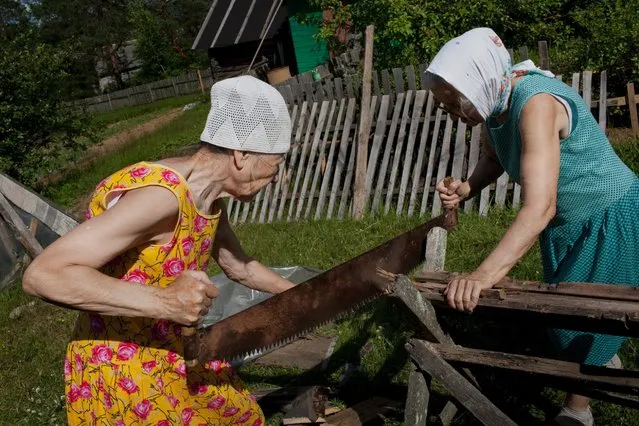
“Two-Handed Saw, 2014”. “Most of the neighbors have switched to power tools to run their households, the buzz of chain saws and weed-whackers overpowering the quieter sounds of country life, but my aunts hold on to the two-handed saw that's decades old, the sickle and scythe that need to be sharpened and polished after each use, the old axe that's becoming heavier each year. Each of these objects is familiar, holding memories of their brother, who succumbed to cancer a few years ago, of days before my grandfather lost his vision in the 50's, of busier days and longer futures”, Sablin told. (Photo by Nadia Sablin)

In northwest Russia, in a small village called Alekhovshchina, Nadia Sablin's aunts spend the warmer months together in the family home and live as the family has always lived, chopping wood to heat the house and making their own clothes. Sablin's book of photographs, “Aunties: The Seven Summers of Alevtina and Ludmila”, is published by Duke University Press. Here: “Two-Handed Saw, 2014”. (Photo by Nadia Sablin)
Details
25 Feb 2016 12:12:00