Loading...
Done
Ecuadorian indigenous people celebrate the festival of the moon or Kulla Raymi, in Quito, Ecuador, 21 September 2021. A circle on the ground made up of fruits and inside the Andean symbol of the chacana, multinational geometric flags and a cross that symbolizes the four cardinal points, were the setting in which the festival of the moon, the Kulla, was commemorated this Tuesday. Raymi, on a hill in Quito. It is one of the four most significant festivities of the Andean agroecological calendar, which commemorates the beginning of life and exalts women as the maximum representation of fertility. (Photo by Jose Jacome/EPA/EFE)

Ecuadorian indigenous people celebrate the festival of the moon or Kulla Raymi, in Quito, Ecuador, 21 September 2021. A circle on the ground made up of fruits and inside the Andean symbol of the chacana, multinational geometric flags and a cross that symbolizes the four cardinal points, were the setting in which the festival of the moon, the Kulla, was commemorated this Tuesday. Raymi, on a hill in Quito. It is one of the four most significant festivities of the Andean agroecological calendar, which commemorates the beginning of life and exalts women as the maximum representation of fertility. (Photo by Jose Jacome/EPA/EFE)
Details
22 Sep 2021 09:01:00
In this photo released by the Israeli military, Emily Damari, right, and her mother, Mandy, embrace near kibbutz Re’im, Israel, after Emily was released from captivity by Hamas militants in Gaza on Sunday, January 19, 2025. Three Israeli hostages and 90 Palestinian prisoners were released as part of the first phase of a long-awaited ceasefire deal between Hamas and Israel. (Photo by Israel Defense Forces)

In this photo released by the Israeli military, Emily Damari, right, and her mother, Mandy, embrace near kibbutz Re’im, Israel, after Emily was released from captivity by Hamas militants in Gaza on Sunday, January 19, 2025. Three Israeli hostages and 90 Palestinian prisoners were released as part of the first phase of a long-awaited ceasefire deal between Hamas and Israel. (Photo by Israel Defense Forces)
Details
29 May 2026 14:21:00
Two young deer seem to look bashfully at the camera after a playfight in Bushy Park, London early February 2023. (Photo by Lesley Marshall/South West News Service)

Two young deer seem to look bashfully at the camera after a playfight in Bushy Park, London early February 2023. (Photo by Lesley Marshall/South West News Service)
Details
12 Feb 2023 02:37:00
A calico sits in its enclosure and suns itself in Hessen, Germany on May 28, 2021. The Opel Zoo presents a walk-in Madagascar aviary for caltas and varis. The primate species is native to Madagascar and is threatened with extinction. (Photo by Andreas Arnold/dpa)

A calico sits in its enclosure and suns itself in Hessen, Germany on May 28, 2021. The Opel Zoo presents a walk-in Madagascar aviary for caltas and varis. The primate species is native to Madagascar and is threatened with extinction. (Photo by Andreas Arnold/dpa)
Details
30 May 2021 09:19:00
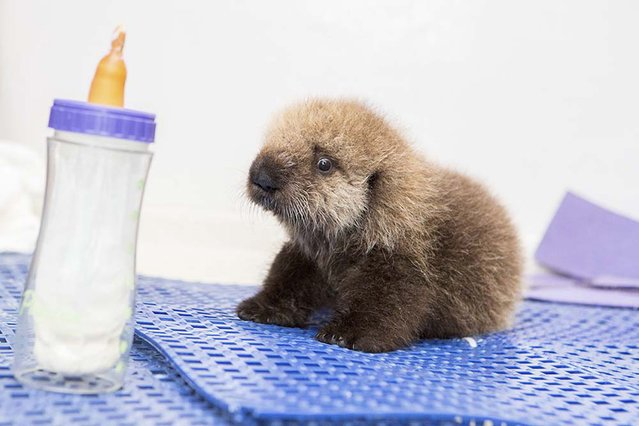
A five-week-old orphaned Southern Sea Otter pup rests on a rubber mat after arriving at the Shedd Aquarium's Abbott Oceanarium in Chicago, Illinois October 28, 2014 in this handout photo provided to Reuters on November 5, 2014. The stranded pup was found on September 30 on Coastways Beach in California and was rescued the next day to be brought back to health at the Monterey Bay Aquarium. (Photo by Brenna Hernandez/Reuters/Shedd Aquarium)

A five-week-old orphaned Southern Sea Otter pup rests on a rubber mat after arriving at the Shedd Aquarium's Abbott Oceanarium in Chicago, Illinois October 28, 2014 in this handout photo provided to Reuters on November 5, 2014. The stranded pup was found on September 30 on Coastways Beach in California and was rescued the next day to be brought back to health at the Monterey Bay Aquarium. Southern sea otters were listed as “threatened” under the U.S. Endangered Species Act in 1977. (Photo by Brenna Hernandez/Reuters/Shedd Aquarium)
Details
08 Nov 2014 13:15:00
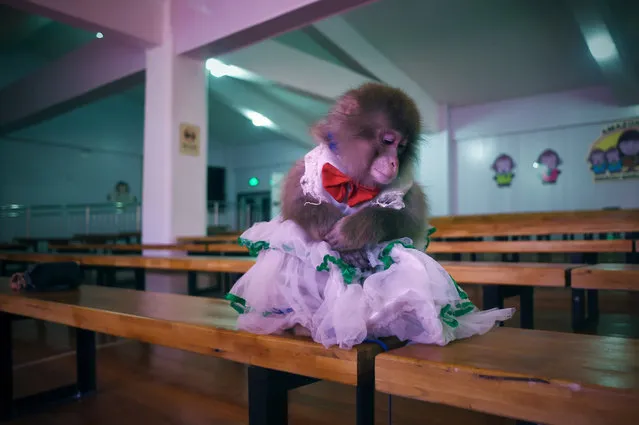
This picture taken on January 26, 2016 shows a monkey sitting on a bench during rehearsal at a monkey training school in a zoo in Dongying, eastern China's Shandong province. Shows featuring performing simians, popular in China and throughout Asia, are expecting a boost in the Lunar New Year of the monkey, which begins on February 8. But they are facing a growing backlash from Chinese people concerned about animal welfare. (Photo by Wang Zhao/AFP Photo)

This picture taken on January 26, 2016 shows a monkey sitting on a bench during rehearsal at a monkey training school in a zoo in Dongying, eastern China's Shandong province. Shows featuring performing simians, popular in China and throughout Asia, are expecting a boost in the Lunar New Year of the monkey, which begins on February 8. But they are facing a growing backlash from Chinese people concerned about animal welfare. (Photo by Wang Zhao/AFP Photo)
Details
09 Feb 2016 13:30:00
Life reconstruction of the new oviraptorosaurian dinosaur species Anzu wyliei in its 66 million-year-old environment in western North America as seen in an undated handout illustration by Mark A. Klinger, Carnegie Museum of Natural History. Some 18,000 species, great and small, were discovered in 2014, adding to the 2 million already known, scientists said on May 21, 2015 as they released a “Top 10” list that highlights the diversity of life. (Photo by Mark A. Klingler/Reuters/Carnegie Museum of Natural History)

Life reconstruction of the new oviraptorosaurian dinosaur species Anzu wyliei in its 66 million-year-old environment in western North America as seen in an undated handout illustration by Mark A. Klinger, Carnegie Museum of Natural History. Some 18,000 species, great and small, were discovered in 2014, adding to the 2 million already known, scientists said on May 21, 2015 as they released a “Top 10” list that highlights the diversity of life. Anzu wyliei, one of the top 10, dubbed “the chicken from hell”, is extinct. The feathered dinosaur whose partial skeletons were unearthed in the Dakotas was a contemporary of T. rex and Triceratops. (Photo by Mark A. Klingler/Reuters/Carnegie Museum of Natural History)
Details
22 May 2015 12:31:00
Astronaut Edward H. White II, pilot for the Gemini-Titan 4 (GT-4) spaceflight, floats in the zero-gravity of space during the third revolution of the GT-4 spacecraft on June 3, 1965. White wears a specially designed spacesuit. His face is shaded by a gold-plated visor to protect him from unfiltered rays of the sun. (Photo by NASA)

Astronaut Edward H. White II, pilot for the Gemini-Titan 4 (GT-4) spaceflight, floats in the zero-gravity of space during the third revolution of the GT-4 spacecraft on June 3, 1965. White wears a specially designed spacesuit. His face is shaded by a gold-plated visor to protect him from unfiltered rays of the sun. In his right hand he carries a Hand-Held Self-Maneuvering Unit (HHSMU) that gives him control over his movements in space. White also wears an emergency oxygen chest pack; and he carries a camera mounted on the HHSMU for taking pictures of the sky, Earth and the GT-4 spacecraft. He is secured to the spacecraft by a 25-feet umbilical line and a 23-feet tether line. Both lines are wrapped together in gold tape to form one cord. Astronaut James A. McDivitt, command pilot, remained inside the spacecraft during the extravehicular activity (EVA). Astronaut White died in the Apollo/Saturn 204 fire at Cape Kennedy on January 27, 1967. (Photo by NASA)
Details
22 Jul 2014 12:05:00