Loading...
Done
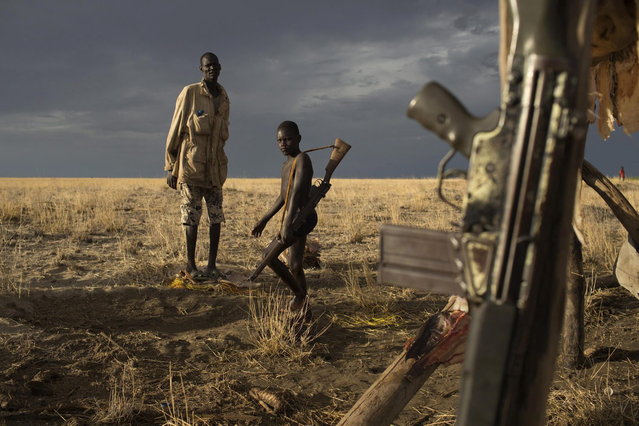
A Turkana man and a boy carrying a gun look on as a G3 battle rifle hangs from a structure used to dry fish at a fishing camp on the shores of Lake Turkana, some kilometres from Todonyang near the Kenya-Ethiopia border in northwestern Kenya October 12, 2013. (Photo by Siegfried Modola/Reuters)

A Turkana man and a boy carrying a gun look on as a G3 battle rifle hangs from a structure used to dry fish at a fishing camp on the shores of Lake Turkana, some kilometres from Todonyang near the Kenya-Ethiopia border in northwestern Kenya October 12, 2013The Turkana are traditionally nomadic pastoralists, but they have seen the pasture that they need to feed their herds suffer from recurring droughts and many have turned to fishing. However, Lake Turkana is overfished, and scarcity of food and pastureland is fuelling long-standing conflict with Ethiopian indigenous Dhaasanac, who have seen grazing grounds squeezed by large-scale government agricultural schemes in southern Ethiopia. The Dhaasanac now venture ever deeper into Kenyan territory in search of fish and grass, clashing with neighbours. Fighting between the communities has a long history, but the conflict has become ever more fatal as automatic weapons from other regional conflicts seep into the area. While the Turkana region is short of basics like grass and ground-water, it contains other resources including oil reserves and massive, newly discovered underground aquifers. (Photo by Siegfried Modola/Reuters)
Details
05 Dec 2013 12:08:00
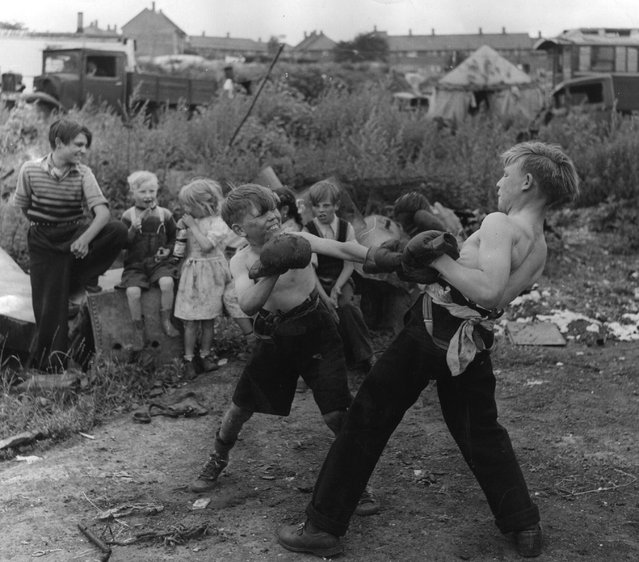
The unromantic gypsies. Children boxing in a gypsy camp in Kent, England on July 1, 1951. Like all boys these gypsy lads like to try their hand at boxing. Encouraged by their friends they fight it out on Corke's Meadow. Few Romanies now live a life of wandering romance. Most are like the three hundred squatters of Corke's Meadow, Kent, which is part of a “gypsy problem” that involves about 100,000 today. Of those about 25,000 can be rightly called gypsies, the rest are Mumpers and Posh-rats and Hobos. Corke's Meadow has both kinds. “Picture Post” cameraman Bert Hardy photographs the Corke's Meadow gypsies in their encampment. (Photo by Hulton-Deutsch Collection/Corbis via Getty Images)

The unromantic gypsies. Children boxing in a gypsy camp in Kent, England on July 1, 1951. Like all boys these gypsy lads like to try their hand at boxing. Encouraged by their friends they fight it out on Corke's Meadow. Few Romanies now live a life of wandering romance. Most are like the three hundred squatters of Corke's Meadow, Kent, which is part of a “gypsy problem” that involves about 100,000 today. Of those about 25,000 can be rightly called gypsies, the rest are Mumpers and Posh-rats and Hobos. Corke's Meadow has both kinds. “Picture Post” cameraman Bert Hardy photographs the Corke's Meadow gypsies in their encampment. (Photo by Hulton-Deutsch Collection/Corbis via Getty Images)
Details
12 Mar 2017 00:01:00
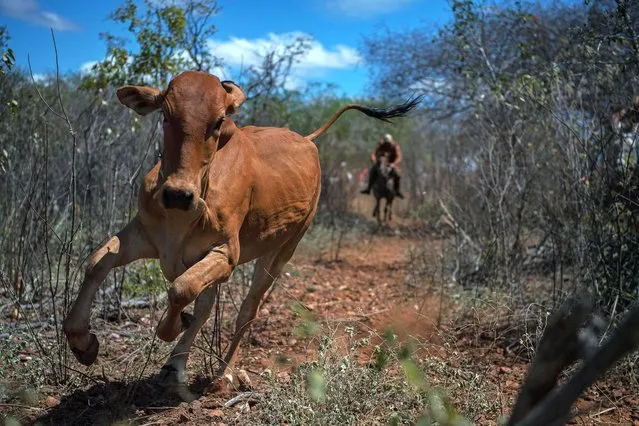
A young bull flees from a Brazilian vaqueiro, or cowboy, competing in the “Pega de Boi” (Ox Catch) tournament in Cabrobo, Pernambuco State, Brazil, on September 4, 2022. The riders compete in pairs to retrieve a cord from a bull which has been released and runs away from them and they are timed on how quickly they can return with the cord. The leather clothing provides them with protection from the dense savannah vegetation which contains a lot of large thorns. Riders have been known to die competing in the tournament (Photo by Carl de Souza/AFP Photo)

A young bull flees from a Brazilian vaqueiro, or cowboy, competing in the “Pega de Boi” (Ox Catch) tournament in Cabrobo, Pernambuco State, Brazil, on September 4, 2022. The riders compete in pairs to retrieve a cord from a bull which has been released and runs away from them and they are timed on how quickly they can return with the cord. The leather clothing provides them with protection from the dense savannah vegetation which contains a lot of large thorns. Riders have been known to die competing in the tournament (Photo by Carl de Souza/AFP Photo)
Details
25 Sep 2022 04:38:00
Rapper Pitbull performs onstage during Nickelodeon's celebration of the new Burbank facility on January 11, 2017 in Los Angeles, California. (Photo by Charley Gallay/Getty Images for Nickelodeon)

Rapper Pitbull performs onstage during Nickelodeon's celebration of the new Burbank facility on January 11, 2017 in Los Angeles, California. (Photo by Charley Gallay/Getty Images for Nickelodeon)
Details
13 Jan 2017 08:55:00
A girl in a vamire costume poses for pictures during the traditional park picnic on the first day of the annual Wave-Gotik Treffen, or Wave and Goth Festival, on May 17, 2013 in Leipzig, Germany. The four-day festival, in which elaborate fashion is a must, brings together over 20,000 Wave, Goth and steam punk enthusiasts from all over the world for concerts, readings, films, a Middle Ages market and workshops. (Photo by Marco Prosch)

A girl in a vamire costume poses for pictures during the traditional park picnic on the first day of the annual Wave-Gotik Treffen, or Wave and Goth Festival, on May 17, 2013 in Leipzig, Germany. The four-day festival, in which elaborate fashion is a must, brings together over 20,000 Wave, Goth and steam punk enthusiasts from all over the world for concerts, readings, films, a Middle Ages market and workshops. (Photo by Marco Prosch)
Details
18 May 2013 12:47:00
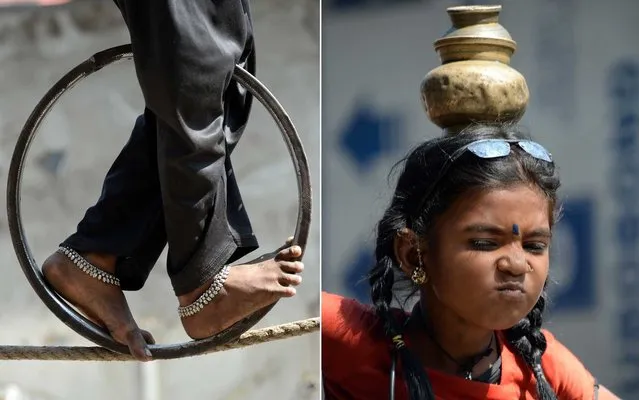
Nine year old girl Barsati reacts while walking on a tightrope in Mumbai on February 11, 2014. Barsati, and her younger brother Rajababu, (4) earn an average of around 2000 rupees (32 dollars) per day from pedestrians and tourists performing various acts on the tightrope near the city's iconic landmark Gateway of India. (Photo by Indranil Mukherjee/AFP Photo)

Nine year old girl Barsati reacts while walking on a tightrope in Mumbai on February 11, 2014. Barsati, and her younger brother Rajababu, (4) earn an average of around 2000 rupees (32 dollars) per day from pedestrians and tourists performing various acts on the tightrope near the city's iconic landmark Gateway of India. (Photo by Indranil Mukherjee/AFP Photo)
Details
15 Feb 2014 12:02:00
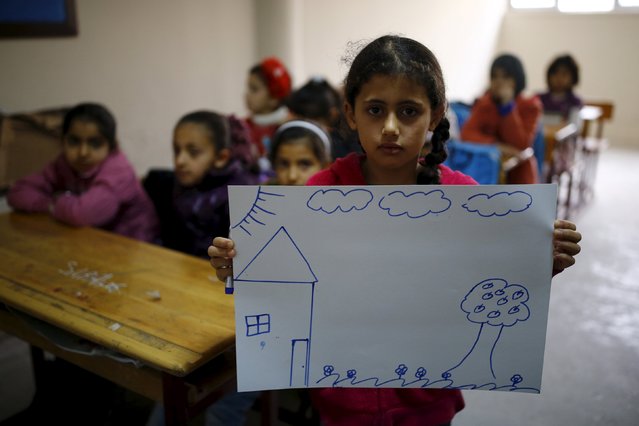
Syrian refugee girl Nur El-Huda, 9, shows a drawing of her home in Syria, in her classroom in Yayladagi refugee camp in Hatay province near the Turkish-Syrian border, Turkey, December 16, 2015. (Photo by Umit Bektas/Reuters)

Syrian refugee girl Nur El-Huda, 9, shows a drawing of her home in Syria, in her classroom in Yayladagi refugee camp in Hatay province near the Turkish-Syrian border, Turkey, December 16, 2015. Syria's conflict has left hundreds of thousands dead, pushed millions more into exile, and had a profound effect on children who lost their homes or got caught up in the bloodletting. The drawings of young refugees living in Turkey show their memories of home and hopes for its future. The pictures also point to the mental scars borne by 2.3 million Syrian refugees living in Turkey, more than half of them children. (Photo by Umit Bektas/Reuters)
Details
16 Jan 2016 08:05:00
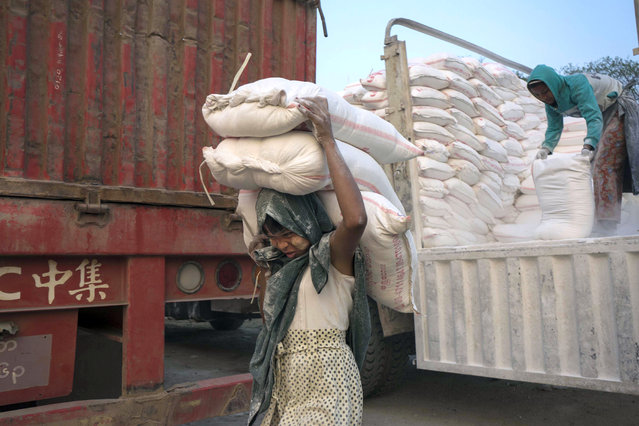
A 14 year-old Myanmar girl carries three bags of powdered-limestone to load in to a boat on the bank of Ayeyarwaddy River, on International Women's Day in Mandalay, Myanmar, Tuesday, March 8, 2016. Migrant workers living along Ayeyarwaddy riverbank earn bout 5000 Kyats (US Dollar 4) a day for loading and unloading goods. (Photro by Hkun Lat/AP Photo)

A 14 year-old Myanmar girl carries three bags of powdered-limestone to load in to a boat on the bank of Ayeyarwaddy River, on International Women's Day in Mandalay, Myanmar, Tuesday, March 8, 2016. Migrant workers living along Ayeyarwaddy riverbank earn bout 5000 Kyats (US Dollar 4) a day for loading and unloading goods. (Photro by Hkun Lat/AP Photo)
Details
09 Mar 2016 12:52:00