Loading...
Done
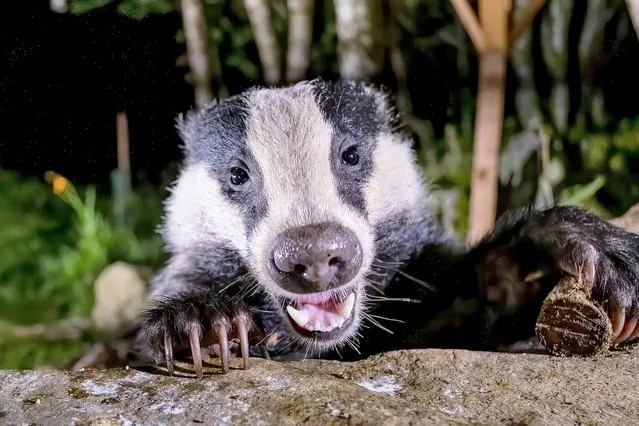
A photographer with a hidden camera took 2,500 photos before this elusive badger was ready for his close-up in September 2020. (Photo by Andy Swinden/BNPS)

A photographer with a hidden camera took 2,500 photos before this elusive badger was ready for his close-up in September 2020. (Photo by Andy Swinden/BNPS)
Details
04 Oct 2020 00:03:00
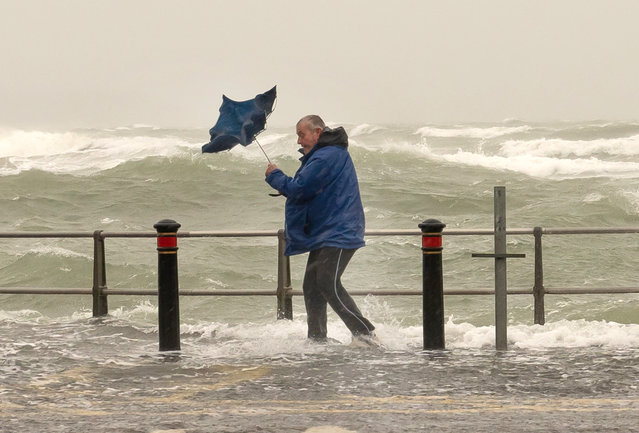
Someone struggles with an umbrella on Mudeford Quay seafront in Dorset, UK during storm Nelson on March 28, 2024. (Photo by Steve Hogan/Picture Exclusive)

Someone struggles with an umbrella on Mudeford Quay seafront in Dorset, UK during storm Nelson on March 28, 2024. (Photo by Steve Hogan/Picture Exclusive)
Details
14 May 2024 05:02:00
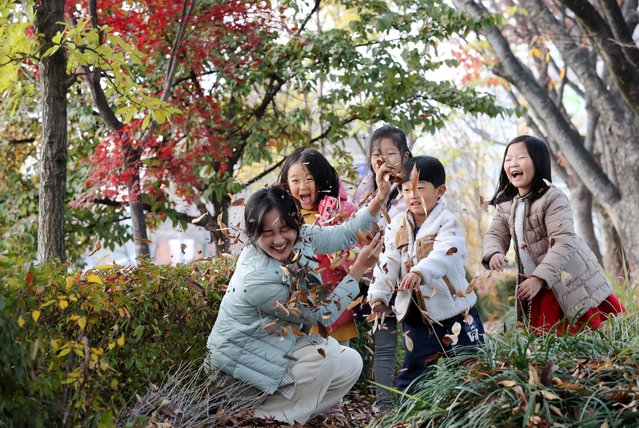
On the November 24, 2025, children are making human faces by collecting fallen leaves in the forest in front of the Yuseong-gu Office in Daejeon. (Photo by Shin Hyeon-jong)

On the November 24, 2025, children are making human faces by collecting fallen leaves in the forest in front of the Yuseong-gu Office in Daejeon. (Photo by Shin Hyeon-jong)
Details
19 Dec 2025 09:13:00
A Donald Trump impersonator with a bikini clad model stops at a hot dog vendor near Trump Tower on October 25, 2016 in New York, as part of a performance art piece by British artist Alison Jackson. The event is to promote Jackson's new show, “Private”, in New York, which features staged photographs portraying the private lives of public individuals. (Photo by Timothy A. Clary/AFP Photo)

A Donald Trump impersonator with a bikini clad model stops at a hot dog vendor near Trump Tower on October 25, 2016 in New York, as part of a performance art piece by British artist Alison Jackson. The event is to promote Jackson's new show, “Private”, in New York, which features staged photographs portraying the private lives of public individuals. (Photo by Timothy A. Clary/AFP Photo)
Details
26 Oct 2016 11:12:00
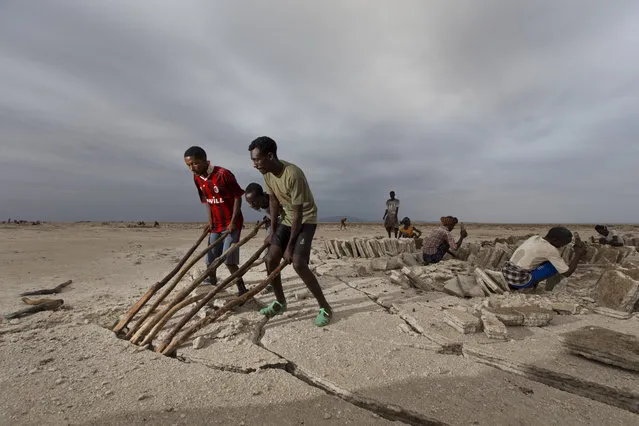
February 8, 2014 – Danakil Desert, Ethiopia: Workers mining salt at the quarry. (Photo by Ziv Koren/Polaris)

Inside the Afar Triangle in Ethiopia’s Danakil desert, camel caravans are used to carry salt. For centuries, the essential mineral has been mined by the Afar people, known for their ability to withstand extremes. The terrain is rugged, travelers are scarce and so are motor vehicles, where the average annual temperature is the highest in the world, and can rise to 122 degrees Fahrenheit, 50 degrees Celsius. (Photo by Ziv Koren/Polaris)
Details
30 Apr 2014 08:17:00
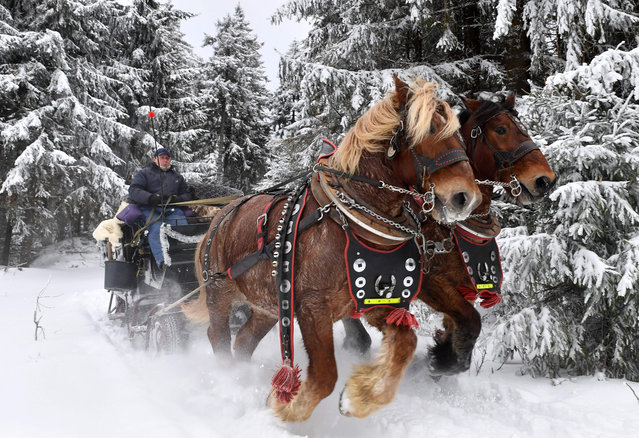
A horse- drawn carriage rides along the race course through the Thuringian Forest in Oberhof, Germany, 05 January 2017. Winter found its way to Saxony, Saxony- Anhalt, and Thuringia. In some regions it can get as low as negative 20 degrees overnight. (Photo by Martin Schutt/Zentralbild/DPA)

A horse- drawn carriage rides along the race course through the Thuringian Forest in Oberhof, Germany, 05 January 2017. Winter found its way to Saxony, Saxony- Anhalt, and Thuringia. In some regions it can get as low as negative 20 degrees overnight. (Photo by Martin Schutt/Zentralbild/DPA)
Details
06 Jan 2017 14:17:00
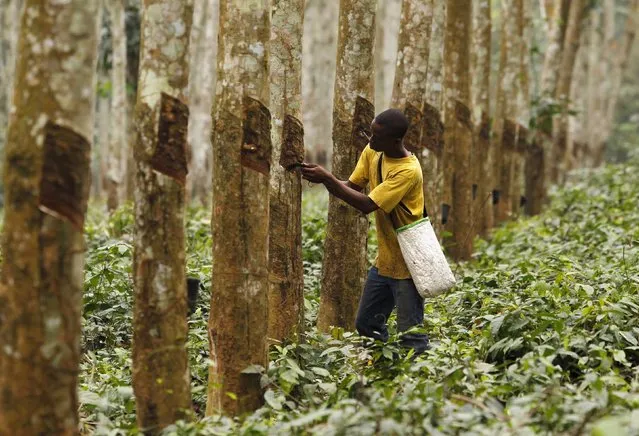
A worker collects rubber sap at a farm in Songon village, north of Abidjan, February 3, 2016. (Photo by Luc Gnago/Reuters)

A worker collects rubber sap at a farm in Songon village, north of Abidjan, February 3, 2016. (Photo by Luc Gnago/Reuters)
Details
12 Feb 2016 12:59:00
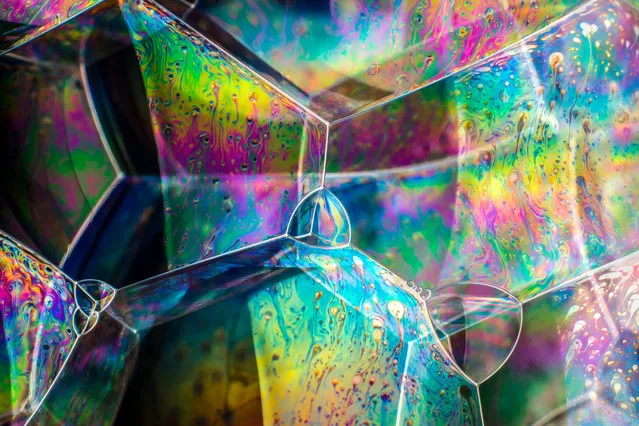
Soap Bubble Structures by Kym Cox. Bubbles optimise space and minimise their surface area for a given volume of air. This phenomenon makes them a useful tool in many areas of research, in particular, materials science and ‘packing’ – how things fit together. Bubble walls drain under gravity, thin at the top, thick at the bottom, which interferes with travelling lightwaves to create bands of colour. Black spots show the wall is too thin for interference colours, indicating the bubble is about to burst. (Photo by Kym Cox/2019 Science Photographer of the Year/RPS)

Soap Bubble Structures by Kym Cox. Bubbles optimise space and minimise their surface area for a given volume of air. This phenomenon makes them a useful tool in many areas of research, in particular, materials science and “packing” – how things fit together. Bubble walls drain under gravity, thin at the top, thick at the bottom, which interferes with travelling lightwaves to create bands of colour. Black spots show the wall is too thin for interference colours, indicating the bubble is about to burst. (Photo by Kym Cox/2019 Science Photographer of the Year/RPS)
Details
15 Aug 2019 00:03:00