Loading...
Done
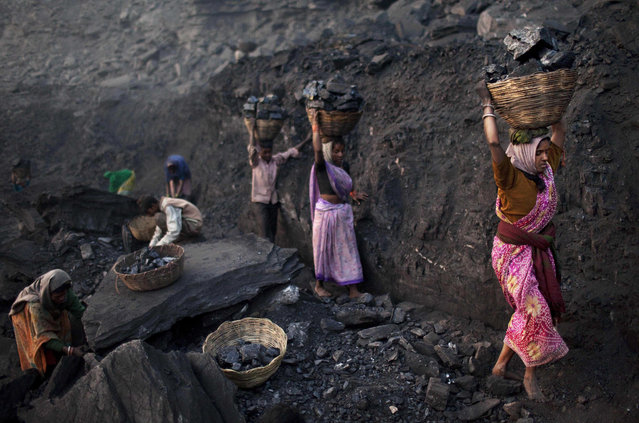
In this Friday, January 7, 2011 photo, people carry baskets of coal scavenged illegally at an open-cast mine in the village of Bokapahari in the eastern Indian state of Jharkhand where a community of coal scavengers live and work. The world's biggest coal users – China, the United States and India – have boosted coal mining in 2017, in an abrupt departure from last year's record global decline for the heavily polluting fuel and a setback to efforts to rein in climate change emissions. (Photo by Kevin Frayer/AP Photo)

In this Friday, January 7, 2011 photo, people carry baskets of coal scavenged illegally at an open-cast mine in the village of Bokapahari in the eastern Indian state of Jharkhand where a community of coal scavengers live and work. The world's biggest coal users – China, the United States and India – have boosted coal mining in 2017, in an abrupt departure from last year's record global decline for the heavily polluting fuel and a setback to efforts to rein in climate change emissions. (Photo by Kevin Frayer/AP Photo)
Details
28 Jun 2017 08:08:00
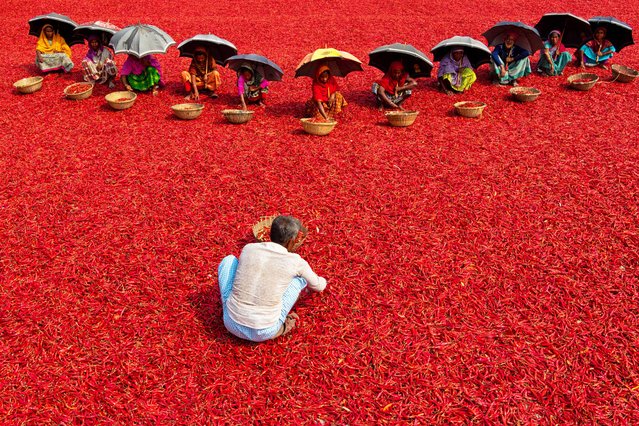
Rows of workers shelter under umbrellas from the scorching heat as they painstakingly sort through a red carpet of millions of chilli peppers in Bogra, Bangladesh on October 3, 2023. They sort the rotten and broken chilli peppers out to separate the poor quality ones which won't sell. In a line, the pickers who are paid less than £3 for a 10-hour shift slowly move forward with their baskets to separate the bad from the good after the chilies have been dried in the sun for a week. The dried & sorted chillies are then packaged and taken to the local market where they are brought mainly by companies to be made into chilli powder. The workers sort them in a warm environment, with temperatures reaching up to 45°C. More than 5,000 people work in almost 100 chilli farms in the Bogra district of Bangladesh to supply local spice companies with chillies for their recipes. Known as “Lal Morich” to the locals, chilli peppers are a major part of Bengali cuisine and are used as part of a combination of spices for various meat dishes, including chicken and beef. (Photo by Joy Saha/Rex Features/Shutterstock)

Rows of workers shelter under umbrellas from the scorching heat as they painstakingly sort through a red carpet of millions of chilli peppers in Bogra, Bangladesh on October 3, 2023. They sort the rotten and broken chilli peppers out to separate the poor quality ones which won't sell. In a line, the pickers who are paid less than £3 for a 10-hour shift slowly move forward with their baskets to separate the bad from the good after the chilies have been dried in the sun for a week. (Photo by Joy Saha/Rex Features/Shutterstock)
Details
21 Oct 2023 04:04:00
Boats of fishermen are seen on the dried Poopo lakebed in the Oruro Department, south of La Paz, Bolivia, December 17, 2015. (Photo by David Mercado/Reuters)

Boats of fishermen are seen on the dried Poopo lakebed in the Oruro Department, south of La Paz, Bolivia, December 17, 2015. Lake Poopo in Bolivia, the Andean nation's formerly second largest after the famed Titicaca, has dried up entirely. With the water now gone, animals have died off in the millions, according to studies. And the local families, having lost much of their sustenance, have been forced to migrate. (Photo by David Mercado/Reuters)
Details
20 Dec 2015 08:04:00
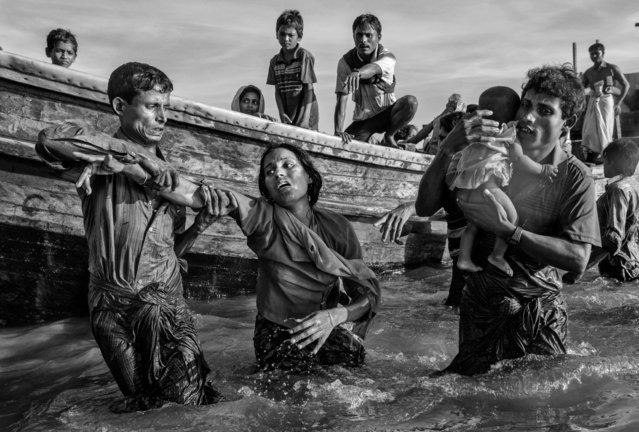
A Rohingya refugee woman is helped from a boat as she arrives exhausted on the Bangladesh side of the Naf River at Shah Porir Dwip after fleeing her village in Myanmar, on October 1, 2017 in Cox's Bazar, Bangladesh. (Photo by Kevin Frayer/Getty Images)

A Rohingya refugee woman is helped from a boat as she arrives exhausted on the Bangladesh side of the Naf River at Shah Porir Dwip after fleeing her village in Myanmar, on October 1, 2017 in Cox's Bazar, Bangladesh. (Photo by Kevin Frayer/Getty Images)
Details
17 Oct 2017 05:51:00
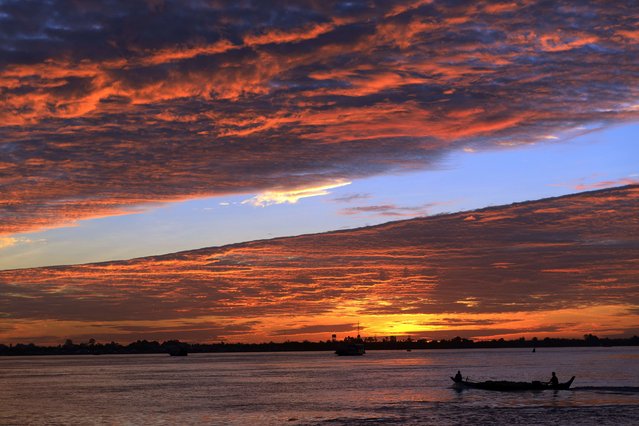
A boat commutes across the Mekong river in Phnom Penh on August 8, 2014. The Mekong is the world's twelth longest river running from the Tibetan Plateau through China's Yunnan province, Myanmar, Laos, Thailand, Cambodia and Vietnam. (Photo by Tang Chhin Sothy/AFP Photo)

A boat commutes across the Mekong river in Phnom Penh on August 8, 2014. The Mekong is the world's twelth longest river running from the Tibetan Plateau through China's Yunnan province, Myanmar, Laos, Thailand, Cambodia and Vietnam. (Photo by Tang Chhin Sothy/AFP Photo)
Details
09 Aug 2014 12:41:00
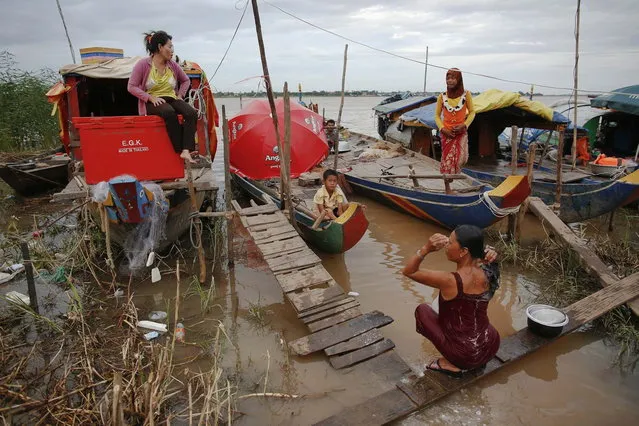
Ethnic Cham Muslim people pass the time near their boats on banks of Mekong river in Phnom Penh July 29, 2013. (Photo by Damir Sagolj/Reuters)

Ethnic Cham Muslim people pass the time near their boats on banks of Mekong river in Phnom Penh July 29, 2013. About 100 ethnic Cham families, made up of nomads and fishermen without houses or land who arrived at the Cambodian capital in search of better lives, live on their small boats on a peninsula where the Mekong and Tonle Sap rivers meet, just opposite the city's centre. The community has been forced to move several times from their locations in Phnom Penh as the land becomes more valuable. They fear that their current home, just behind a new luxurious hotel under construction at the Chroy Changva district is only temporary and that they would have to move again soon. (Photo by Damir Sagolj/Reuters)
Details
31 Jul 2013 06:34:00
People in boats approach Die Badende (The Bather), a giant sculpture showing a woman's head and knees as if she were resting in the Binnenalster lake in Hamburg, Germany

People in boats approach “Die Badende” (“The Bather”), a giant sculpture showing a woman's head and knees as if she were resting in the Binnenalster lake on August 3, 2011 in Hamburg, Germany. The sculpture, which is made of styrofoam and steel and measures 4 meters high and 30 meters long, is a project by artist Oliver Voss and will be on display for the next ten days. (Photo by Sean Gallup/Getty Images)
Details
04 Aug 2011 11:36:00
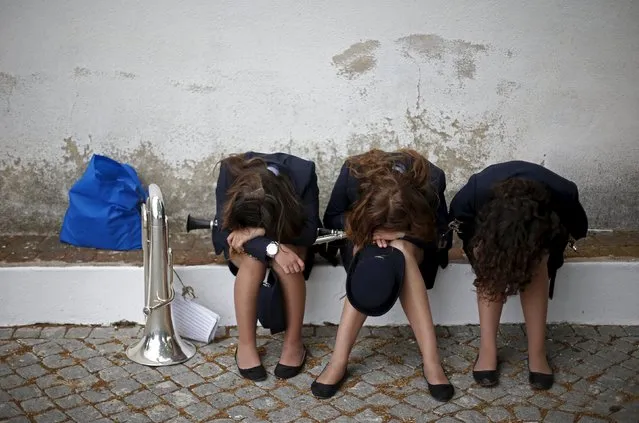
Members of a music band rest before the procession of “Nossa Senhora da Boa Viagem”, in Constancia April 6, 2015. (Photo by Rafael Marchante/Reuters)

Members of a music band rest before the procession of “Nossa Senhora da Boa Viagem”, in Constancia April 6, 2015. This benediction has been held annually for about 200 years. In the past, goods were transported by the Tagus river in small boats to Lisbon, 100 km south. The sailors, as the navigation was dangerous, blessed their boats every year during the festivity of “Nossa Senhora da Boa Viagem”. (Photo by Rafael Marchante/Reuters)
Details
07 Apr 2015 11:14:00