Loading...
Done
French twins Thomas and Vincent (L) Seris take the tram in Bordeaux, November 12, 2014. Born with Xeroderma Pigmentosum (XP), the twins cannot be exposed to the sun and its ultraviolet (UV) light, which could provoke precocious cancers due to an autosomal recessive genetic disorder of DNA repair. (Photo by Regis Duvignau/Reuters)

French twins Thomas and Vincent (L) Seris take the tram in Bordeaux, November 12, 2014. Born with Xeroderma Pigmentosum (XP), the twins cannot be exposed to the sun and its ultraviolet (UV) light, which could provoke precocious cancers due to an autosomal recessive genetic disorder of DNA repair. Colloquially referred to as Children of the Night (Les Enfants de la Lune) the Seris twins are among 70 to 80 people in France who suffer from the genetic defect. The French association “Les Enfants de la Lune” reports that there are between five and ten thousand such cases in the world. Thomas and Vincent have been testing a new protective mask for the last year which is transparent and ventilated and developed by several hospitals in France. (Photo by Regis Duvignau/Reuters)
Details
01 Feb 2015 10:27:00
Vitoria Bueno, a 16-year-old dancer whose genetic condition left her without arms, poses for a picture in her neighborhood in Santa Rita do Sapucai, Brazil, February 7, 2021. (Photo by Ueslei Marcelino/Reuters)

Vitoria Bueno, a 16-year-old dancer whose genetic condition left her without arms, poses for a picture in her neighborhood in Santa Rita do Sapucai, Brazil, February 7, 2021. (Photo by Ueslei Marcelino/Reuters)
Details
14 Jan 2022 08:15:00
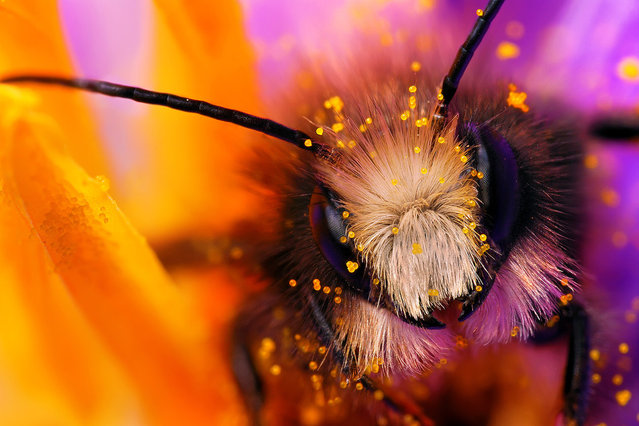
Bee. (Photo by Boris Godfroid)

Belgian Photographer Boris Godfroid, a former biology student who recently graduated from film school, started shooting macro photography in 2008. Photo: Bee. (Photo by Boris Godfroid)
Details
02 Aug 2013 07:25:00
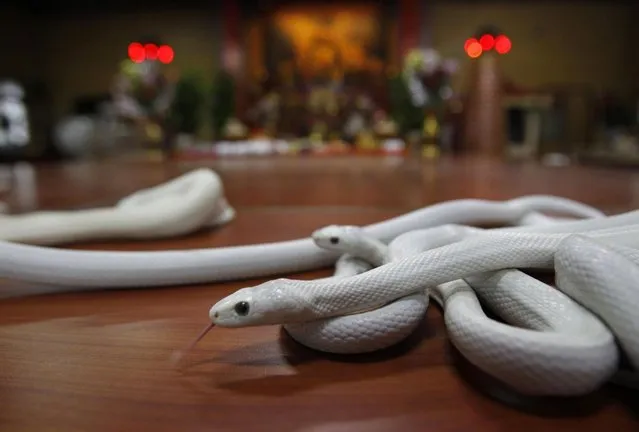
In this photo taken on Wednesday, January 9, 2013, ahead of the Chinese lunar new year of the Snake, following the Chinese zodiac, genetically modified, auspicious, white snakes slither across the altar at the Temple of White Snakes in Taoyuan county, in north western Taiwan. Director of the temple Mr. Lo Chin-shih says the new year of the snake would be a time of steady progress, in contrast to the more turbulent nature of the outgoing year of the dragon. The Chinese new year fall on February 10. (Photo by Wally Santana/AP Photo)

In this photo taken on Wednesday, January 9, 2013, ahead of the Chinese lunar new year of the Snake, following the Chinese zodiac, genetically modified, auspicious, white snakes slither across the altar at the Temple of White Snakes in Taoyuan county, in north western Taiwan. Director of the temple Mr. Lo Chin-shih says the new year of the snake would be a time of steady progress, in contrast to the more turbulent nature of the outgoing year of the dragon. The Chinese new year fall on February 10. (Photo by Wally Santana/AP Photo)
Details
09 Feb 2013 10:53:00
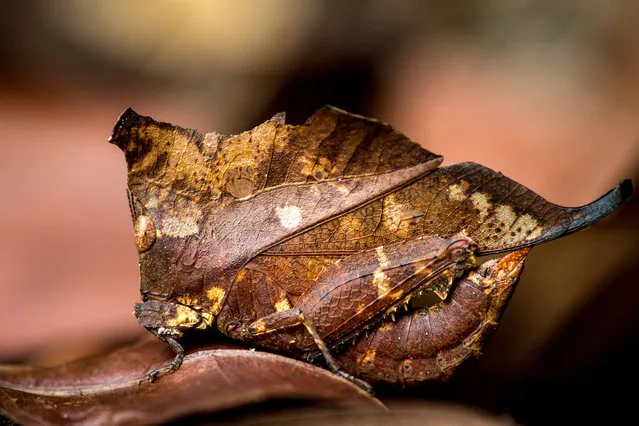
Dead leaf or almost by Guilhem Duvot. Taken in Nován Stráž, Slovakia. Describe what is pictured? A dead leaf grasshopper. How does this image fit with the theme of the competition? The perfect camouflage – nature is amazing. I saw the grasshopper only because it jumped. (Photo by Guilhem Duvot/Royal Society of Biology)

Dead leaf or almost by Guilhem Duvot. Taken in Nován Stráž, Slovakia. Describe what is pictured? A dead leaf grasshopper. How does this image fit with the theme of the competition? The perfect camouflage – nature is amazing. I saw the grasshopper only because it jumped. (Photo by Guilhem Duvot/Royal Society of Biology)
Details
10 Oct 2018 00:05:00
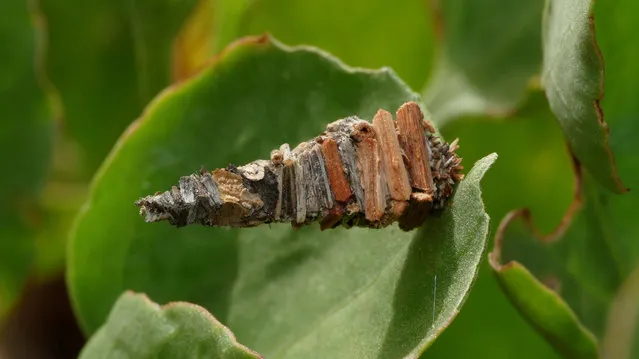
An undated handout photo made available by the Zerynthia Association shows the pupa of an amicta moneiba, a recently discovered species of moth endemic to La Gomera and El Hierro islands in the Canary Islands, Spain (issued 01 July 2020), as those two islands pulled apart from the rest of the Canary Islands 2.5 million years ago. The Institute of Evolutionary Biology of the Spanish National Research Council (CSIC) and the Zerynthia Association have recently discovered two new moth species in El Hierro and La Gomera. (Photo by Yeray Monasterio/Zerynthia/EPA/EFE)

An undated handout photo made available by the Zerynthia Association shows the pupa of an amicta moneiba, a recently discovered species of moth endemic to La Gomera and El Hierro islands in the Canary Islands, Spain (issued 01 July 2020), as those two islands pulled apart from the rest of the Canary Islands 2.5 million years ago. The Institute of Evolutionary Biology of the Spanish National Research Council (CSIC) and the Zerynthia Association have recently discovered two new moth species in El Hierro and La Gomera. (Photo by Yeray Monasterio/Zerynthia/EPA/EFE)
Details
11 Oct 2020 00:01:00


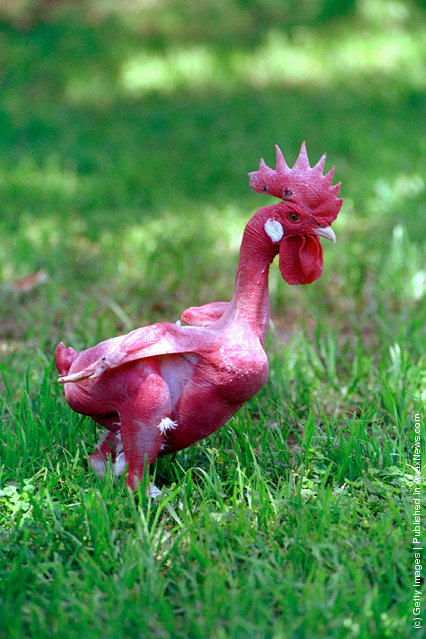
A genetically engineered featherless rooster struts around the campus of the Hebrew University of Jerusalem's Department of Agriculture May 22, 2002 in Rehovot, Israeli. After two years of research, departmental scientists announced the naked chicken, as it has been dubbed, as a low calorie bird because the lack of feathers means the chicken has less fat. It also matures earlier than its feathered counterparts. (Photo by Moshe Milner/GPO/Getty Images)
Details
29 Mar 2011 14:15:00
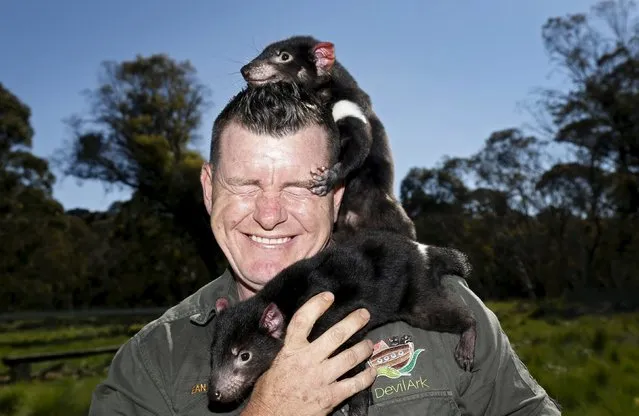
Devil Ark manager Dean Reid reacts as Tasmanian Devil joeys climb on him before the first shipment of healthy and genetically diverse devils to the island state of Tasmania leave the Devil Ark sanctuary in Barrington Tops on Australia's mainland, November 17, 2015. The largest group so far of disease-free Tasmanian devils has been released in the wild, as part of plans to save the carnivorous marsupials from a cancer threatening them with extinction. (Photo by Jason Reed/Reuters)

Devil Ark manager Dean Reid reacts as Tasmanian Devil joeys climb on him before the first shipment of healthy and genetically diverse devils to the island state of Tasmania leave the Devil Ark sanctuary in Barrington Tops on Australia's mainland, November 17, 2015. The largest group so far of disease-free Tasmanian devils has been released in the wild, as part of plans to save the carnivorous marsupials from a cancer threatening them with extinction. (Photo by Jason Reed/Reuters)
Details
21 Nov 2015 08:05:00