Loading...
Done
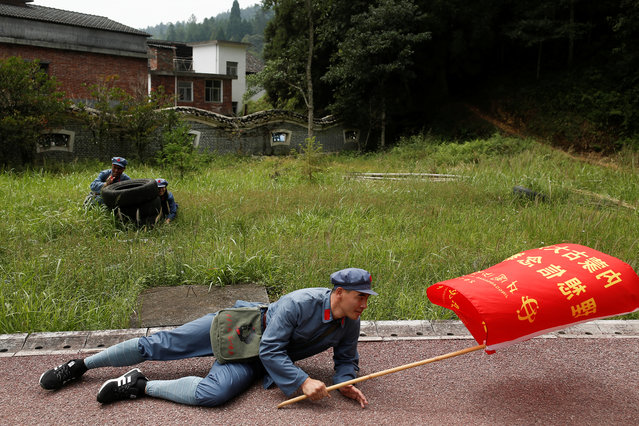
A man in “Red Army” garb hits the pavement during a simulated attack during a re-staging of part of the Long March in Jinggangshan September 14, 2017. The scene brings alive an extraordinary chapter in China's history that established the supremacy of Chairman Mao Zedong and the Communist Party. Deep in the mountains of Jinggangshan in the southeastern province of Jiangxi, a classroom of bank tellers participates in an ideological boot camp that plays into Chinese President Xi Jinping's drive to further consolidate his grip on power. (Photo by Thomas Peter/Reuters)

A man in “Red Army” garb hits the pavement during a simulated attack during a re-staging of part of the Long March in Jinggangshan September 14, 2017. The scene brings alive an extraordinary chapter in China's history that established the supremacy of Chairman Mao Zedong and the Communist Party. Deep in the mountains of Jinggangshan in the southeastern province of Jiangxi, a classroom of bank tellers participates in an ideological boot camp that plays into Chinese President Xi Jinping's drive to further consolidate his grip on power. (Photo by Thomas Peter/Reuters)
Details
25 Sep 2017 06:46:00
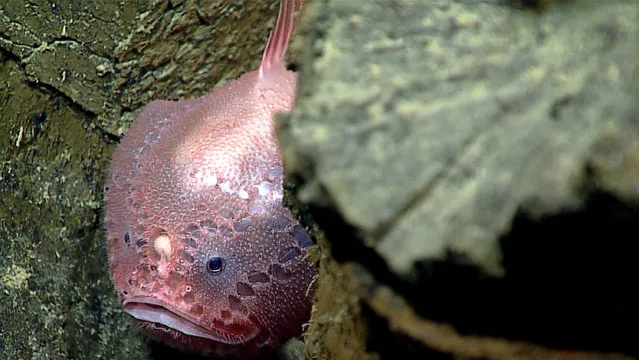
This April 30, 2016 image made available by NOAA shows a deep sea anglerfish living between pillow basalt rock formations, during a deepwater exploration of the Marianas Trench Marine National Monument area in the Pacific Ocean near Guam and Saipan. The ambush predator waits for prey to be attracted by its lure, located between its eyes, and gulps it with its large mouth. (Photo by NOAA Office of Ocean Exploration and Research via AP Photo)

This April 30, 2016 image made available by NOAA shows a deep sea anglerfish living between pillow basalt rock formations, during a deepwater exploration of the Marianas Trench Marine National Monument area in the Pacific Ocean near Guam and Saipan. The ambush predator waits for prey to be attracted by its lure, located between its eyes, and gulps it with its large mouth. (Photo by NOAA Office of Ocean Exploration and Research via AP Photo)
Details
21 Oct 2016 12:30:00
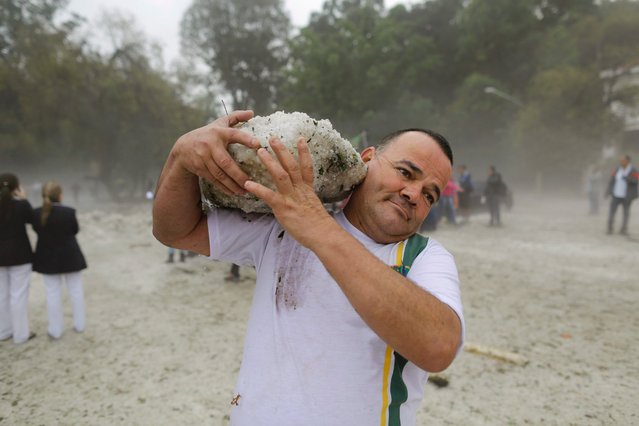
A man carries a block of ice left behind by a hailstorm in Sao Paulo, Brazil, on May 19, 2014. (Photo by Nelson Antoine/AP Photo)

A man carries a block of ice left behind by a hailstorm in Sao Paulo, Brazil, on May 19, 2014. After the severe overnight hailstorm a layer of hailstones as deep as 20 centimeters covered streets and parks, drawing people to make snowmen and play in the ice, an unusual scene to the city. (Photo by Nelson Antoine/AP Photo)
Details
20 May 2014 10:34:00


Traditional miners carry sulphur on the Ijen volcano complex on May 25, 2009 outside Banyuwangi, East Java, Indonesia. Miners carry the solidified yellow sulphur blocks from the crater floor to the rim for as many hours a day as they can tolerate, paid by the kilogram of sulphur they extract. The average wage is USD $.05 per kilogram of sulphur and a worker, depending on his strength and stamina, carry on average 3 baskets of 70-80kg per day, earning him around USD $11. (Photo by Ulet Ifansasti/Getty Images)
Details
08 Jul 2011 10:53:00
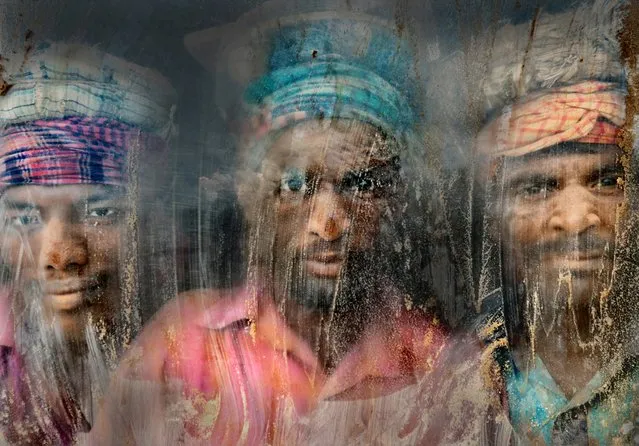
Gravel Workmen of Chittagong, Bangladesh, by Faisal Azim. Gravel workmen look through a glass window at a gravel-crushing yard in Chittagong. Full of dust and sand, it is an extremely unhealthy environment for working, but still hundreds of people work here for their livelihoods. (Photo by Faisal Azim/2016 Atkins CIWEM Environmental Photographer of the Year)

From Tibetan monks playing basket ball with ice thawing high up in the Himalayas, to the pollution that hides behind the Taj Mahal, here’s pick from 60 exceptional environmental photographs, by photographers and filmmakers from 70 countries, that will go on show at the Royal Geographical Society in London from 29 June to 21 August. The winners will be announced on 28 June. Here: Gravel Workmen of Chittagong, Bangladesh, by Faisal Azim. Gravel workmen look through a glass window at a gravel-crushing yard in Chittagong. Full of dust and sand, it is an extremely unhealthy environment for working, but still hundreds of people work here for their livelihoods. (Photo by Faisal Azim/2016 Atkins CIWEM Environmental Photographer of the Year)
Details
01 Jun 2016 12:25:00
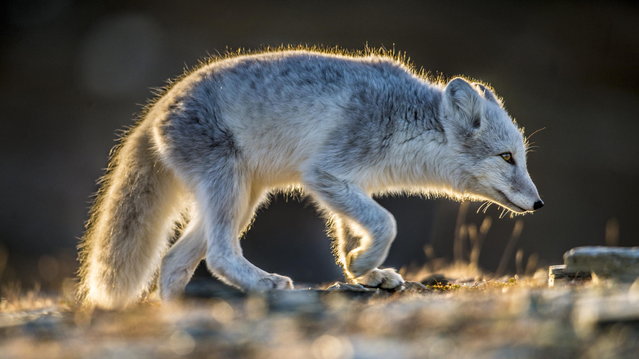
Arctic Fox. (Photo by Trond Eriksen)

“The arctic fox (Vulpes lagopus), also known as the white fox, polar fox, or snow fox, is a small fox native to the Arctic regions of the Northern Hemisphere and is common throughout the Arctic tundra biome. It is well adapted to living in cold environments. It has a deep thick fur which is brown in summer and white in winter. It averages in size at about 85.3 cm (33.6 in) in body length, with a generally rounded body shape to minimize the escape of body heat. – Wikipedia. (Photo by Trond Eriksen)
Details
26 May 2014 14:09:00
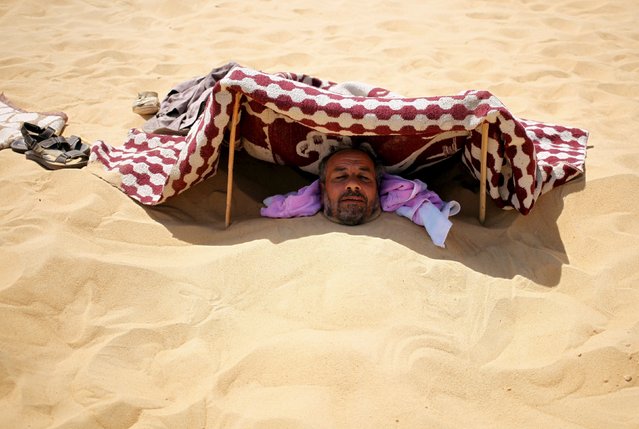
A patient buried in the hot sand looks out from under a shade that protects his face from the sun in Siwa, Egypt, August 12, 2015. (Photo by Asmaa Waguih/Reuters)

A patient buried in the hot sand looks out from under a shade that protects his face from the sun in Siwa, Egypt, August 12, 2015. In the searing heat of summer in western Egypt, at the hottest time of the day, sufferers of rheumatism, joint pain, infertility or impotence lie buried neck-deep in the sand of Siwa near Dakrour Mountain. Locals say taking a sand bath is a natural therapy with powers to cure many medical conditions. (Photo by Asmaa Waguih/Reuters)
Details
28 Aug 2015 12:07:00
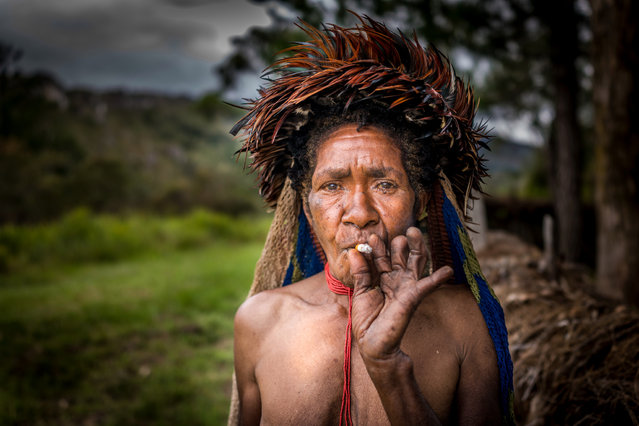
Dani tribeswoman smokes a cigarette and shows her amputated fingers in, Western New Guinea, Indonesia, August 2016. (Photo by Teh Han Lin/Barcroft Images)

Dani tribeswoman smokes a cigarette and shows her amputated fingers in, Western New Guinea, Indonesia, August 2016. Deep in the highlands of Western New Guinea, Indonesia, lives one of the world’s most isolated tribes. Known as the Dani people, the tribe was unwittingly discovered by American philanthropist, Richard Archbold, after an expedition in 1938. (Photo by Teh Han Lin/Barcroft Images)
Details
18 Nov 2016 11:03:00