Loading...
Done
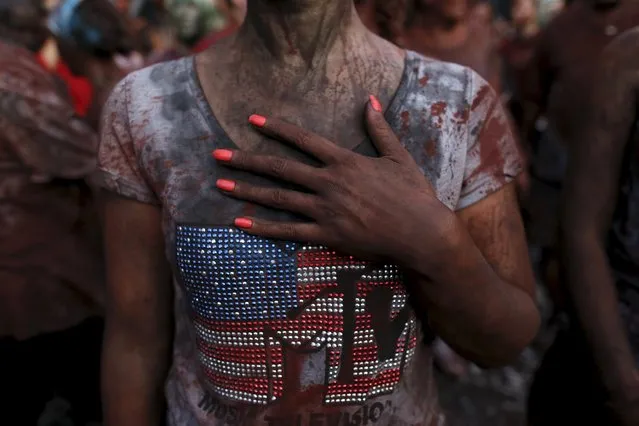
A reveller covered in paint takes part during the annual Cascamorras festival in Guadix, southern Spain September 9, 2015. (Photo by Marcelo del Pozo/Reuters)

A reveller covered in paint takes part during the annual Cascamorras festival in Guadix, southern Spain September 9, 2015. The festival was inspired by a dispute between the town of Baza and Guadix over the possession of an icon of the Virgin of Piedad. The Cascamorras refers to representatives from Guadix, who were sent to Baza to recover the statue. As the Cascamorras had to stay perfectly clean to gain possession of the statue, Baza residents attempt to make them as “dirty” as possible. (Photo by Marcelo del Pozo/Reuters)
Details
10 Sep 2015 12:59:00
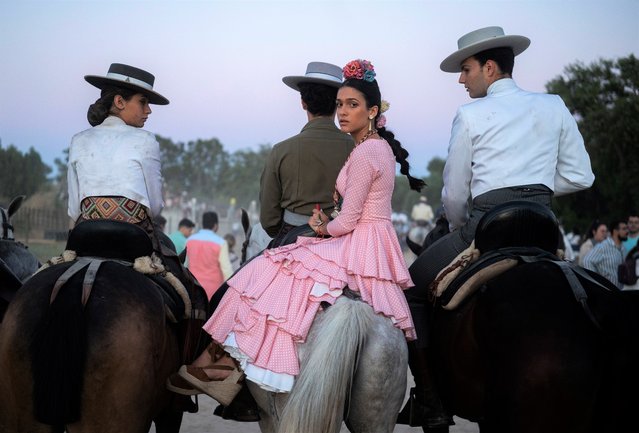
Pilgrims ride their horses on their way to the shrine of El Rocio in Villamanrique, Spain, on Saturday, June 4, 2022, during the annual pilgrimage in which hundreds of thousands of devotees of the Virgin del Rocio converge in and around the shrine. (Photo by Joan Mateu Parra/AP Photo)

Pilgrims ride their horses on their way to the shrine of El Rocio in Villamanrique, Spain, on Saturday, June 4, 2022, during the annual pilgrimage in which hundreds of thousands of devotees of the Virgin del Rocio converge in and around the shrine. (Photo by Joan Mateu Parra/AP Photo)
Details
23 Sep 2023 03:09:00
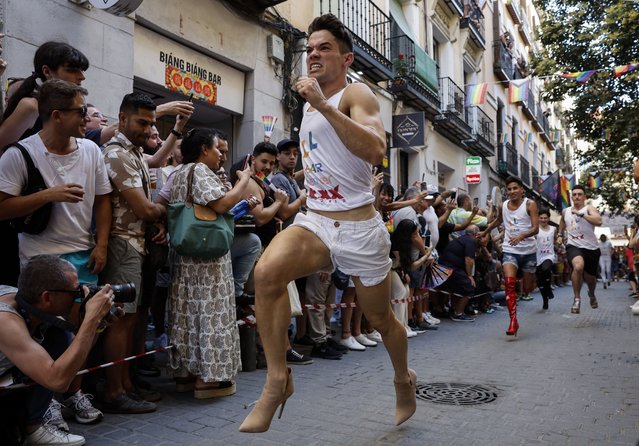
Participants compete in the High-Heels Race as part of the Pride celebrations, in the Chueca neighbourhood in Madrid on July 4 29, 2024. MADO (Madrid Pride) is a series of street celebrations that take place during the city´s LGBTIQ (lesbian, gay, bisеxual, transgender, intersеx and queer) Pride week. (Photo by Óscar del Pozo/AFP Photo)

Participants compete in the High-Heels Race as part of the Pride celebrations, in the Chueca neighbourhood in Madrid on July 4 29, 2024. MADO (Madrid Pride) is a series of street celebrations that take place during the city´s LGBTIQ (lesbian, gay, bisеxual, transgender, intersеx and queer) Pride week. (Photo by Óscar del Pozo/AFP Photo)
Details
01 Dec 2025 05:17:00
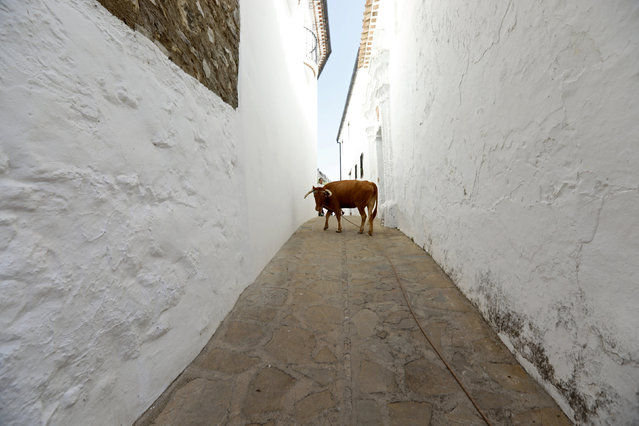
A heifer, tied with a rope, turns during “Toro de Cuerda” in the white village of Villaluenga del Rosario, southern Spain September 3, 2016. Dazzling clusters of cube-shaped houses perched on top of Andalusia's olive tree-studded mountains, the “Pueblos Blancos”, or white villages, of southern Spain are named for the lime wash the buildings are painted with to keep the interiors cool. The labyrinths of narrow alleyways are a throwback to when this region was known as Al-Andalus and was part of a medieval Muslim territory. While this region is stunningly beautiful and a big draw to tourists visiting the south of Spain, it is also one of the poorest areas in the country and has one of the highest unemployment rates in the European Union. (Photo by Marcelo del Pozo/Reuters)

A heifer, tied with a rope, turns during “Toro de Cuerda” in the white village of Villaluenga del Rosario, southern Spain September 3, 2016. Dazzling clusters of cube-shaped houses perched on top of Andalusia's olive tree-studded mountains, the “Pueblos Blancos”, or white villages, of southern Spain are named for the lime wash the buildings are painted with to keep the interiors cool. The labyrinths of narrow alleyways are a throwback to when this region was known as Al-Andalus and was part of a medieval Muslim territory. While this region is stunningly beautiful and a big draw to tourists visiting the south of Spain, it is also one of the poorest areas in the country and has one of the highest unemployment rates in the European Union. (Photo by Marcelo del Pozo/Reuters)
Details
20 Oct 2016 11:09:00
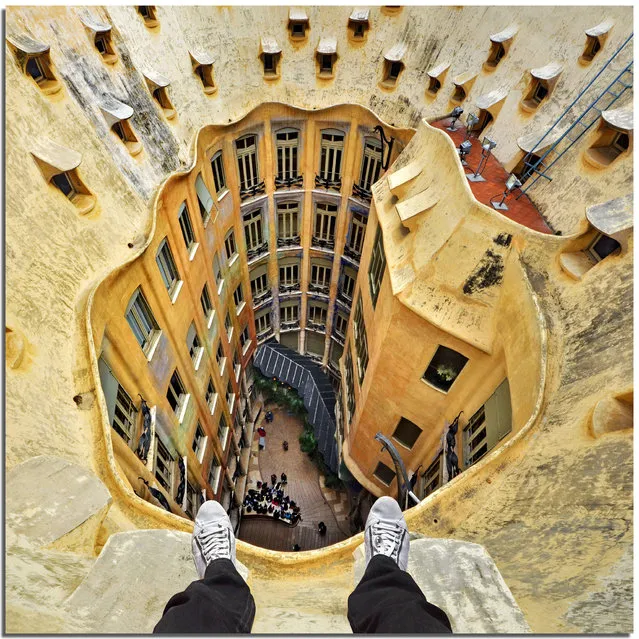
“Not for the faint of heart”. Casa Milà, better known as La Pedrera, is a building designed by the Catalan architect Antoni Gaudí and built during the years 1905–1910, being considered officially completed in 1912. It is located at 92, Passeig de Gràcia in the Eixample district of Barcelona, Catalonia, Spain. (Stefano Scarselli)

“Not for the faint of heart”. Casa Milà, better known as La Pedrera, is a building designed by the Catalan architect Antoni Gaudí and built during the years 1905–1910, being considered officially completed in 1912. It is located at 92, Passeig de Gràcia in the Eixample district of Barcelona, Catalonia, Spain. (Photo by Stefano Scarselli)
Details
17 Jan 2013 14:17:00
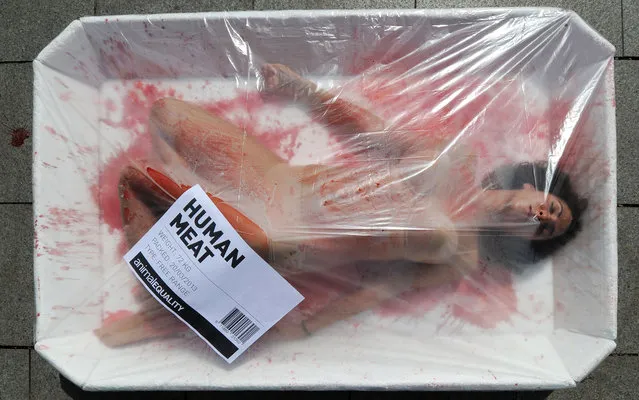
Ativista do grupo Igualdade Animal posa dentro de um enorme pacote de carne na Praça da Catedral, em Barcelona, Espanha. O ato marca uma campanha por um dia mundial sem carne. (Photo by Lluis Gene/AFP Photo)

Animal rights activists from the group “Animal Equality” are covered with plastic sheets to represent meat packaging as they stage a protest during “Day Without Meat” event in Barcelona, Spain, on March 20, 2013. (Photo by Lluis Gene/AFP Photo)
Details
21 Mar 2013 15:18:00
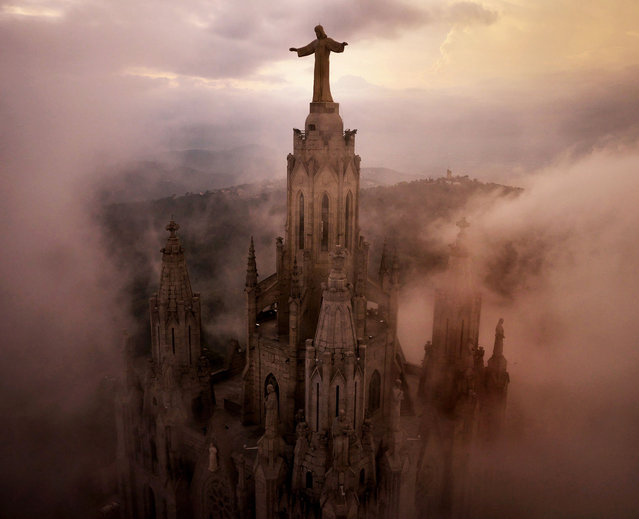
Clouds swirl through the pillars of Sagrat Cor Church, high on a hill above Barcelona, Spain. (Photo by Amos Chapple/Rex Features)

The beautiful shots were taken by photographer Amos Chapple using a camera mounted to a quadcopter drone. This enabled him to capture these unusual aerials showing some of Europe’s sights like they’ve never been seen before. Travelling across the continent he took photos everywhere from France and Germany to Spain and Russia. Photo: Clouds swirl through the pillars of Sagrat Cor Church, high on a hill above Barcelona, Spain. (Photo by Amos Chapple/Rex Features)
Details
06 Oct 2014 08:01:00
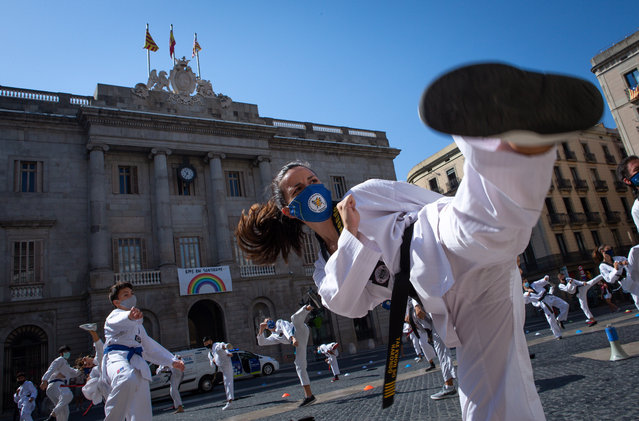
Dozens of people practice martial arts before the regional Government's headquarters in Barcelona, Spain, 27 July 2020, as a protest against the closure of gyms and martial arts centers in the region imposed by the Catalan Government due to a surge in coronavirus cases. (Photo by Enric Fontcuberta/EPA/EFE)

Dozens of people practice martial arts before the regional Government's headquarters in Barcelona, Spain, 27 July 2020, as a protest against the closure of gyms and martial arts centers in the region imposed by the Catalan Government due to a surge in coronavirus cases. (Photo by Enric Fontcuberta/EPA/EFE)
Details
29 Jul 2020 00:07:00