Loading...
Done
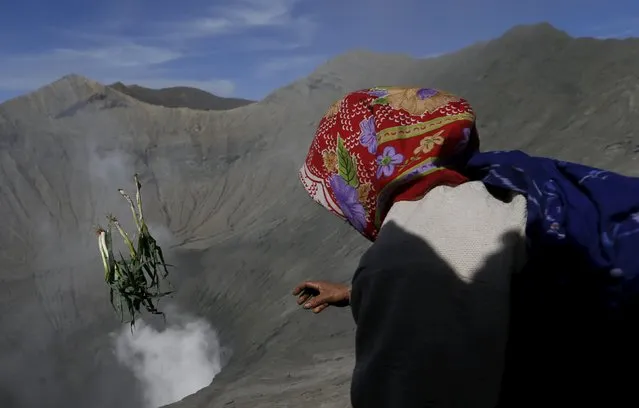
A Hindu worshipper throws vegetables into the crater as offerings during the Kasada Festival at Mount Bromo in Probolinggo, Indonesia's East Java province, August 1, 2015. (Photo by Reuters/Beawiharta)

A Hindu worshipper throws vegetables into the crater as offerings during the Kasada Festival at Mount Bromo in Probolinggo, Indonesia's East Java province, August 1, 2015. Every year people gather for the annual festival where offerings of rice, fruit, vegetables, livestock or money are made to Hindu gods at the active volcano to ask for blessings and assure a bountiful harvest. (Photo by Reuters/Beawiharta)
Details
02 Aug 2015 12:34:00
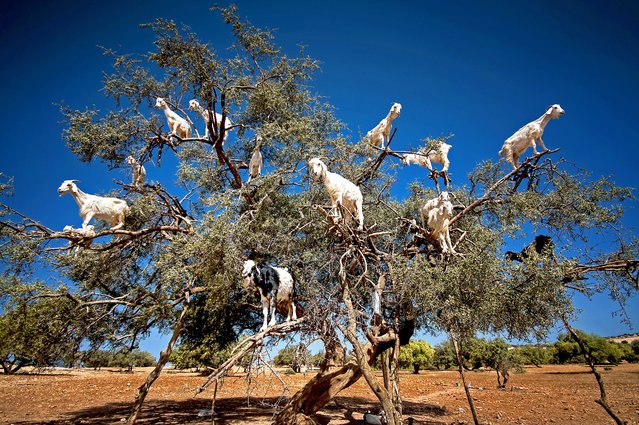
These goats threw caution to the wind and scaled this Argan tree right to the very top, even balancing on the most unsturdy of branches. It looks like a bit of a baa-lancing act, but the goats hooves are perfectly adapted to climbing the trees, where they graze on the Argan fruit. Amateur photographer Burak Senbak, 51, took these photos whilst travelling through Morocco in July 2016. Burak is originally from Turkey and works as a mechanical engineer, but has pursued his passion for photography for 10 years. Intrigued by the sight of goats in a tree, Burak couldnt resist the opportunity to take some photos, and said the goats proved a perfect subject. (Photo by Burak Senbak/Caters News)

These goats threw caution to the wind and scaled this Argan tree right to the very top, even balancing on the most unsturdy of branches. It looks like a bit of a baa-lancing act, but the goats hooves are perfectly adapted to climbing the trees, where they graze on the Argan fruit. Amateur photographer Burak Senbak, 51, took these photos whilst travelling through Morocco in July 2016. Burak is originally from Turkey and works as a mechanical engineer, but has pursued his passion for photography for 10 years. Intrigued by the sight of goats in a tree, Burak couldnt resist the opportunity to take some photos, and said the goats proved a perfect subject. (Photo by Burak Senbak/Caters News)
Details
27 Aug 2017 07:00:00
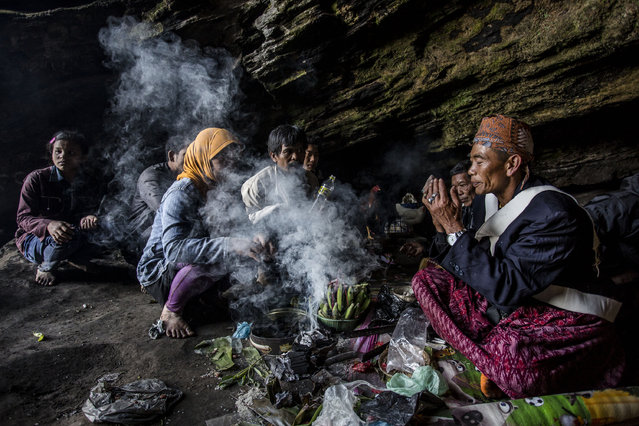
A Tenggerese shaman praying for worshippers at Widodaren cave during the Tenggerese Hindu Yadnya Kasada festival on July 31, 2015 in Probolinggo, East Java, Indonesia. The festival is the main festival of the Tenggerese people and lasts about a month. On the fourteenth day, the Tenggerese make the journey to Mount Bromo to make offerings of rice, fruits, vegetables, flowers and livestock to the mountain gods by throwing them into the volcano's caldera. (Photo by Ulet Ifansasti/Getty Images)

A Tenggerese shaman praying for worshippers at Widodaren cave during the Tenggerese Hindu Yadnya Kasada festival on July 31, 2015 in Probolinggo, East Java, Indonesia. The festival is the main festival of the Tenggerese people and lasts about a month. On the fourteenth day, the Tenggerese make the journey to Mount Bromo to make offerings of rice, fruits, vegetables, flowers and livestock to the mountain gods by throwing them into the volcano's caldera. The origin of the festival lies in the 15th century when a princess named Roro Anteng started the principality of Tengger with her husband Joko Seger, and the childless couple asked the mountain Gods for help in bearing children. The legend says the Gods granted them 24 children but on the provision that the 25th must be tossed into the volcano in sacrifice. The 25th child, Kesuma, was finally sacrificed in this way after initial refusal, and the tradition of throwing sacrifices into the caldera to appease the mountain Gods continues today. (Photo by Ulet Ifansasti/Getty Images)

Details
01 Aug 2015 12:07:00
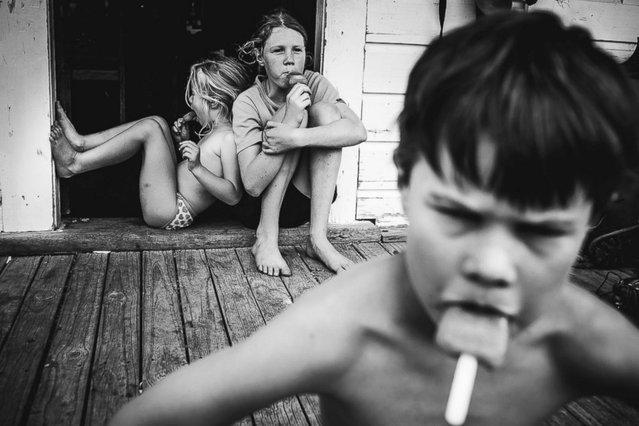
New Zealand photographer Niki Boon captured her children, who are growing up with limited electronics, in the photo series “Childhood in the Raw Photos”. Niki Boon began taking photos as a hobby while she was working as a physiotherapist in Scotland. However, the New Zealand native found her interest in the art waning while she travelled, and it wasn’t until she had returned home and started raising a family that her passion was rekindled. “Childhood in the Raw”, an ongoing photo series of her four children’s technology-free life on her 10-acre property in New Zealand, is the perennial fruit of this passion. (Photo by Niki Boon)

New Zealand photographer Niki Boon captured her children, who are growing up with limited electronics, in the photo series “Childhood in the Raw Photos”. Niki Boon began taking photos as a hobby while she was working as a physiotherapist in Scotland. However, the New Zealand native found her interest in the art waning while she travelled, and it wasn’t until she had returned home and started raising a family that her passion was rekindled. “Childhood in the Raw”, an ongoing photo series of her four children’s technology-free life on her 10-acre property in New Zealand, is the perennial fruit of this passion. (Photo by Niki Boon)
Details
20 Apr 2016 12:01:00
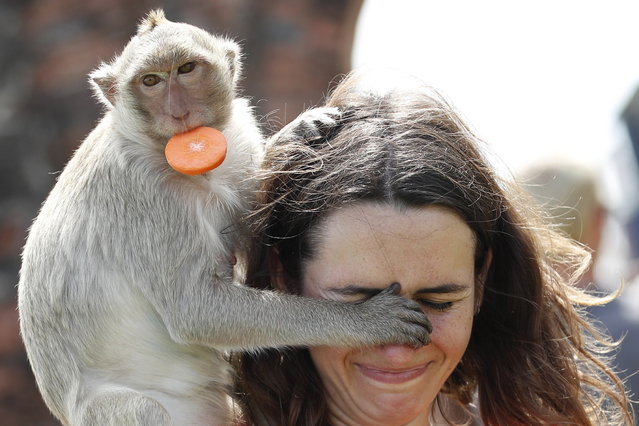
A monkey is being fed by a foreign tourist during the annual Monkey Banquet at Phra Prang Sam Yod ancient temple in Lopburi, some 180km from Bangkok, central Thailand, 24 November 2024. The annual gala has been organized since 1989 by Lopburi's entrepreneur Yongyuth Kitwatananusont, offering all-you-can-eat fruits, vegetables, and desserts for monkeys to honor the long-tailed macaques to attract tourists to visit the town to promote tourism. According to the Wildlife Department, more than 2,000 urban monkeys were captured in 2024 by authorities to control the monkey population after the growing complaints of residents that the macaques maraud food, frequently confront residents, causing accidents as well as their properties, assets, and the ancient city to be overrun and damaged by the monkeys. (Photo by Rungroj Yongrit/EPA)

A monkey is being fed by a foreign tourist during the annual Monkey Banquet at Phra Prang Sam Yod ancient temple in Lopburi, some 180km from Bangkok, central Thailand, 24 November 2024. The annual gala has been organized since 1989 by Lopburi's entrepreneur Yongyuth Kitwatananusont, offering all-you-can-eat fruits, vegetables, and desserts for monkeys to honor the long-tailed macaques to attract tourists to visit the town to promote tourism. (Photo by Rungroj Yongrit/EPA)
Details
08 Dec 2024 04:22:00
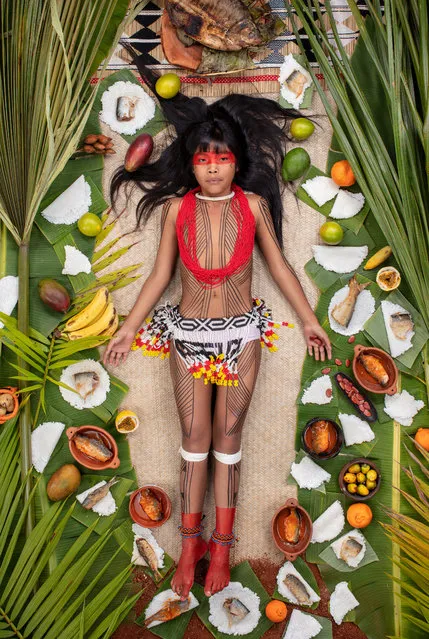
Kawakanih Yawalapiti, 9, Upper Xingu region of Mato Grosso, Brazil, 2018: Kawakanih lives with her tribe, the Yawalapiti, in Xingu national park, a preserve in the Amazon basin of Brazil. The Yawalapiti collect seeds to preserve species unique to their ecosystem, which lies between the rain forest and savannah. Kawakanih’s diet is simple, consisting mainly of fish, cassava, porridge, fruit and nuts. “It takes five minutes to catch dinner”, says Kawakanih. “When you’re hungry, you just go to the river with your net”. (Photo by Gregg Segal/The Guardian)

Photographer Gregg Segal travelled the world to document children and the food they eat in a week. Partly inspired by the increasing problems of childhood obesity, he tracked traditional regional diets as yet unaffected by globalisation, and ironically, found that the healthiest diets were often eaten by the least well off. (Photo by Gregg Segal/The Guardian)
Details
03 Jul 2019 00:03:00
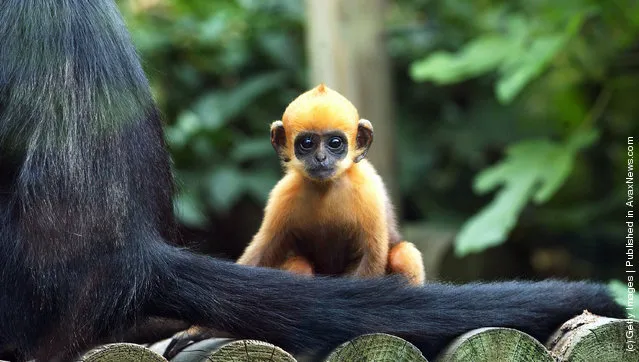
Baby Francois' Langur

“Francois' langur is one of several species of leaf monkeys. Over 50% of its diet is made up of young leaves. It will also consume fruits (17.2%), seeds, flowers, stems, roots, bark and occasionally minerals and insects off of rock surfaces and cliffs. This langur consumes its favorite food, young leaves, at the highest rate during the dry season, April through September, also known as the young leaf-lean period”. – Wikipedia

Photo: An endangered baby Francois' Langur monkey called Laa Laa settles in following her July 6 birth at London Zoo, Regent's Park on August 5, 2004 in London. The bright ginger youngster was born to glossy black parents Max and Shaneka and has the typical orange baby coat which is in stark contrast against the black of her parent's and older brother Grub's fur. (Photo by Steve Finn/Getty Images)
Details
22 Sep 2011 11:28:00
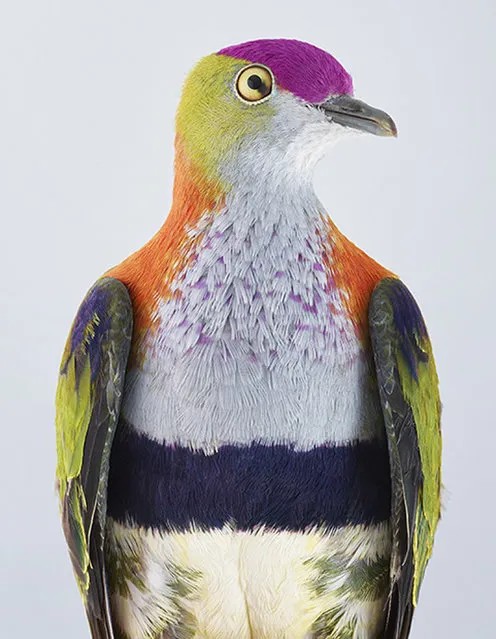
The series, which was photographed between 2015 and 2017, is currently on display at the Purdy Hicks Gallery in London, running through August 24, 2018. (Photo by Leila Jefferies/Caters News Agency)

This photographer has made it her mission to change people’s perception of pigeons – focusing on some of the most beautiful of the more than 300 species found globally. Rather than focus on the gray, nondescript birds people usually associate with the term “pigeon”, Leila Jeffreys has instead decided to snap the more vibrant varieties. Whether it be the wompoo pigeon, with its deep purple breast and green wings, or the rose-crowned fruit dove, with its pink head, Jeffreys, 46, gives the birds the same attention she would give a human model. (Photo by Leila Jefferies/Caters News Agency)
Details
14 Aug 2018 00:01:00