Loading...
Done
A Syrian boy plays with the head of a sacrificed sheep at a DIP camp for Interally Displaced Persons near the town of Aqrabat in Syria's northern Idlib province on August 12, 2019. Known as the “big” festival, Eid Al-Adha is celebrated each year by Muslims sacrificing various animals according to religious traditions, including cows, camels, goats and sheep. The festival marks the end of the Hajj pilgrimage to Mecca and commemorates Prophet Abraham's readiness to sacrifice his son to show obedience to God. (Photo by Aaref Watad/AFP Photo)

A Syrian boy plays with the head of a sacrificed sheep at a DIP camp for Interally Displaced Persons near the town of Aqrabat in Syria's northern Idlib province on August 12, 2019. Known as the “big” festival, Eid Al-Adha is celebrated each year by Muslims sacrificing various animals according to religious traditions, including cows, camels, goats and sheep. The festival marks the end of the Hajj pilgrimage to Mecca and commemorates Prophet Abraham's readiness to sacrifice his son to show obedience to God. (Photo by Aaref Watad/AFP Photo)
Details
15 Aug 2019 00:05:00
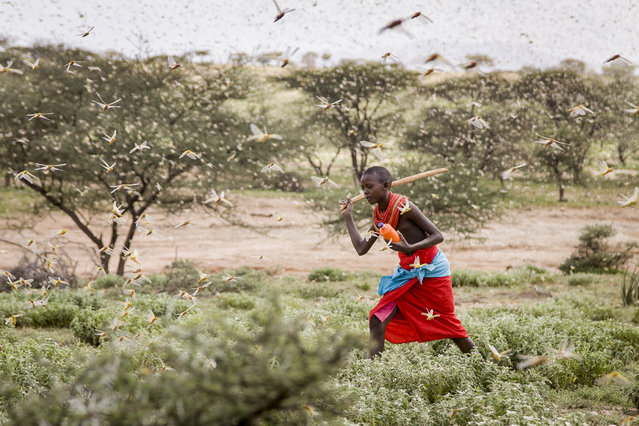
In this photo taken Thursday, January 16, 2020, a Samburu boy uses a wooden stick to try to swat a swarm of desert locusts filling the air, as he herds his camel near the village of Sissia, in Samburu county, Kenya. The most serious outbreak of desert locusts in 25 years is spreading across East Africa and posing an unprecedented threat to food security in some of the world's most vulnerable countries, authorities say, with unusual climate conditions partly to blame. (Photo by Patrick Ngugi/AP Photo)

In this photo taken Thursday, January 16, 2020, a Samburu boy uses a wooden stick to try to swat a swarm of desert locusts filling the air, as he herds his camel near the village of Sissia, in Samburu county, Kenya. The most serious outbreak of desert locusts in 25 years is spreading across East Africa and posing an unprecedented threat to food security in some of the world's most vulnerable countries, authorities say, with unusual climate conditions partly to blame. (Photo by Patrick Ngugi/AP Photo)
Details
19 Jan 2020 00:07:00
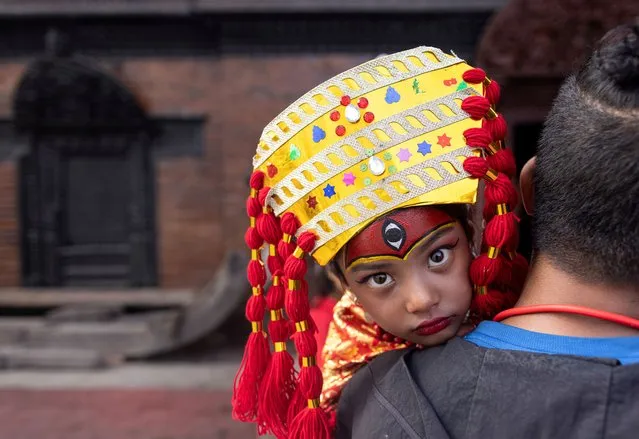
A Nepalese girl in traditional attire takes part in Kumari Puja, a mass worship ceremony for preteen girls, in Kathmandu, Nepal on September 27, 2023. In Nepal, Kumari Puja is the tradition of selecting a Kumari, usually a preadolescent girl, to worship symbolically as a goddess. More than hundred girls under the age of nine from across the country gathered for the mass worship. Performing Kumari Puja for three continuous years is believed to protect the girls from diseases throughout their entire life. (Photo by Narendra Shrestha/EPA/EFE)

A Nepalese girl in traditional attire takes part in Kumari Puja, a mass worship ceremony for preteen girls, in Kathmandu, Nepal on September 27, 2023. In Nepal, Kumari Puja is the tradition of selecting a Kumari, usually a preadolescent girl, to worship symbolically as a goddess. More than hundred girls under the age of nine from across the country gathered for the mass worship. Performing Kumari Puja for three continuous years is believed to protect the girls from diseases throughout their entire life. (Photo by Narendra Shrestha/EPA/EFE)
Details
07 Oct 2023 04:02:00
Members of South Korean K-Pop girl group Brave Girls pose on the red carpet at KCON Seoul 2022 in Seoul on May 7, 2022. (Photo by Anthony Wallace/AFP Photo)

Members of South Korean K-Pop girl group Brave Girls pose on the red carpet at KCON Seoul 2022 in Seoul on May 7, 2022. (Photo by Anthony Wallace/AFP Photo)
Details
12 May 2022 05:31:00
Yak near Yamdrok lake, Tibet. It is a long-haired bovinae found throughout the Himalayan region of south Central Asia, the Tibetan Plateau and as far north as Mongolia and Russia. The Tibetan economy is dominated by subsistence agriculture. Due to limited arable land, the primary occupation of the Tibetan Plateau is raising livestock, such as sheep, cattle, goats, camels, yaks, dzo, and horses. The Tibetan yak is an integral part of Tibetan life. (Photo by Dennis Jarvis)

Yak near Yamdrok lake, Tibet. It is a long-haired bovinae found throughout the Himalayan region of south Central Asia, the Tibetan Plateau and as far north as Mongolia and Russia. The Tibetan economy is dominated by subsistence agriculture. Due to limited arable land, the primary occupation of the Tibetan Plateau is raising livestock, such as sheep, cattle, goats, camels, yaks, dzo, and horses. The Tibetan yak is an integral part of Tibetan life. (Photo by Dennis Jarvis)
Details
10 Jun 2015 10:48:00
A Pakistani feeds his goat wearing the words “Eid Mubarak” or “Eid Greeting”, to be slaughtered on the Muslim holiday of Eid al-Adha, or “Feast of Sacrifice”, in Islamabad, Pakistan on Tuesday, October 15, 2013. Muslims all over the world are celebrating Eid al-Adha by sacrificing sheep, goats, cows and camels, to commemorate the Prophet Abraham's readiness to sacrifice his son, Ismail, on God's command. (Photo by Anjum Naveed/AP Photo)

A Pakistani feeds his goat wearing the words “Eid Mubarak” or “Eid Greeting”, to be slaughtered on the Muslim holiday of Eid al-Adha, or “Feast of Sacrifice”, in Islamabad, Pakistan on Tuesday, October 15, 2013. Muslims all over the world are celebrating Eid al-Adha by sacrificing sheep, goats, cows and camels, to commemorate the Prophet Abraham's readiness to sacrifice his son, Ismail, on God's command. (Photo by Anjum Naveed/AP Photo)
Details
17 Oct 2013 07:56:00
A dune buggy driver trains before competing in a sand dune drag racing event on January 8, 2016, as part of the Liwa 2016 Moreeb Dune Festival in the Liwa desert, some 250 kilometres southwest of Abu Dhabi. The festival, which attracts participants from around the Gulf region, includes a variety of races (cars, bikes, falcons, camels and horses) or other activities aimed at promoting the country's folklore. (Photo by Karim Sahib/AFP Photo)

A dune buggy driver trains before competing in a sand dune drag racing event on January 8, 2016, as part of the Liwa 2016 Moreeb Dune Festival in the Liwa desert, some 250 kilometres southwest of Abu Dhabi. The festival, which attracts participants from around the Gulf region, includes a variety of races (cars, bikes, falcons, camels and horses) or other activities aimed at promoting the country's folklore. (Photo by Karim Sahib/AFP Photo)
Details
09 Jan 2016 13:45:00
A Pakistani owner tries to load camel on a truck at a cattle market set up for the upcoming Muslim festival Eid al-Adha in Karachi, Pakistan, Friday, August 17, 2018. Eid al-Adha, or Feast of Sacrifice, most important Islamic holiday marks the willingness of the Prophet Ibrahim (Abraham to Christians and Jews) to sacrifice his son. (Photo by Shakil Adil/AP Photo)

A Pakistani owner tries to load camel on a truck at a cattle market set up for the upcoming Muslim festival Eid al-Adha in Karachi, Pakistan, Friday, August 17, 2018. Eid al-Adha, or Feast of Sacrifice, most important Islamic holiday marks the willingness of the Prophet Ibrahim (Abraham to Christians and Jews) to sacrifice his son. (Photo by Shakil Adil/AP Photo)
Details
20 Sep 2018 00:01:00