Loading...
Done
A shop assistant creates a window display in a Next store in central London December 30, 2014.  British clothing retailer Next's sales rose 2.9 percent in the run up to Christmas mostly due to online and catalogue purchases, hitting the upper end of its predictions and it said full-year profit would rise by about 11.5 percent. (Photo by Neil Hall/Reuters)

A shop assistant creates a window display in a Next store in central London December 30, 2014. British clothing retailer Next's sales rose 2.9 percent in the run up to Christmas mostly due to online and catalogue purchases, hitting the upper end of its predictions and it said full-year profit would rise by about 11.5 percent. (Photo by Neil Hall/Reuters)
Details
03 Jan 2015 12:38:00
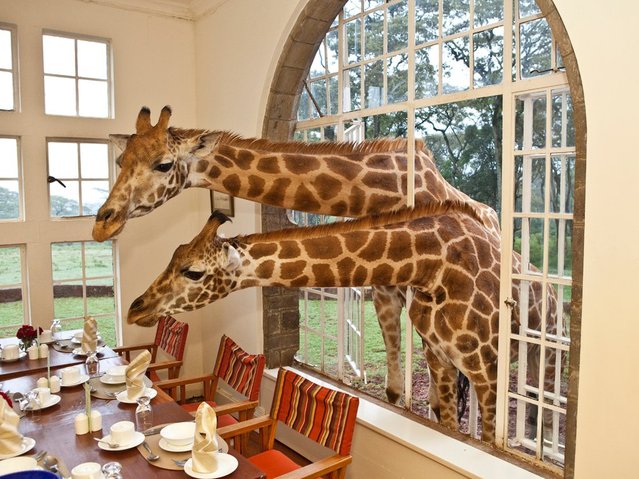
The World S Only Giraffe Hotel In Kenya

Giraffe Manor is a delightful family lodge situated outside of Nairobi. The manor is known for its Rothschild's giraffes, which often stick their heads through the windows of the lodge to greet you. Each of the six luxury rooms offer en suite facilities, and sumptuous surroundings. Guests enjoy evening cocktails in front of the fireplace before a delicious gourmet dinner.
Details
12 Jan 2013 14:33:00


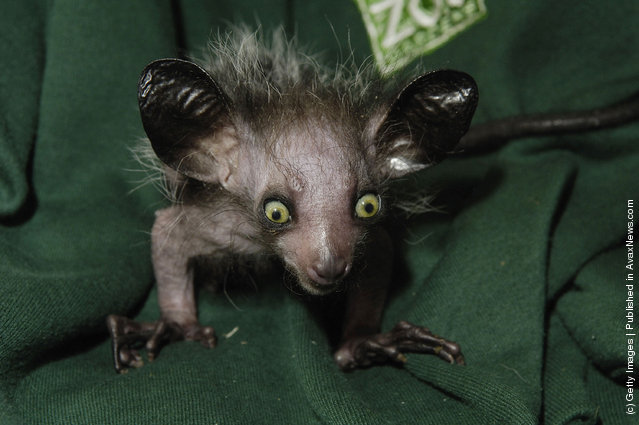
“The aye-aye (Daubentonia madagascariensis) is a lemur, a strepsirrhine primate native to Madagascar that combines rodent-like teeth and a special thin middle finger to fill the same ecological niche as a woodpecker. It is the world's largest nocturnal primate, and is characterized by its unusual method of finding food; it taps on trees to find grubs, then gnaws holes in the wood and inserts its narrow middle finger to pull the grubs out. The only other animal species known to find food in this way is the striped possum. From an ecological point of view the aye-aye fills the niche of a woodpecker as it is capable of penetrating wood to extract the invertebrates within”. – Wikipedia

Photo: In this handout image from Bristol Zoo is seen the first captive bred aye-aye in the UK named “Kintana” (meaning star in Malagasy) April 15, 2005 at Bristol Zoo Gardens, England. The zoo announced today only the second baby aye-aye to be hand-reared in the world (the first was in Jersey Zoo) and has now made his first public appearance since his birth on 11 February 2005. (Photo by Rob Cousins/Bristol Zoo via Getty Images)
Details
13 Apr 2011 13:33:00
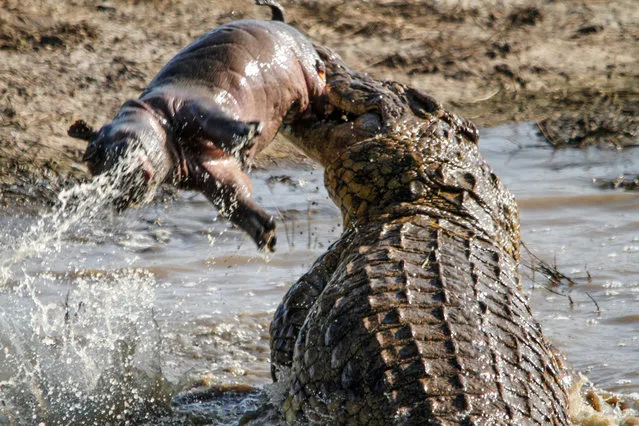
An enormous crocodile mauls a young hippo calf carcass near Lower Sabie on May 11, 2014, in Kruger National Park, South Africa. (Photo by Roland Ross/Barcroft Media)

An enormous crocodile mauls a young hippo calf carcass near Lower Sabie on May 11, 2014, in Kruger National Park, South Africa. An enormous crocodile tosses around a young hippo calf caught in its lethal jaws. The giant reared out of the water revealing a young hippo calf between its teeth. The huge beast then span, jumped and splashed in the water with the small carcass. Amateur photographer Roland Ross captured these incredible photographs near Lower Sabie in Kruger Park, South Africa. (Photo by Roland Ross/Barcroft Media)
Details
06 Aug 2014 10:52:00


“The Red River Hog (Potamochoerus porcus), also known as the Bush Pig (but not to be confused with P. larvatus, common name “Bushpig”), is a wild member of the pig family living in Africa, with most of its distribution in the Guinean and Congolian forests. It is rarely seen away from rainforests, and generally prefers areas near rivers or swamps.

Red River Hogs eat grass, berries, roots, insects, molluscs, small vertebrates and carrion. They are capable of causing damage to plantations. Red River Hogs typically live in herds of 6-20 members led by a dominant boar. Sows rear 3-6 piglets at a time.”

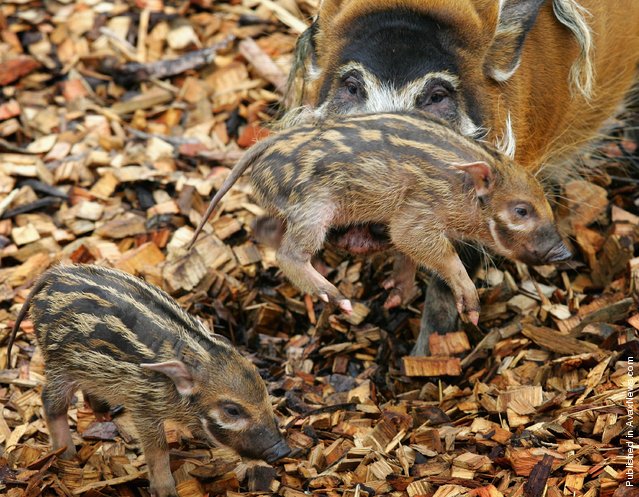
Photo: Two 17 day old red river hoglet twins forage for food next to their mother Bahiti at London Zoo on August 23, 2007 in London, England. Red River hoglets inhabit the forests and swamps of West and Central Africa. The recent additions to the London Zoo pig pen have been eagerly awaited by zoo keepers. (Photo by Chris Jackson/Getty Images)

Details
18 Mar 2011 15:15:00
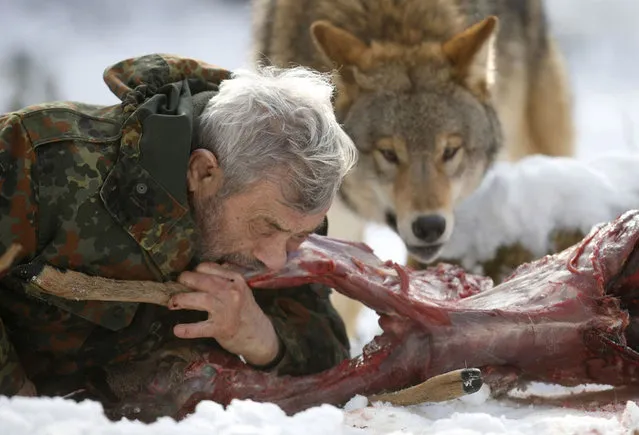
The Wolf Man

Wolfspark Werner Freund is a wolf sanctuary spread over 25 acres in western Germany. It is home to 29 wolves -- six distinct packs hailing from Europe, Siberia, Canada, the Arctic, and Mongolia. Researcher Werner Freund, 79, a former German paratrooper, established the sanctuary in 1972 and has raised more than 70 animals there over the last 40 years. He acquired the wolves as cubs from zoos or animal parks and has reared them mostly by hand. Werner has also taken to living closely with his wolves, behaving as an alpha male to earn their acceptance and respect. Reuters photographer Lisi Niesner recently spent some time with Freund and his wolves, capturing the interactions between these old friends.
Details
31 Jan 2013 15:50:00
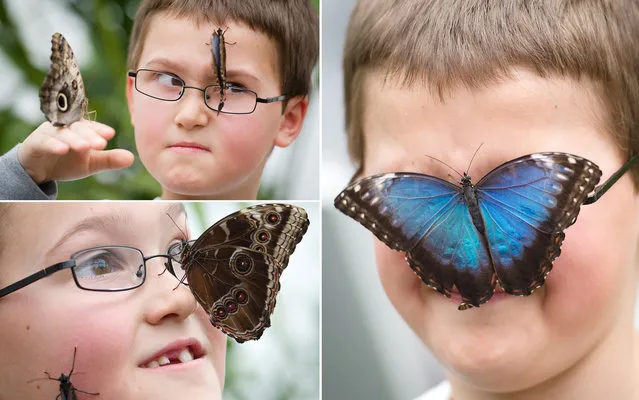
A boy poses with a butterfly on his face during a photocall to promote the "Sensational Butterflies" exhibition at the Natural History Museum in central London, on March 25, 2013.  With around 400 live tropical butterflies and moths living in the temporary facility, visitors will get the chance to see them flying freely as well as looking for emerging butterflies at the hatchery window. Running from March 29 to September 15, 2013, the exhibition is housed in a structure in the museum grounds. (Photo by Leon Neal/AFP Photo)

A boy poses with a butterfly on his face during a photocall to promote the “Sensational Butterflies” exhibition at the Natural History Museum in central London, on March 25, 2013. With around 400 live tropical butterflies and moths living in the temporary facility, visitors will get the chance to see them flying freely as well as looking for emerging butterflies at the hatchery window. Running from March 29 to September 15, 2013, the exhibition is housed in a structure in the museum grounds. (Photo by Leon Neal/AFP Photo)
Details
26 Mar 2013 13:37:00
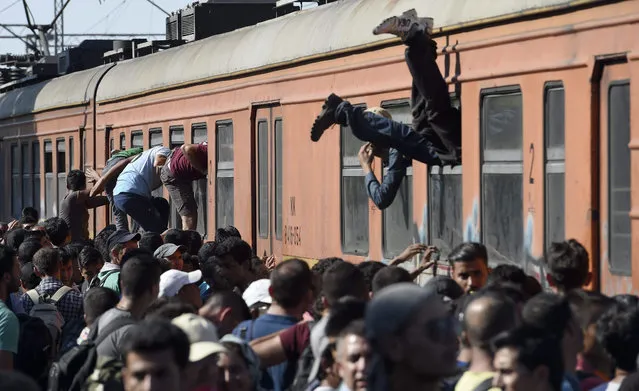
Migrants climb through the windows of a train bound for Serbia at the train station in Gevgelija, The Former Yugoslav Republic of Macedonia, 19 July 2015. Thousands of migrants who crossed Greece are on their way through Macedonia towards Serbia in order to access other European countries. (Photo by Georgi Licovski/EPA)

Migrants climb through the windows of a train bound for Serbia at the train station in Gevgelija, The Former Yugoslav Republic of Macedonia, 19 July 2015. Thousands of migrants who crossed Greece are on their way through Macedonia towards Serbia in order to access other European countries. Hungary in mid-July started to put up a fence on its border with Serbia, which makes the situation with the migrants in the transit countries even more complicated. The European countries on 20 July will discuss the quota of how many migrants each country should accept. (Photo by Georgi Licovski/EPA)
Details
20 Jul 2015 09:52:00