Loading...
Done
A woman carries water during during a visit by a European Union delegation, at an IDP camp in Azaza, east of Ad Damazin, capital of Blue Nile state, October 21, 2015. (Photo by Mohamed Nureldin Abdallah/Reuters)

A woman carries water during during a visit by a European Union delegation, at an IDP camp in Azaza, east of Ad Damazin, capital of Blue Nile state, October 21, 2015. The camp houses people displaced by war between the Sudan People's Liberation Movement-North (SPLM-N) rebels and the Sudanese government. (Photo by Mohamed Nureldin Abdallah/Reuters)
Details
24 Oct 2015 08:04:00
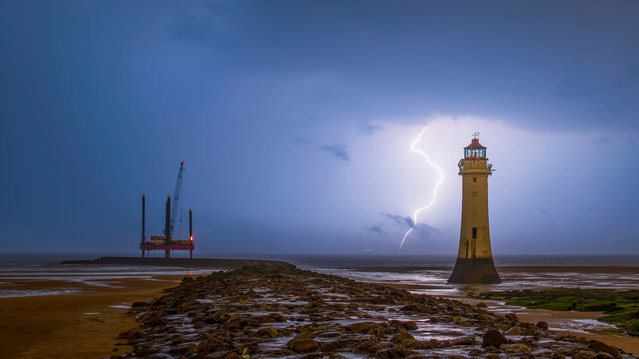
Lightning at Perch Rock Lighthouse in Merseyside, North West England on August 10, 2020. (Photo by Bav Media/The Sun)

Lightning strikes above Perch Rock Lighthouse in Merseyside, North West England on August 10, 2020. (Photo by Bav Media/The Sun)
Details
11 Dec 2020 00:03:00
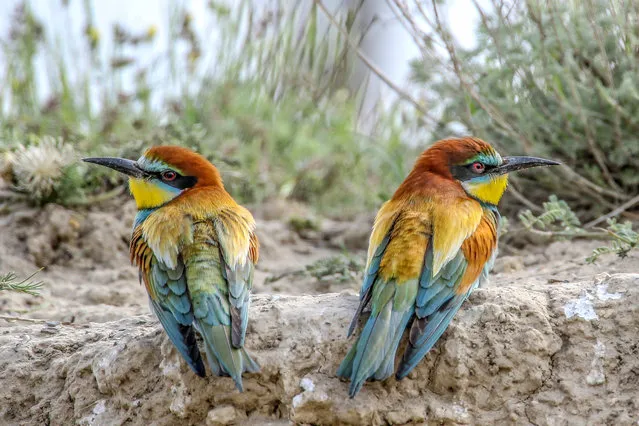
Meropidae are seen on a rock in Van in Turkey on March 03, 2018. (Photo by Ali Ihsan Ozturk/Anadolu Agency/Getty Images)

Meropidae are seen on a rock in Van in Turkey on March 03, 2018. (Photo by Ali Ihsan Ozturk/Anadolu Agency/Getty Images)
Details
11 Mar 2018 00:03:00
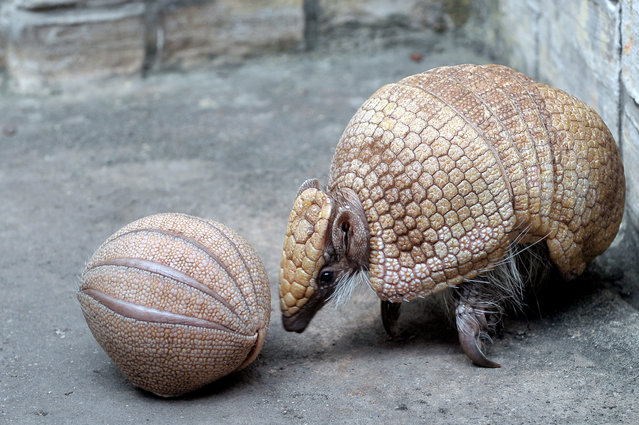
A four-week old southern three-banded armadillo (Tolypeutes matacus) is rolled up into a ball next to its mother in the tropical house of Budapest Zoo in Budapest, Hungary on May 3, 2019. The South American insect-eating mammal and its close relative, the Brasilian three-banded armadillo (Tolypeutes tricinctus) are the only two species of armadillos capable of rolling into a complete ball to defend themselves when feeling threatened. (Photo by Attila Kovács/EPA/EFE)

A four-week old southern three-banded armadillo (Tolypeutes matacus) is rolled up into a ball next to its mother in the tropical house of Budapest Zoo in Budapest, Hungary on May 3, 2019. The South American insect-eating mammal and its close relative, the Brasilian three-banded armadillo (Tolypeutes tricinctus) are the only two species of armadillos capable of rolling into a complete ball to defend themselves when feeling threatened. (Photo by Attila Kovács/EPA/EFE)
Details
05 May 2019 00:03:00
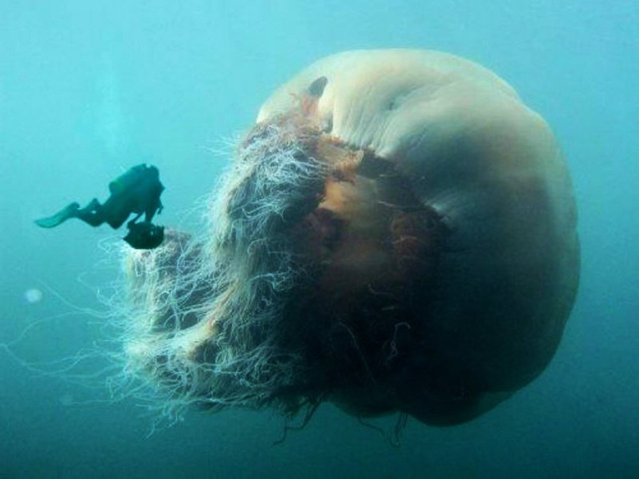
Giant Jellyfish Cyanea capillata

Cyanea capillata is the largest known species of jellyfish. Its range is confined to cold, boreal waters of the Arctic, northern Atlantic, and northern Pacific Oceans, seldom found farther south than 42°N latitude. Similar jellyfish, which may be the same species, are known to inhabit seas near Australia and New Zealand. The largest recorded specimen found, washed up on the shore of Massachusetts Bay in 1870, had a bell (body) with a diameter of 7 feet 6 inches (2.29 m) and tentacles 120 feet (37 m) long.Lion's mane jellyfish have been observed below 42°N latitude for some time—specifically in the larger bays of the east coast of the United States.
Details
24 Jul 2012 12:00:00
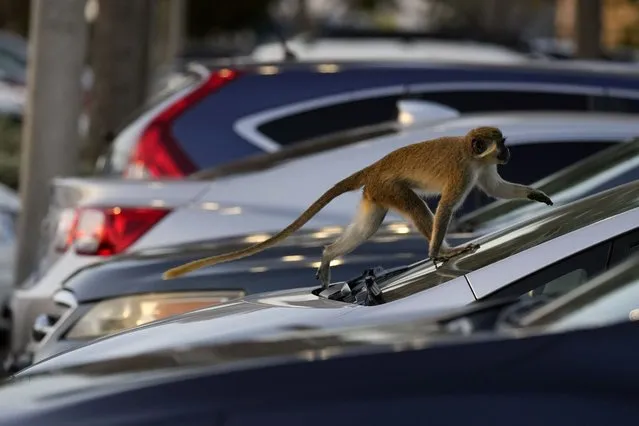
A vervet monkey walks over a parked car in the Park 'N Fly airport lot which lies adjacent to the mangrove preserve where the monkey colony lives, Tuesday, March 1, 2022, in Dania Beach, Fla. For 70 years, a group of non-native monkeys has made their home next to a South Florida airport, delighting visitors and becoming local celebrities. (Photo by Rebecca Blackwell/AP Photo)

A vervet monkey walks over a parked car in the Park 'N Fly airport lot which lies adjacent to the mangrove preserve where the monkey colony lives, Tuesday, March 1, 2022, in Dania Beach, Fla. For 70 years, a group of non-native monkeys has made their home next to a South Florida airport, delighting visitors and becoming local celebrities. (Photo by Rebecca Blackwell/AP Photo)
Details
07 Apr 2022 05:26:00
The Bratz Rock Angels are displayed at the Dream Toys 2005 Pre-Christmas Expo

The Bratz Rock Angels are displayed at the Dream Toys 2005 Pre-Christmas Expo on October 5, 2005 in London. (Photo by Daniel Berehulak/Getty Images)
Details
14 Dec 2011 13:27:00
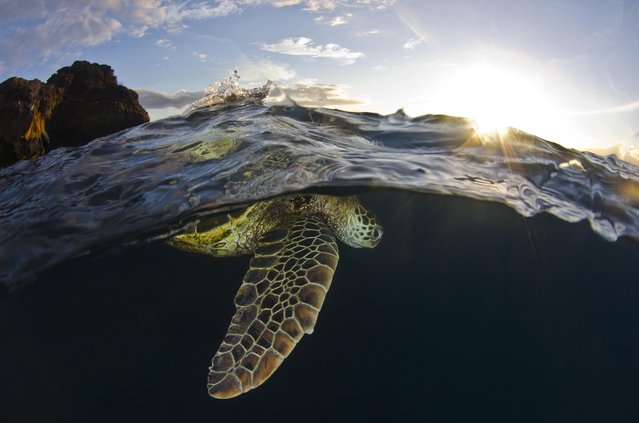
Breath at sunset, captures a sea turtle at a dive site called Black Rock. Kāʻanapali, Hawaiʻi, August 2013. (Photo by Christopher Doherty/Smithsonian.com)

Breath at sunset, captures a sea turtle at a dive site called Black Rock. Kāʻanapali, Hawaiʻi, August 2013. (Photo by Christopher Doherty/Smithsonian.com)
Details
28 Apr 2014 12:20:00