Loading...
Done
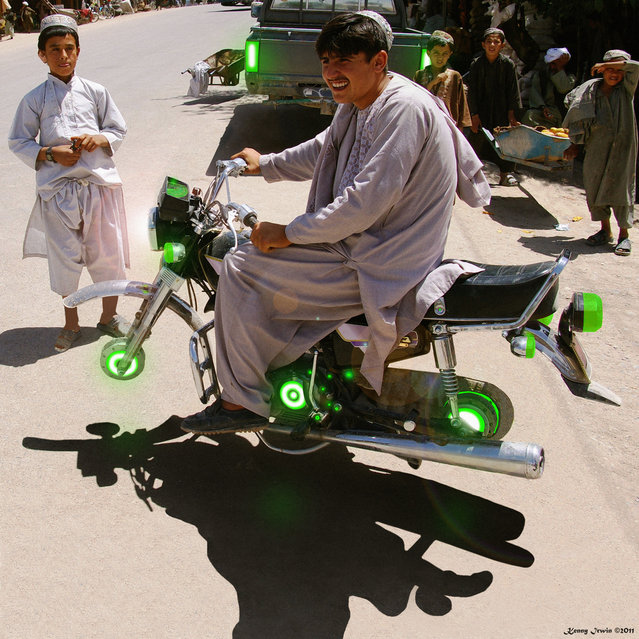
Mingora Hovoped Takes No Ordinary Rider. (Kenny Hassan Irwin)

“In the ongoing epics of the Pakistani Starfleet in their ever lasting quest to embrace and protect the freedoms of all humanity and life elsewhere in the cosmos we explore the future of Pakistan as a leader in advanced technology, diverse culture, exploration, helping to preserve peace & help those in need from the less than benign that reside in the darkest reaches of the cosmos to those who share & cherish kinship with all of humanity from the brightest reaches of the cosmos”. – Kenny Hassan Irwin

Mingora Hovoped Takes No Ordinary Rider. (Photo by Kenny Hassan Irwin)

Details
06 Dec 2012 12:15:00
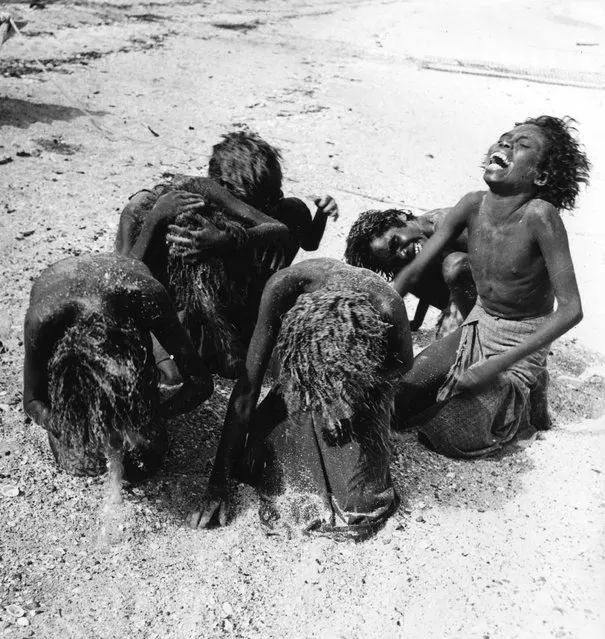
1st January 1950:  Aboriginal women washing their hair with sand at Arnhem land in the Northern Territory of Australia.  (Photo by Three Lions/Getty Images)

“Australian Aborigines are those people regarded as indigenous to the Australian continent. In the High Court of Australia, Australian Aborigines have been specifically identified as a group of people who share, in common, biological ancestry back to the original occupants of the continent”. – Wikipedia

Photo: Aboriginal women washing their hair with sand at Arnhem land in the Northern Territory of Australia. 1st January 1950. (Photo by Three Lions)
Details
02 Feb 2014 07:29:00
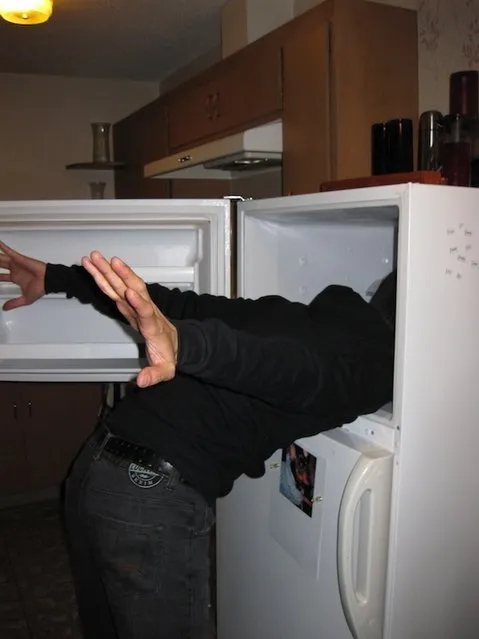
241543903 Heads In Freezer Part 2

241543903 (a.k.a “Heads in Freezers”) is a numerical keyword associated with a photo meme that involves people taking pictures with their heads in the freezer & sharing them online. By tagging a series of image files with a cryptic number, a high level of search engine optimization can be easily achieved. As a result, typing “241543903” into image search engines like Google Images successfully yields pages after pages of pictures showing people’s heads in freezers.
In 2009, David Horvitz started the “Heads in Freezers” meme. Participants took photos of their heads in freezers, tagged them with “241543903” and uploaded them to social media sites like Tumblr.
Details
12 Mar 2014 10:32:00
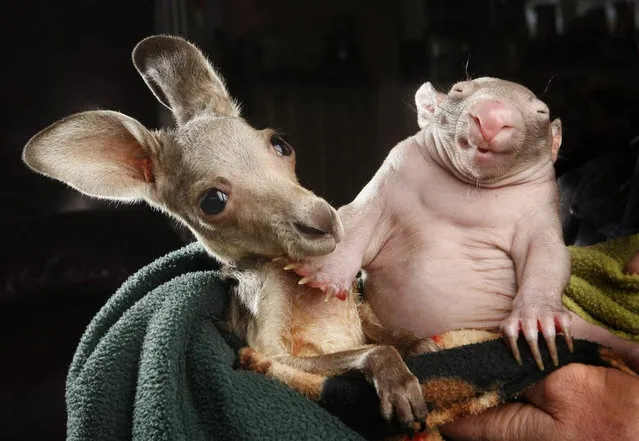
Orphaned Wombat Baby And Kangaroo Joey Are Best Friends

Opposites can attract and Anzac a doe-eyed baby kangaroo has become best friends with Peggy, a tiny squint-eyed wombat. Their unlikely union developed after the pair - both orphans - shared a pouch at the Wildlife Kilmore Rescue Centre in Victoria, Australia. At just over five months old, Anzac was brought to the centre after being rescued in the Macedon Ranges. The joey is in the mother kangaroo's pouch for about eight months, depending on the species, but Anzac was abandoned a few months before he was ready to be free.
Details
11 Oct 2013 10:11:00
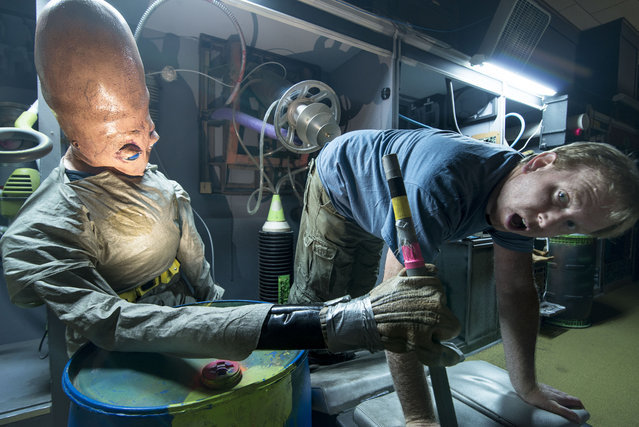
Chris has fun with one of the exhibits. (Photo by Chris Burton/Caters News Agency)

A UFO enthusiast who found himself locked in the iconic Roswell museum has shared the pictures he took with aliens to pass the time. Chris Burton, from the U.K., had dreamed of visiting Roswell, N.M., since he was a child but was stunned when he found himself locked in the International UFO Museum and Research Center during a recent trip. The 42-year-old used the unique opportunity to get interactive with the usually out of bounds exhibits and set up some funny snaps with the extraterrestrials – posing for a beer with one alien and taking a nap with another. (Photo by Chris Burton/Caters News Agency)
Details
24 Dec 2017 08:48:00
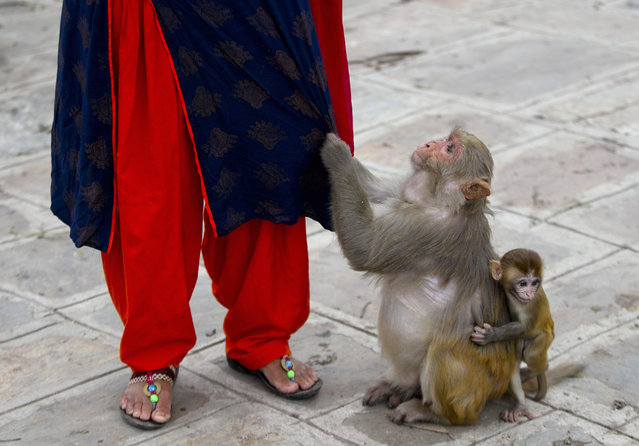
In this July 8, 2019, photo, a monkey pulls on the clothes of Saraswati Dangol as she arrives to feed monkeys in the forest near Pashupatinath temple in Kathmandu, Nepal. For the past four years, Dangol has been bringing the bread every day to feed the monkeys. As soon as they see her with her white sack, they gather around her, some patiently waiting for their turn while others less patiently snatching the bread from her hands. Many of Dangol's regulars are elderly, or are mother or baby monkeys who are unable to fight for their share of food in the wild. (Photo by Niranjan Shrestha/AP Photo)

In this July 8, 2019, photo, a monkey pulls on the clothes of Saraswati Dangol as she arrives to feed monkeys in the forest near Pashupatinath temple in Kathmandu, Nepal. For the past four years, Dangol has been bringing the bread every day to feed the monkeys. As soon as they see her with her white sack, they gather around her, some patiently waiting for their turn while others less patiently snatching the bread from her hands. Many of Dangol's regulars are elderly, or are mother or baby monkeys who are unable to fight for their share of food in the wild. (Photo by Niranjan Shrestha/AP Photo)
Details
26 Jul 2019 00:03:00
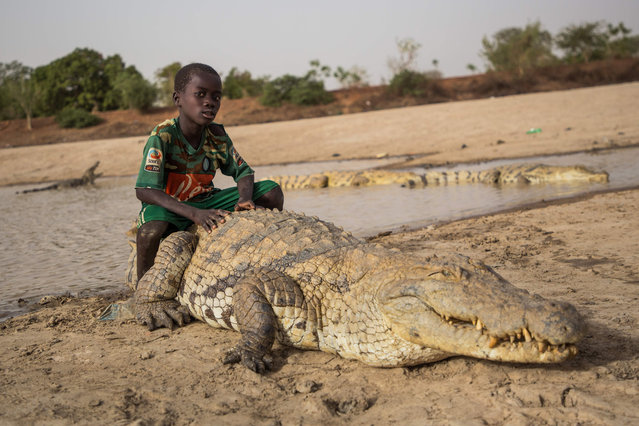
A boy sits on the back of a crocodile on May 19, 2018 at a pond in Bazoule in Burkina Faso, a village which happily shares its local pond with “sacred” crocodiles. Crocodiles may be one of the deadliest hunters in the animal kingdom, but in a small village in Burkina Faso it is not unusual to see someone sitting atop one of the fearsome reptiles. According to local legend, the startling relationship with the predators dates back to at least the 15 th century. The village was in the grip of an agonising drought until the crocodiles led women to a hidden pond where the population could slake their thirst. (Photo by Olympia de Maismont/AFP Photo)

A boy sits on the back of a crocodile on May 19, 2018 at a pond in Bazoule in Burkina Faso, a village which happily shares its local pond with “sacred” crocodiles. Crocodiles may be one of the deadliest hunters in the animal kingdom, but in a small village in Burkina Faso it is not unusual to see someone sitting atop one of the fearsome reptiles. According to local legend, the startling relationship with the predators dates back to at least the 15 th century. The village was in the grip of an agonising drought until the crocodiles led women to a hidden pond where the population could slake their thirst. (Photo by Olympia de Maismont/AFP Photo)
Details
17 Jul 2018 00:01:00
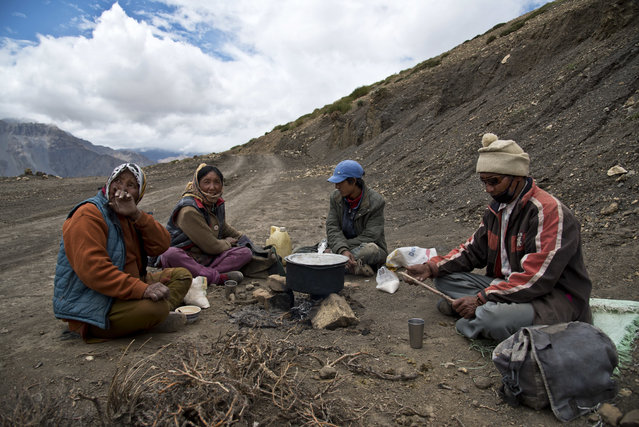
In this August 17, 2016, photo, from left to right, Chhering Chodom, 60, Tashi Yangzom, 50, Lobsang Chhering, 27, and Dorje Tandup, 58, drink milk tea on the side of the road. For centuries, the sleepy valley nestled in the Indian Himalayas remained a hidden Buddhist enclave forbidden to outsiders. Enduring the harsh year-round conditions of the high mountain desert, the people of Spiti Valley lived by a simple communal code – share the Earth's bounty, be hospitable to neighbors, and eschew greed and temptation at all turns. That's all starting to change, for better or worse. Since India began allowing its own citizens as well as outsiders to visit the valley in the early 1990s, tourism and trade have boomed. And the marks of modernization, such as solar panels, asphalt roads and concrete buildings, have begun to appear around some of the villages that dot the remote landscape at altitudes above 4,000 meters (13,000 feet). (Photo by Thomas Cytrynowicz/AP Photo)

In this August 17, 2016, photo, from left to right, Chhering Chodom, 60, Tashi Yangzom, 50, Lobsang Chhering, 27, and Dorje Tandup, 58, drink milk tea on the side of the road. For centuries, the sleepy valley nestled in the Indian Himalayas remained a hidden Buddhist enclave forbidden to outsiders. Enduring the harsh year-round conditions of the high mountain desert, the people of Spiti Valley lived by a simple communal code – share the Earth's bounty, be hospitable to neighbors, and eschew greed and temptation at all turns. That's all starting to change, for better or worse. (Photo by Thomas Cytrynowicz/AP Photo)
Details
15 Sep 2016 09:22:00