Loading...
Done
A year after hundreds of thousands of migrants and refugees snaked their way across southeastern Europe and onto television screens worldwide, the roads through the Balkans are now clear, depriving an arguably worsening tragedy of its poignant visibility. Europe's migrant crisis is at the very least numerically worse than it was last year. More people are arriving and more are dying. (Photo by Antonio Bronic/Reuters)

A year after hundreds of thousands of migrants and refugees snaked their way across southeastern Europe and onto television screens worldwide, the roads through the Balkans are now clear, depriving an arguably worsening tragedy of its poignant visibility. Reuters photographer, Antonio Bronic revisiting the people-packed locations where he and his colleagues captured last year's diaspora, found empty roads, unencumbered railway tracks and bucolic countryside. (Photo by Antonio Bronic/Reuters)


Details
12 Aug 2016 12:10:00
Children playing their smart phone during Lunar New Year's Eve celebrations at Fuk Ling Miau temple on January 28, 2025 in Yogyakarta, Indonesia. Chinese New Year, also known as Lunar New Year, will begin on January 29, 2025, marking the Year of the Snake. The celebrations, which last for approximately 15 days, are filled with traditional activities such as family gatherings, lion dances, and the exchange of red envelopes, making it a vibrant cultural event observed by Chinese communities worldwide. (Photo by Ulet Ifansasti/Getty Images)

Children playing their smart phone during Lunar New Year's Eve celebrations at Fuk Ling Miau temple on January 28, 2025 in Yogyakarta, Indonesia. Chinese New Year, also known as Lunar New Year, will begin on January 29, 2025, marking the Year of the Snake. The celebrations, which last for approximately 15 days, are filled with traditional activities such as family gatherings, lion dances, and the exchange of red envelopes, making it a vibrant cultural event observed by Chinese communities worldwide. (Photo by Ulet Ifansasti/Getty Images)
Details
25 Feb 2025 02:05:00
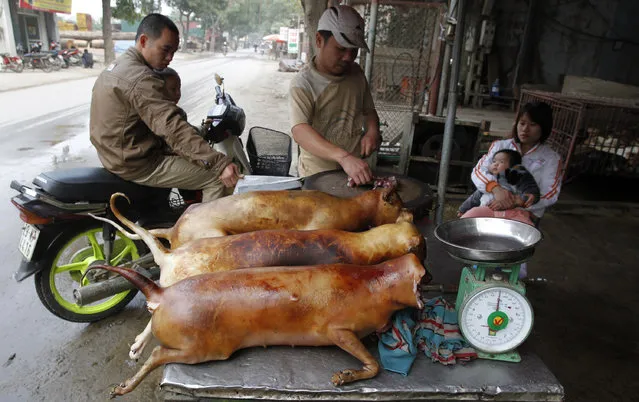
A vendor (C) cuts slaughtered dogs for sale at his roadside stall in Duong Noi village, outside Hanoi December 16, 2011. While animal rights activists have condemned eating dog meat as cruel treatment of the animals, it is still an accepted popular delicacy for some Vietnamese, as well in some other Asian countries. (Photo by Reuters/Kham)

A vendor (C) cuts slaughtered dogs for sale at his roadside stall in Duong Noi village, outside Hanoi December 16, 2011. While animal rights activists have condemned eating dog meat as cruel treatment of the animals, it is still an accepted popular delicacy for some Vietnamese, as well in some other Asian countries. Duong Noi is well-known as a dog-meat village, where hundreds of dogs are killed each day for sale as popular traditional food. Dog-eating as a custom is rooted in Vietnam and was developed as a result of poverty. One kilogram of dog meat costs about 130,000 dongs ($6.2). (Photo by Reuters/Kham)
Details
16 Jul 2013 11:40:00
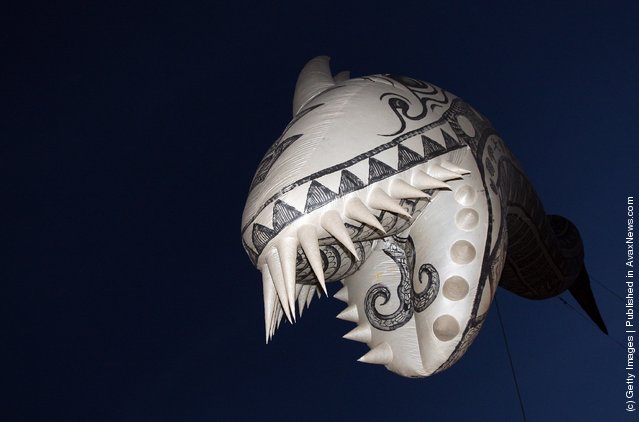
Plasticiens Volants Fly Inflatable Puppets Over Berlin

An inflatable snake hovers during a performance by the French street theater company Plasticiens Volants on September 4, 2011 in Berlin, Germany. The spectale, featuring gigantic flying inflatable fairy-tale creatures and performers on stilts and in costume was a part of celebrations for the 125th anniversary of the Kurfuerstendamm, known locally as the Ku'damm, a shopping boulevard. (Photo by Adam Berry/Getty Images)
Details
05 Sep 2011 12:56:00
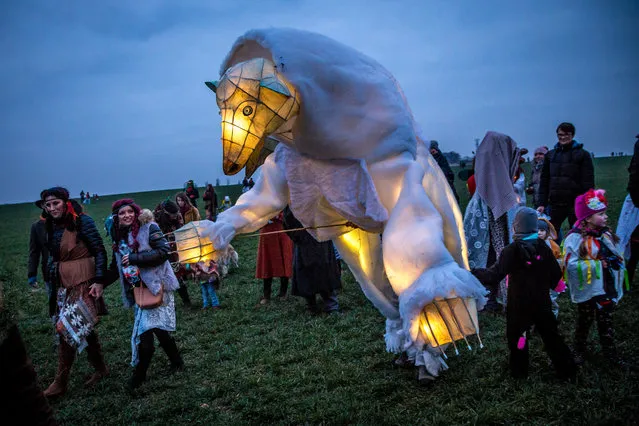
Parade participants during the traditional “Masopust Carnival” festival on February 13, 2018 in Roztoky near Prague, Czech Republic. Known as Masopust (literally, “giving up meat”), the festival was traditionally the last chance to eat and drink in excess before the austerity of Lent. (Photo by Margot Buff/RFE/RL)

Parade participants during the traditional “Masopust Carnival” festival on February 13, 2018 in Roztoky near Prague, Czech Republic. Known as Masopust (literally, “giving up meat”), the festival was traditionally the last chance to eat and drink in excess before the austerity of Lent. (Photo by Margot Buff/RFE/RL)
Details
14 Feb 2018 08:44:00
A protester from the People for the Ethical Treatment of Animals (PETA) displays a placard from a bathtub as a people looks on during a demonstration to call on the public to eat more vegetables to save water, in Sao Paulo on August 2, 2016. (Photo by Cris Faga via ZUMA Wire)

A protester from the People for the Ethical Treatment of Animals (PETA) displays a placard from a bathtub as a people looks on during a demonstration to call on the public to eat more vegetables to save water, in Sao Paulo on August 2, 2016. (Photo by Cris Faga via ZUMA Wire)
Details
03 Aug 2016 12:06:00
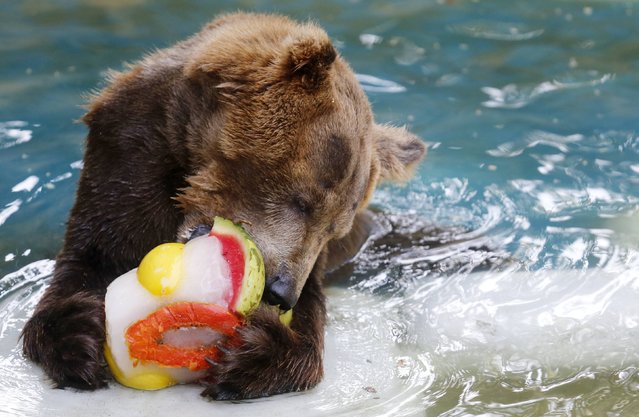
A grizzly bear eats a frozen fruits during a hot summer day at Rio de Janeiro's zoo January 13, 2015. According to a local climate institute, temperatures in Rio de Janeiro on Tuesday rose up to 34 degrees Celsius (93.2 degrees Fahrenheit). (Photo by Sergio Moraes/Reuters)

A grizzly bear eats a frozen fruits during a hot summer day at Rio de Janeiro's zoo January 13, 2015. According to a local climate institute, temperatures in Rio de Janeiro on Tuesday rose up to 34 degrees Celsius (93.2 degrees Fahrenheit). (Photo by Sergio Moraes/Reuters)
Details
14 Jan 2015 11:52:00
A woman eats candy in the shape of a phallus during the Kanamara Matsuri, or Iron Phallus Festival through a street near the Kanamara shrine in Kawasaki outside of Tokyo April 5, 2015. The festival celebrates fertility and is used to raise awareness and money for the prevention of sexually transmitted diseases. (Photo by Thomas Peter/Reuters)

A woman eats candy in the shape of a phallus during the Kanamara Matsuri, or Iron Phallus Festival through a street near the Kanamara shrine in Kawasaki outside of Tokyo April 5, 2015. The festival celebrates fertility and is used to raise awareness and money for the prevention of sexually transmitted diseases. (Photo by Thomas Peter/Reuters)
Details
11 Apr 2015 10:13:00