Loading...
Done
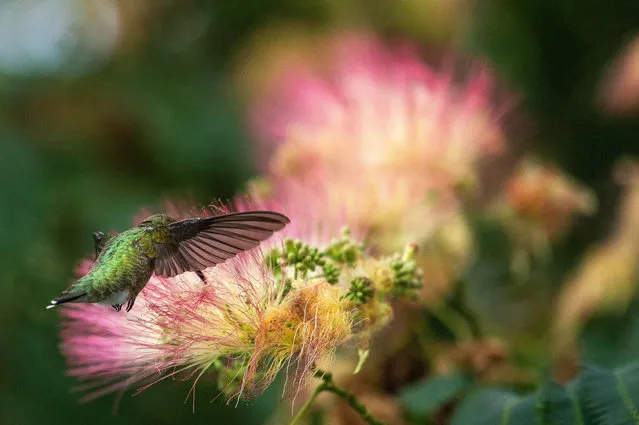
A hummingbird feeds on the nectar from a Mimosa tree in Saugus, Massachusetts on July 30, 2020. (Photo by Joseph Prezioso/ZUMA Wire/Rex Features/Shutterstock)

A hummingbird feeds on the nectar from a Mimosa tree in Saugus, Massachusetts on July 30, 2020. (Photo by Joseph Prezioso/ZUMA Wire/Rex Features/Shutterstock)
Details
16 Aug 2020 00:03:00
Racegoers in fashionable hats attend Ladies Day at Cheltenham Festival on March 15, 2017 in Cheltenham, England. (Photo by David Davies/PA Wire)

Racegoers in fashionable hats attend Ladies Day at Cheltenham Festival on March 15, 2017 in Cheltenham, England. (Photo by David Davies/PA Wire)
Details
21 Apr 2017 07:45:00
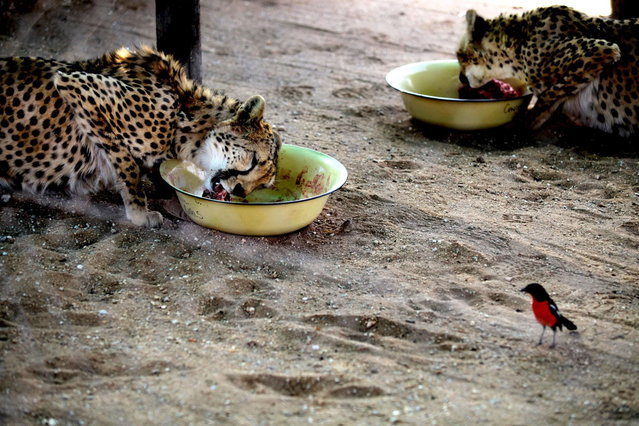
Young cheetahs eat meat at The Cheetah Conservation Fund (CCF) center in Otjiwarongo, Namibia, on August 13, 2013. The CCF started breeding Anatolian livestock dogs to promote cheetah-friendly farming after some 10,000 big cats – the current total worldwide population – were killed or moved off farms in the 1980s.  Up to 1,000 cheetahs were being killed a year, mostly by farmers who saw them as livestock killers. But the use of dogs has slashed losses for sheep and goat farmers and led to less retaliation against the vulnerable cheetah. (Photo by Jennifer Bruce/AFP Photo)

Young cheetahs eat meat at The Cheetah Conservation Fund (CCF) center in Otjiwarongo, Namibia, on August 13, 2013. The CCF started breeding Anatolian livestock dogs to promote cheetah-friendly farming after some 10,000 big cats – the current total worldwide population – were killed or moved off farms in the 1980s. Up to 1,000 cheetahs were being killed a year, mostly by farmers who saw them as livestock killers. But the use of dogs has slashed losses for sheep and goat farmers and led to less retaliation against the vulnerable cheetah. (Photo by Jennifer Bruce/AFP Photo)
Details
29 Aug 2013 10:56:00
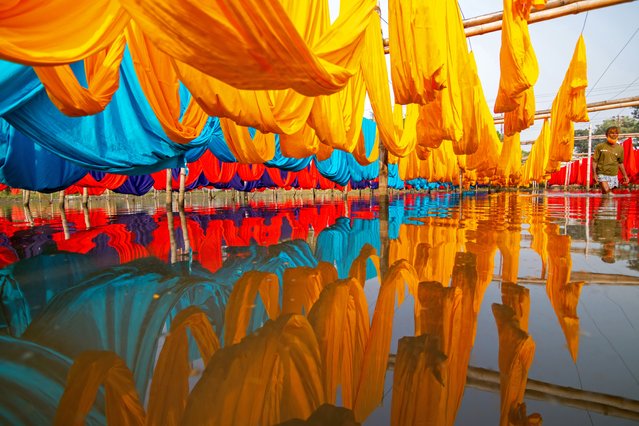
Workers hang thousands of different colorful fabrics on iron wires tied between a bamboo framework and constantly turn them so that they dry perfectly in a flooded field in Narayanganj, Bangladesh on March 16, 2022. Iron wires are used between a bamboo framework to create giant washing lines for the final part of the dying process as the fabrics are dried in the sun. Bright strands of blue, pink, orange and green-dyed cloths hang above the grassy field in a dazzling network of interlocking colors. This is the final part of the dying process after which the cloth is made into t-shirts and vests at the garment factory. (Photo by Joy Saha/ZUMA Press Wire/Rex Features/Shutterstock)

Workers hang thousands of different colorful fabrics on iron wires tied between a bamboo framework and constantly turn them so that they dry perfectly in a flooded field in Narayanganj, Bangladesh on March 16, 2022. (Photo by Joy Saha/ZUMA Press Wire/Rex Features/Shutterstock)
Details
25 Mar 2022 05:47:00


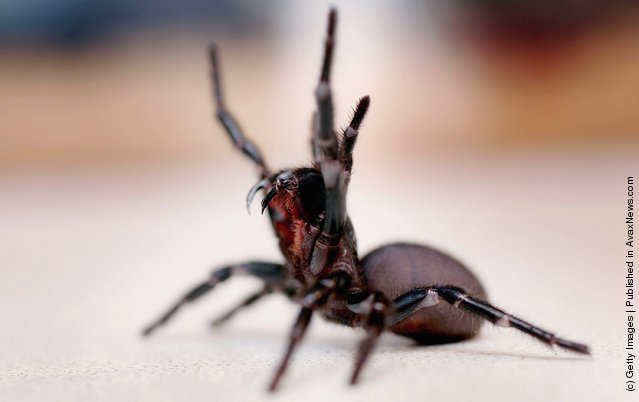
A Funnel Web spider is pictured at the Australian Reptile Park January 23, 2006 in Sydney, Australia. The Funnel Web is one of Australia's deadliest animals, with a venom that is packed with at least 40 different toxic proteins. A bite from a Funnel Web causes massive electrical over-load in the body's nervous system. Finally, fatalities occur from either heart attack or a pulmonary oedema, where the capillaries around the lungs begin to leak fluid and the patient effectively drowns. Death can come as quickly as two hours after a bite if no medical treatment is sought. Due to advances in anti-venom, there has been no death from a Funnel Web bite in Australia since 1980. Australia is home to some of the most deadly and poisonous animals on earth. (Photo by Ian Waldie/Getty Images)
Details
25 Apr 2011 07:49:00
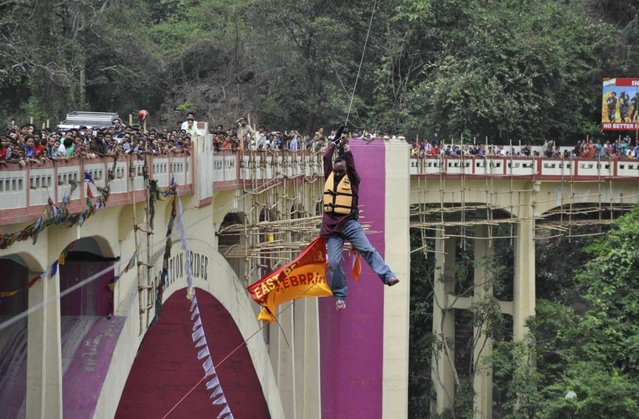
In this Sunday, April 28, 2013 photograph, people watch as Indian Sailendra Nath Roy attempts to cross Teesta river suspended from a zip wire attached to his ponytail moments before his death in Siliguri, West Bengal state, India. Roy who was named a Guinness World Record holder in 2011 for travelling the farthest distance on a zip wire using hair died during the stunt Sunday when he suffered a heart attack. (Photo by AP Photo)

In this Sunday, April 28, 2013 photograph, people watch as Indian Sailendra Nath Roy attempts to cross Teesta river suspended from a zip wire attached to his ponytail moments before his death in Siliguri, West Bengal state, India. Roy who was named a Guinness World Record holder in 2011 for travelling the farthest distance on a zip wire using hair died during the stunt Sunday when he suffered a heart attack. (Photo by AP Photo)
Details
30 Apr 2013 08:21:00
Chinese artist Zhou Jie takes a nap on an unfinished iron wire bed, one of her sculpture works, after lunch as a friend of hers looks on at Beijing Now Art Gallery, in Beijing August 11, 2014. (Photo by Jason Lee/Reuters)

Chinese artist Zhou Jie takes a nap on an unfinished iron wire bed, one of her sculpture works, after lunch as a friend of hers looks on at Beijing Now Art Gallery, in Beijing August 11, 2014. Zhou started her art project titled “36 Days” on August 9, in which she would live inside an exhibition hall with an unfinished iron wire bed, some iron wire sculptures in the shape of stuffed animal dolls, a certain amount of food and her mobile phone, for 36 days. The entire process is open to visitors and she may also interact with them, according to Zhou. (Photo by Jason Lee/Reuters)
Details
16 Aug 2014 10:37:00
Protestors from the Extinction Rebellion march on day six of protests stopping traffic in the city district of Melbourne, Australia on October 12, 2019. (Photo by ydney Low/ZUMA Wire/Rex Features/Shutterstock)

Protestors from the Extinction Rebellion march on day six of protests stopping traffic in the city district of Melbourne, Australia on October 12, 2019. (Photo by ydney Low/ZUMA Wire/Rex Features/Shutterstock)
Details
14 Oct 2019 00:07:00