Loading...
Done
A rescued red fox rests under a closet at “Pawsitive Beginnings” fox rescue sanctuary in Key Largo, Florida, USA on August 1, 2023. Pawsitive Beginnings is a nonprofit group that works closely with organizations in parts of the USA where fur farming takes place to find permanent placement for foxes when needed. According to Pawsitive Beginnings, about 300 fur farms operate in the United States and there are very few federal laws to regulate the treatment of these animals born in captivity, raised for one year, and then killed for their coats. (Photo by Cristobal Herrera-Ulashkevich/EPA/EFE)

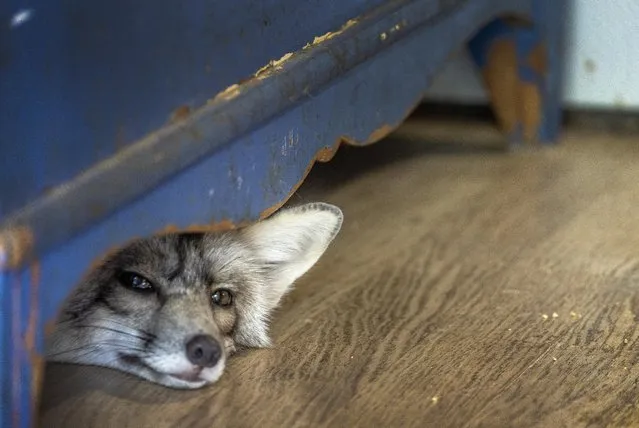
A rescued red fox rests under a closet at “Pawsitive Beginnings” fox rescue sanctuary in Key Largo, Florida, USA on August 1, 2023. Pawsitive Beginnings is a nonprofit group that works closely with organizations in parts of the USA where fur farming takes place to find permanent placement for foxes when needed. According to Pawsitive Beginnings, about 300 fur farms operate in the United States and there are very few federal laws to regulate the treatment of these animals born in captivity, raised for one year, and then killed for their coats. (Photo by Cristobal Herrera-Ulashkevich/EPA/EFE)
Details
13 Aug 2023 05:02:00
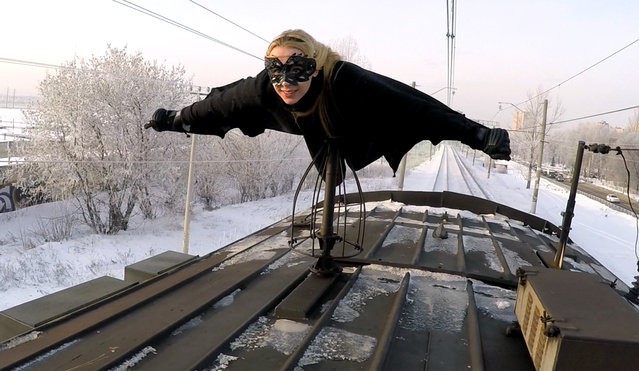
Rush-hour in Russia means one thing for this daredevil: train surfing! The 19-year-old daredevil who goes by the name Kobzarro started train surfing aged 15 as a way of escaping an oppressive family life. Here Kobzarro can be seen balanced on top of a train as it speeds through the wintery Russian environment. Kobzarro is so dedicated to train surfing that she rarely gets inside a train. Even in winter she prefers to travel in this less conventional way. It has resulted in a few run ins with the law, but Kobzarro says it has never resulted in anything more serious than a fine, with many police officers even being interested in the train surfing community. (Photo by Caters News Agency)

Rush-hour in Russia means one thing for this daredevil: train surfing! The 19-year-old daredevil who goes by the name Kobzarro started train surfing aged 15 as a way of escaping an oppressive family life. Here Kobzarro can be seen balanced on top of a train as it speeds through the wintery Russian environment. Kobzarro is so dedicated to train surfing that she rarely gets inside a train. Even in winter she prefers to travel in this less conventional way. It has resulted in a few run ins with the law, but Kobzarro says it has never resulted in anything more serious than a fine, with many police officers even being interested in the train surfing community. (Photo by Caters News Agency)
Details
11 Nov 2016 08:28:00
In this photo taken Friday, September 4, 2015, tourists Sarah and John Scott from Worcester, England, take a step back as a male silverback mountain gorilla from the family of mountain gorillas named Amahoro, which means “peace” in the Rwandan language, unexpectedly steps out from the bush to cross their path in the dense forest on the slopes of Mount Bisoke volcano in Volcanoes National Park, northern Rwanda. (Photo by Ben Curtis/AP Photo)

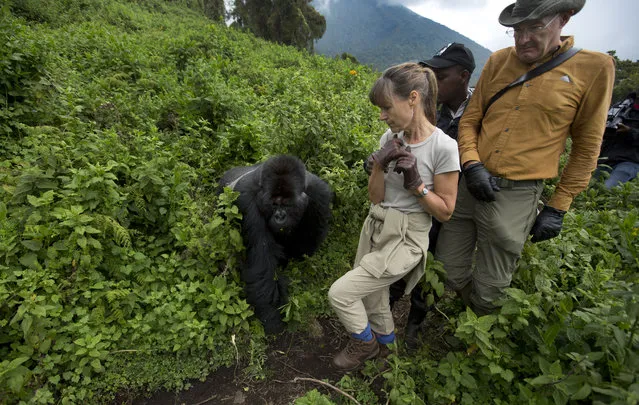
In this photo taken Friday, September 4, 2015, tourists Sarah and John Scott from Worcester, England, take a step back as a male silverback mountain gorilla from the family of mountain gorillas named Amahoro, which means “peace” in the Rwandan language, unexpectedly steps out from the bush to cross their path in the dense forest on the slopes of Mount Bisoke volcano in Volcanoes National Park, northern Rwanda. Deep in Rwanda's steep-sloped forest, increasing numbers of tourists are heading to see the mountain gorillas, a subspecies whose total population is an estimated 900 and who also live in neighboring Uganda and Congo, fueling an industry seen as key to the welfare of the critically endangered species as well as Rwanda's economy. (Photo by Ben Curtis/AP Photo)
Details
18 Sep 2015 14:55:00
The Wildscreen festival is the world’s biggest celebration of screen-based natural history storytelling which takes place every two years in Bristol. Here: “Walrus in Midnight Sun”. Walrus feed mostly on bivalves in productive, shallow and often sandy habitats in the Arctic. This individual, though, arrived on a beach outside Tromsø, northern Norway, and found comfort on a stranded dead sperm whale. After two weeks he approached Audun, and only half a metre away he stretched his tusk forward and touched his hand gently. “This was one of the most memorable moments of my life”, Rikardsen says. He named the 500kg male Buddy. After two months, the dead whale was decomposed and Buddy suddenly disappeared. (Photo by Audun Rikardsen/Wildscreen 2016)

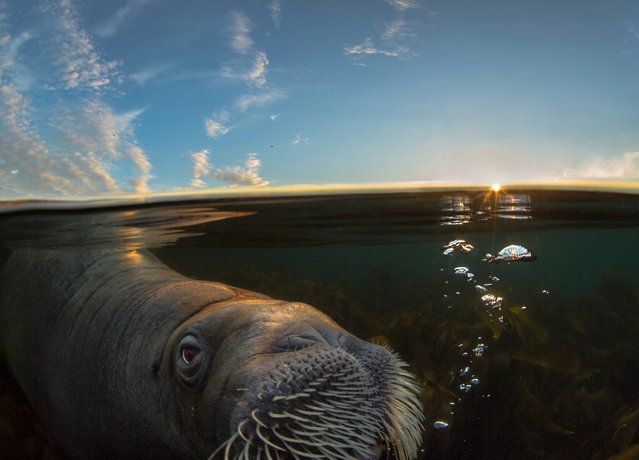
The Wildscreen festival is the world’s biggest celebration of screen-based natural history storytelling which takes place every two years in Bristol. Here: “Walrus in Midnight Sun”. Walrus feed mostly on bivalves in productive, shallow and often sandy habitats in the Arctic. This individual, though, arrived on a beach outside Tromsø, northern Norway, and found comfort on a stranded dead sperm whale. After two weeks he approached Audun, and only half a metre away he stretched his tusk forward and touched his hand gently. “This was one of the most memorable moments of my life”, Rikardsen says. He named the 500kg male Buddy. After two months, the dead whale was decomposed and Buddy suddenly disappeared. (Photo by Audun Rikardsen/Wildscreen 2016)
Details
07 Oct 2016 10:02:00
In this February 22, 2021, file photo, climate activist Disha Ravi, 22, travels in a car as she is taken to a court in New Delhi, India. To her friends, Ravi, was most concerned about her future in a world where temperatures are rising. But her life changed last month as she became a household name in the country, dominating news coverage after police charged her with sedition, a colonial-era law which carries a sentence up to life. Her alleged crime: sharing an online document to help amplify months-long farmer protests in India on Twitter. She was released after 10 days in custody. (Photo by Dinesh Joshi/AP Photo/File)

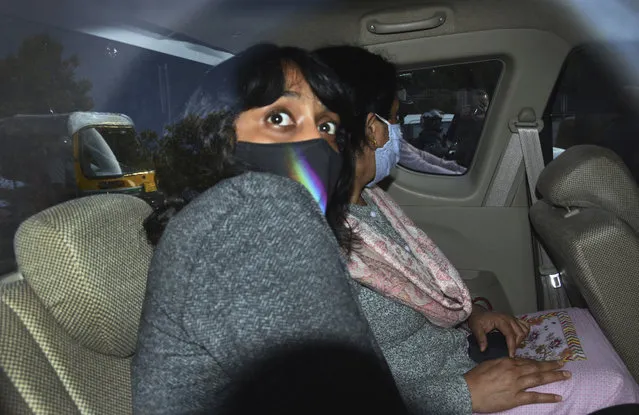
In this February 22, 2021, file photo, climate activist Disha Ravi, 22, travels in a car as she is taken to a court in New Delhi, India. To her friends, Ravi, was most concerned about her future in a world where temperatures are rising. But her life changed last month as she became a household name in the country, dominating news coverage after police charged her with sedition, a colonial-era law which carries a sentence up to life. Her alleged crime: sharing an online document to help amplify months-long farmer protests in India on Twitter. She was released after 10 days in custody. (Photo by Dinesh Joshi/AP Photo/File)
Details
12 Mar 2021 09:56:00
A handout photo made available by the World Press Photo (WPP) organization on 13 February 2017 shows a picture by Rossiya Segodnya photographer Valery Melnikov that won the Long-Term Projects – First Prize award of the 60th annual World Press Photo Contest, it was announced by the WPP Foundation in Amsterdam, The Netherlands on 13 February 2017. Caption: Civilians escape from a fire at a house destroyed by an air attack in the Luhanskaya village. Story: Ordinary people became victims of the conflict between self-proclaimed republics and the official Ukrainian authorities from 2014 onwards in the region of Donbass. Disaster came into their lives unexpectedly. These people were involved in the military confrontation against their will. They experienced the most terrible things: the death of their friends and relatives, destroyed homes and the ruined lives of thousands of people. (Photo by Valery Melnikov/EPA/Rossiya Segodnya/World Press Photo)

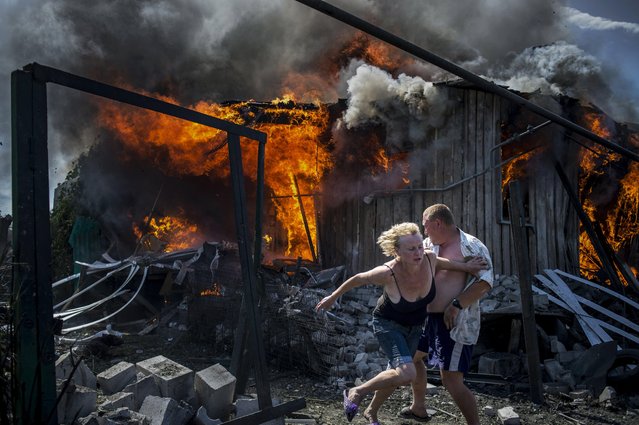
A handout photo made available by the World Press Photo (WPP) organization on 13 February 2017 shows a picture by Rossiya Segodnya photographer Valery Melnikov that won the Long-Term Projects – First Prize award of the 60th annual World Press Photo Contest, it was announced by the WPP Foundation in Amsterdam, The Netherlands on 13 February 2017. Caption: Civilians escape from a fire at a house destroyed by an air attack in the Luhanskaya village. (Photo by Valery Melnikov/EPA/Rossiya Segodnya/World Press Photo)
Details
15 Feb 2017 00:06:00
Faruk, 17, a Rohingya refugee trader holds betel leaves which are on sale at a stall in Palong Khali refugee camp near Cox's Bazar, Bangladesh, November 3, 2017. He left his village in Myanmar when the military opened fire towards the Rohingya. “I buy this betel leaf from Palong Khali market, in one bundle there are 160 pieces, I buy it for 80 taka and I sell it for 100 taka. Bangladeshi's and I sell for the same rate in the camp. Outside in the local market it is 80 taka per bundle. My problem is that I don't have money so I can't buy anything to eat, I can't buy fish to eat”, he said. (Photo by Hannah McKay/Reuters)

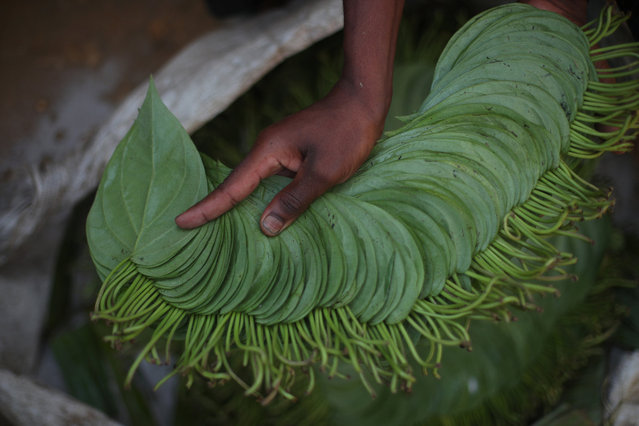
Faruk, 17, a Rohingya refugee trader holds betel leaves which are on sale at a stall in Palong Khali refugee camp near Cox's Bazar, Bangladesh, November 3, 2017. He left his village in Myanmar when the military opened fire towards the Rohingya. “I buy this betel leaf from Palong Khali market, in one bundle there are 160 pieces, I buy it for 80 taka and I sell it for 100 taka (1 Bangladeshi Taka = 0.012 US Dollar). Bangladeshi's and I sell for the same rate in the camp. Outside in the local market it is 80 taka per bundle. My problem is that I don't have money so I can't buy anything to eat, I can't buy fish to eat”, he said. (Photo by Hannah McKay/Reuters)
Details
27 Nov 2017 08:54:00
Young Lebanese women wearing protective masks and gloves against the coronavirus pandemic, stand on August 5, 2020 amid the rubble in Beirut's Gimmayzeh commercial district which was heavily damaged by the previous day's powerful explosion that tore through Lebanon's capital, resulting from the ignition of a huge depot of ammonium nitrate at the city's main port. Rescuers searched for survivors in Beirut after a cataclysmic explosion at the port sowed devastation across entire neighbourhoods, killing more than 100 people, wounding thousands and plunging Lebanon deeper into crisis. The blast, which appeared to have been caused by a fire igniting 2,750 tonnes of ammonium nitrate left unsecured in a warehouse, was felt as far away as Cyprus, some 150 miles (240 kilometres) to the northwest. (Photo by AFP Photo/Stringer)

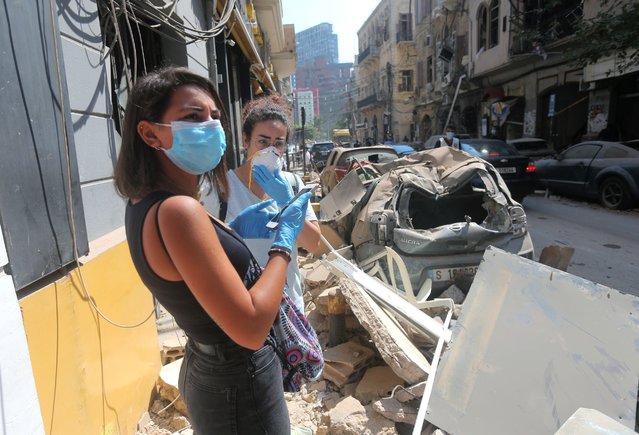
Young Lebanese women wearing protective masks and gloves against the coronavirus pandemic, stand on August 5, 2020 amid the rubble in Beirut's Gimmayzeh commercial district which was heavily damaged by the previous day's powerful explosion that tore through Lebanon's capital, resulting from the ignition of a huge depot of ammonium nitrate at the city's main port. Rescuers searched for survivors in Beirut after a cataclysmic explosion at the port sowed devastation across entire neighbourhoods, killing more than 100 people, wounding thousands and plunging Lebanon deeper into crisis. The blast, which appeared to have been caused by a fire igniting 2,750 tonnes of ammonium nitrate left unsecured in a warehouse, was felt as far away as Cyprus, some 150 miles (240 kilometres) to the northwest. (Photo by AFP Photo/Stringer)
Details
10 Aug 2020 00:05:00