People gather outside Red Square and the Kremlin for the New Year celebrations in downtown Moscow late on December 31, 2023. (Photo by Tatyana Makeyeva/AFP Photo)
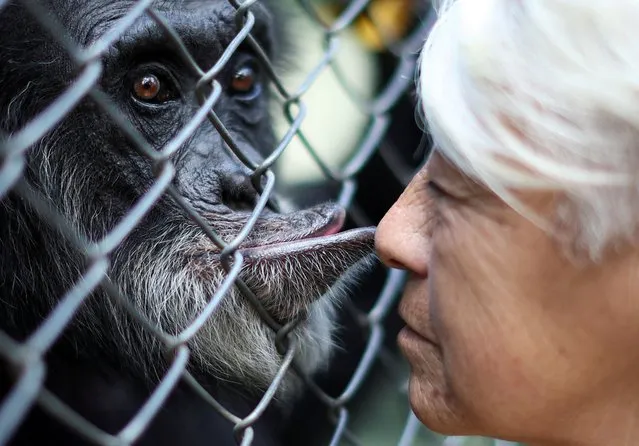
Keeper Silvia Salvatierra, 59, is kissed by a chimp named “Jony”, 54, who was rescued from a circus, at the Lujan Zoo from where felines, including tigers and lions, will be transferred to a wildlife sanctuary in India, in Lujan, on the outskirts of Buenos Aires, Argentina on April 8, 2024. (Photo by Agustin Marcarian/Reuters)
Honda MotoGP rider Dani Pedrosa (R) of Spain sprays champagne on an attendant next to Yamaha MotoGP rider Valentino Rossi (C) of Italy after winning the Japanese Grand Prix at the Twin Ring Motegi circuit in Motegi, north of Tokyo, Japan, October 11, 2015. Rossi placed second. (Photo by Issei Kato/Reuters)
Yerevan residents celebrate Armenian Prime Minister's Serzh Sargsyan's resignation in Yerevan, Armenia, Monday, April 23, 2018. Sargsyan resigned unexpectedly on Monday, an apparent move to bring to an end massive anti-government protests. (Photo by Amos Chapple/RFE/RL)
“The most serious health problem in the U.S. today is obesity.” Sounds familiar, doesn’t it? But that pronouncement about obesity’s primacy in the hierarchy of national health problems is not new. Rather, it’s the opening line to a remarkable article published 60 years ago in LIFE magazine. This photographs made by Martha Holmes to illustrate that March 1954 article, titled “The Plague of Overweight.” Photo: Dorothy Bradley (left), photographed for LIFE magazine article on obesity, 1949. (Photo by Martha Holmes/Time & Life Pictures)
A woman holds her umbrella while walking against strong winds as Typhoon Chan-hom approaches Taiwan, in Taipei, July 10, 2015. (Photo by Pichi Chuang/Reuters)
Visitors walk past a family of scarecrows during the Scarecrow Festival in Heather, Britain July 29, 2015. The annual event asks residents of Heather to make scarecrows to raise thousands of pounds for local groups and charities. (Photo by Darren Staples/Reuters)
Merit: A Night at Deadvlei. The night before returning to Windhoek, we spent several hours at Deadveli. The moon was bright enough to illuminate the sand dunes in the distance, but the skies were still dark enough to clearly see the milky way and magellanic clouds. Deadveli means “dead marsh. The camelthorn trees are believed to be about 900 years old, but have not decomposed because the environment is so dry. (Photo and caption by Beth McCarley/National Geographic Traveler Photo Contest)