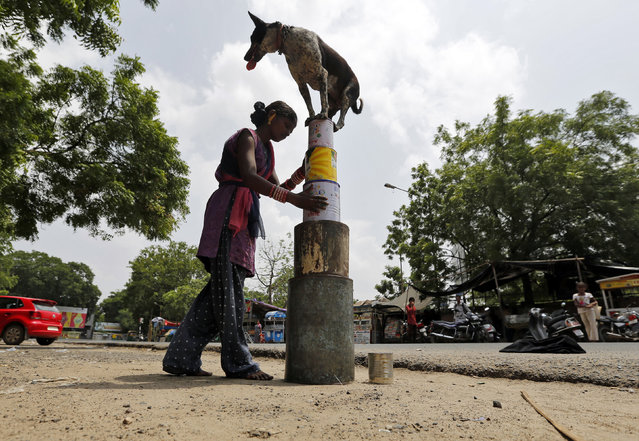
Savita, a street performer, helps her dog to balance on empty tin containers as they perform at a roadside in Ahmedabad September 7, 2014. (Photo by Amit Dave/Reuters)
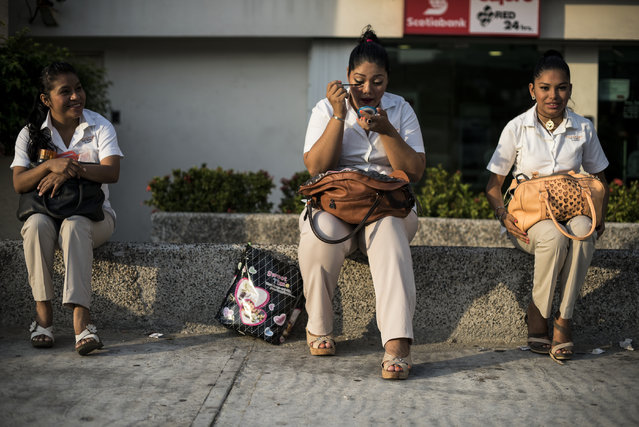
Employees of the Park Royal resort wait for a shuttle to take them to work early in the morning on April 2, 2015 in Acapulco, Mexico. Despite problems with cartel violence Semana Santa is one of the biggest tourist weeks of the year in Acapulco, a city whose entire economy depends on tourism, and officials expect around 350,000 mostly Mexican visitors this week. (Photo by Jonathan Levinson/The Washington Post)
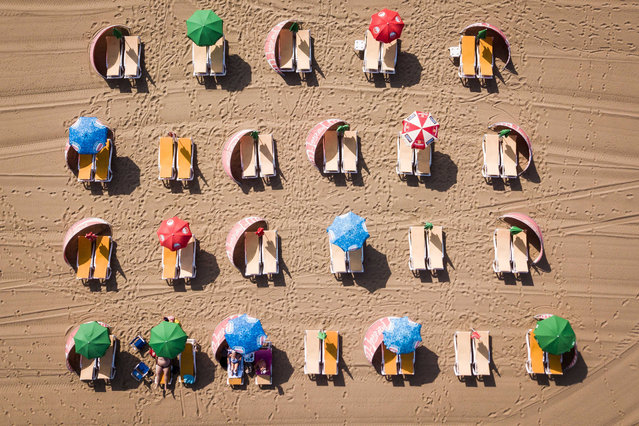
An image taken with a drone shows beach umbrellas and deck chairs as beachgoers enjoy the hot weather in Scheveningen, the Netherlands, 24 July 2019. The Royal Dutch Meteorological Institute has issued an official warning due to high temperatures affecting the country as well as Western Europe. (Photo by Sem van der Wal/EPA/EFE)
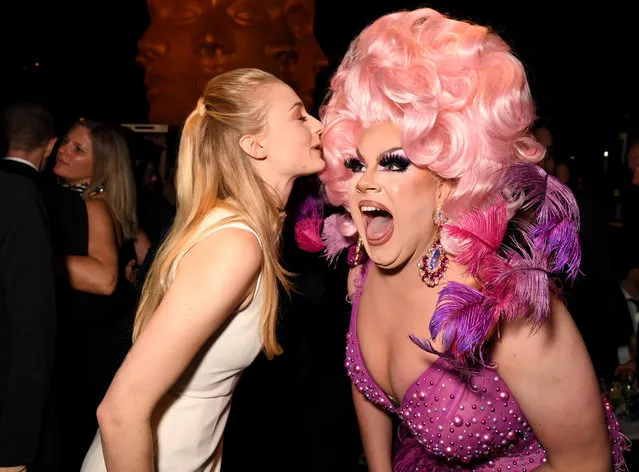
Sophie Turner (L) attends HBO's Official 2019 Emmy After Party on September 22, 2019 in Los Angeles, California. (Photo by Jeff Kravitz/FilmMagic for HBO)
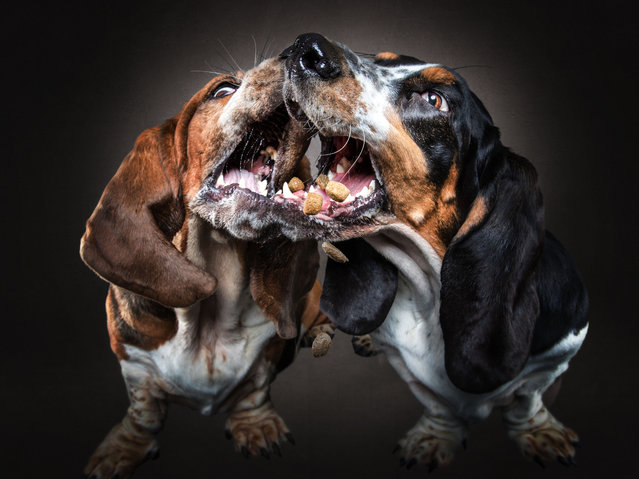
A photographer tested the concentration of several pairs of dogs as he captured their reactions to treat time in a series of shots. Christian Vieler, 47, of Waltrop, Germany, has been a professional dog photographer since 2016. He came up with the idea of snapping two dogs catching treats simultaneously. Here: Basset Hounds. (Photo by Vieler Photography/Caters News Agency)
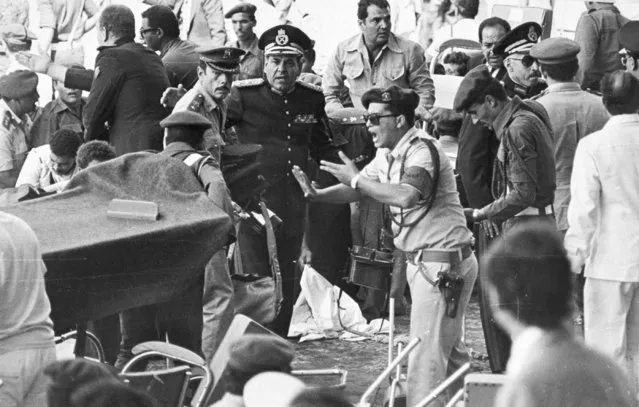
An Egyptian security guard screams at people as medics bring in a stretcher to carry the wounded after the attack which killed President Anwar Sadat, October 6, 1981, as he watched a military parade. (Photo by AP Photo)
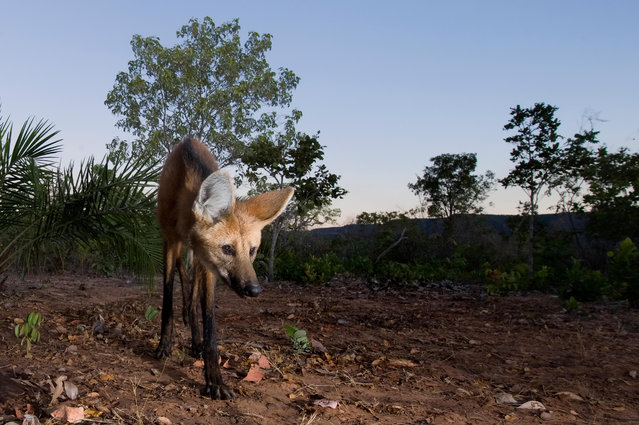
Global wildlife populations will decline by 67% by 2020 unless urgent action is taken to reduce human impact on species and ecosystems, warns the biennial Living Planet Index report from WWF (World Wide Fund for Nature) and ZSL (Zoological Society of London). From elephants to eels, here are some of the wildlife populations most affected by human activity. Here: The maned wolf is among the large mammals in the Brazilian Cerrado that are threatened by the increasing conversion of grasslands into farmland for grazing and growing crops. (Photo by Ben Cranke/Nature Picture Library/Alamy Stock Photo)