Loading...
Done
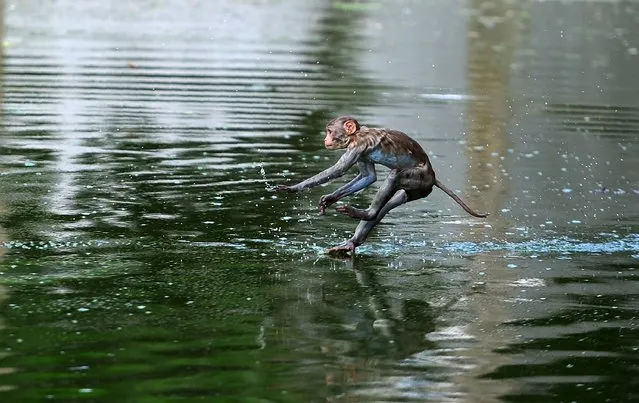
A monkey leaps into a pond on a hot day in Allahabad on May 19, 2017. According to local reports temperatures have soared in the northern Indian city to 47.28 Celsius. (Photo by Sanjay Kanojia/AFP Photo)

A monkey leaps into a pond on a hot day in Allahabad on May 19, 2017. According to local reports temperatures have soared in the northern Indian city to 47.28 Celsius. (Photo by Sanjay Kanojia/AFP Photo)
Details
21 May 2017 08:31:00
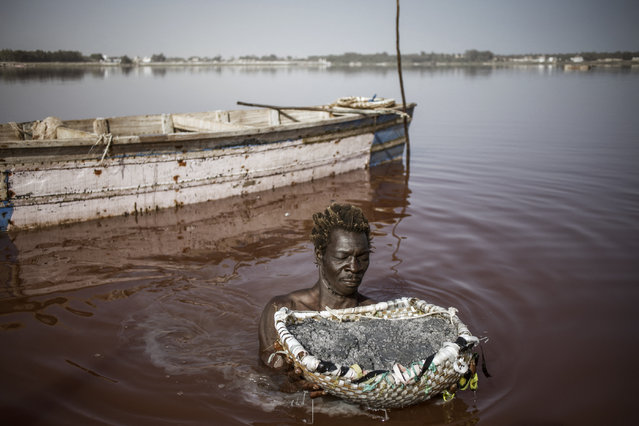
Toure, a Gambian salt harvester, holds a basket filled with  the salt collected from the crust of the bottom of the Lake Retba (Pink Lake) in Senegal on March 16, 2021. Lake Retba, divided from the Atlantic Ocean by a narrow corridor of dunes, owes its name to the pink waters caused by the Dunaliella salina algae and is known for its high salt content, up to 40% in some areas. (Photo by Marco Longari/AFP Photo)

Toure, a Gambian salt harvester, holds a basket filled with the salt collected from the crust of the bottom of the Lake Retba (Pink Lake) in Senegal on March 16, 2021. Lake Retba, divided from the Atlantic Ocean by a narrow corridor of dunes, owes its name to the pink waters caused by the Dunaliella salina algae and is known for its high salt content, up to 40% in some areas. (Photo by Marco Longari/AFP Photo)
Details
24 Mar 2021 10:29:00
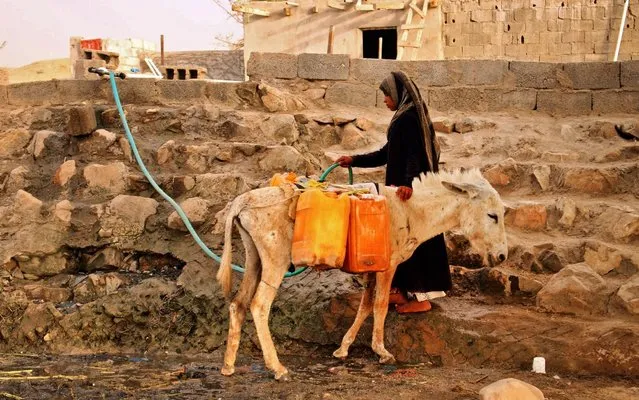
A displaced Yemeni woman from Hodeida fills water containers at a make-shift camp in a village in the northern district of Abs in the country's Hajjah province, on May 9, 2019. The Yemeni conflict has triggered what the United Nations describes as the world's worst humanitarian crisis, with 3.3 million people still displaced and 24.1 million in need of aid. (Photo by Essa Ahmed/AFP Photo)

A displaced Yemeni woman from Hodeida fills water containers at a make-shift camp in a village in the northern district of Abs in the country's Hajjah province, on May 9, 2019. The Yemeni conflict has triggered what the United Nations describes as the world's worst humanitarian crisis, with 3.3 million people still displaced and 24.1 million in need of aid. (Photo by Essa Ahmed/AFP Photo)
Details
13 May 2019 00:03:00
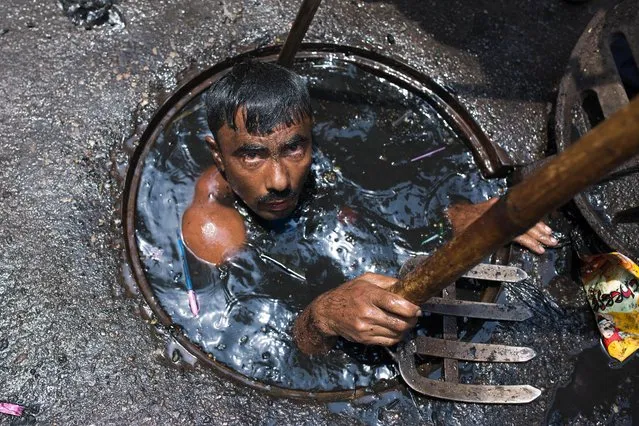
A sewer cleaner of Dhaka City Corporation cleaning out the city's sewers on May 03, 2017 in Dhaka, Bangladesh. Despite a rise in the number of deaths of manhole workers every year, workers regularly go into the manholes without any protective gear. (Photo by Zakir Chowdhury/Barcroft Images)

A sewer cleaner of Dhaka City Corporation cleaning out the city's sewers on May 03, 2017 in Dhaka, Bangladesh. Despite a rise in the number of deaths of manhole workers every year, workers regularly go into the manholes without any protective gear. (Photo by Zakir Chowdhury/Barcroft Images)
Details
06 May 2017 08:19:00
Kritchaya “Lolita” Boonhor (R) curls her eyelashes in ladyboy Candy's (L) room while she chats her about her boyfriend, in Bangkok, Thailand, 27 November 2017. (Photo by Lola Levan/EPA/EFE)

Kritchaya “Lolita” Boonhor (R) curls her eyelashes in ladyboy Candy's (L) room while she chats her about her boyfriend, in Bangkok, Thailand, 27 November 2017. Most things in life are a question of negotiation. Lolita is a woman, that was not to be negotiated. What needed to be negotiated was how she was perceived by those around her. And that negotiation was one that took time and effort. (Photo by Lola Levan/EPA/EFE)
Details
19 Jan 2018 07:39:00
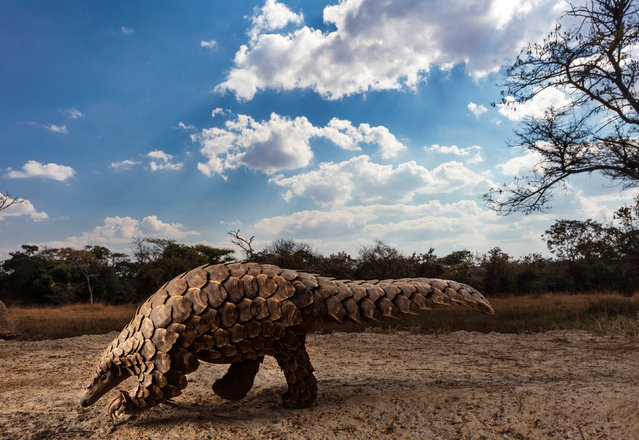
Pangolins in Crisis: Brent Stirton, South Africa; 1st place, Natural world and wildlife. “Pangolins are the world’s most illegally trafficked mammals, with an estimated one million trafficked to Asia in the last 10 years. Their scales are used in traditional Chinese and Vietnamese medicine, and their meat is sold as a high-priced delicacy. As a result, pangolins are listed as critically endangered and anyone who trades or consumes them is breaking the law. This body of work exposes the trade, while exploring aspects of illegality and celebrating the people who are trying to save these animals”. (Photo by Brent Stirton/Sony World Photography Awards 2020)

Pangolins in Crisis: Brent Stirton, South Africa; 1st place, Natural world and wildlife. “Pangolins are the world’s most illegally trafficked mammals, with an estimated one million trafficked to Asia in the last 10 years. Their scales are used in traditional Chinese and Vietnamese medicine, and their meat is sold as a high-priced delicacy. As a result, pangolins are listed as critically endangered and anyone who trades or consumes them is breaking the law. This body of work exposes the trade, while exploring aspects of illegality and celebrating the people who are trying to save these animals”. (Photo by Brent Stirton/Sony World Photography Awards 2020)
Details
11 Jun 2020 00:05:00
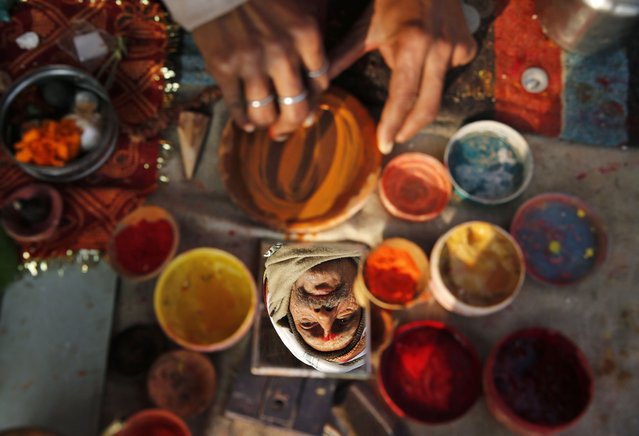
A Hindu holy man is reflected on a mirror as he prepares a bowl of vermillion powder for devotees near “Sangam”, the confluence of holy rivers of Ganges, Yamuna and the mythical Saraswati, during the annual traditional fair of Magh Mela in Allahabad, in the northern Indian state of Uttar Pradesh, India, Tuesday, January 6, 2015. (Photo by Rajesh Kumar Singh/AP Photo)

A Hindu holy man is reflected on a mirror as he prepares a bowl of vermillion powder for devotees near “Sangam”, the confluence of holy rivers of Ganges, Yamuna and the mythical Saraswati, during the annual traditional fair of Magh Mela in Allahabad, in the northern Indian state of Uttar Pradesh, India, Tuesday, January 6, 2015. Hundreds of thousands of devout Hindus are expected to take holy dips at the confluence during the astronomically auspicious period of over 45 days celebrated as Magh Mela. (Photo by Rajesh Kumar Singh/AP Photo)
Details
07 Jan 2015 13:41:00
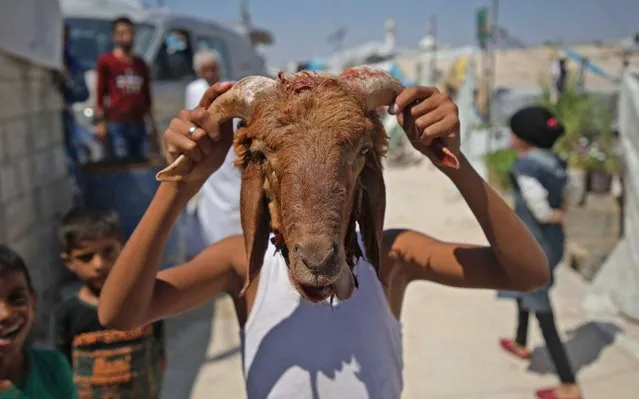
A Syrian boy plays with the head of a sacrificed sheep at a DIP camp for Interally Displaced Persons near the town of Aqrabat in Syria's northern Idlib province on August 12, 2019. Known as the “big” festival, Eid Al-Adha is celebrated each year by Muslims sacrificing various animals according to religious traditions, including cows, camels, goats and sheep. The festival marks the end of the Hajj pilgrimage to Mecca and commemorates Prophet Abraham's readiness to sacrifice his son to show obedience to God. (Photo by Aaref Watad/AFP Photo)

A Syrian boy plays with the head of a sacrificed sheep at a DIP camp for Interally Displaced Persons near the town of Aqrabat in Syria's northern Idlib province on August 12, 2019. Known as the “big” festival, Eid Al-Adha is celebrated each year by Muslims sacrificing various animals according to religious traditions, including cows, camels, goats and sheep. The festival marks the end of the Hajj pilgrimage to Mecca and commemorates Prophet Abraham's readiness to sacrifice his son to show obedience to God. (Photo by Aaref Watad/AFP Photo)
Details
15 Aug 2019 00:05:00