Loading...
Done
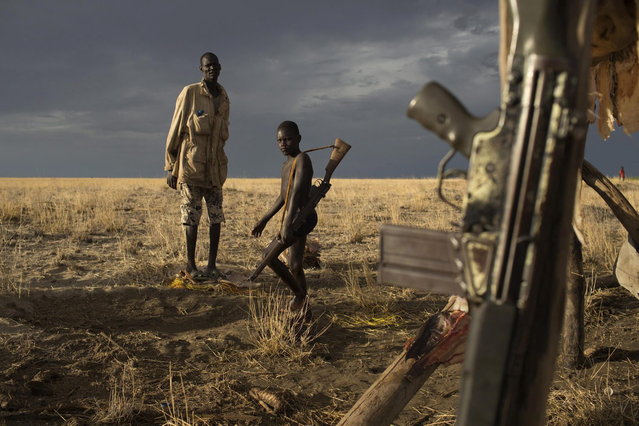
A Turkana man and a boy carrying a gun look on as a G3 battle rifle hangs from a structure used to dry fish at a fishing camp on the shores of Lake Turkana, some kilometres from Todonyang near the Kenya-Ethiopia border in northwestern Kenya October 12, 2013. (Photo by Siegfried Modola/Reuters)

A Turkana man and a boy carrying a gun look on as a G3 battle rifle hangs from a structure used to dry fish at a fishing camp on the shores of Lake Turkana, some kilometres from Todonyang near the Kenya-Ethiopia border in northwestern Kenya October 12, 2013The Turkana are traditionally nomadic pastoralists, but they have seen the pasture that they need to feed their herds suffer from recurring droughts and many have turned to fishing. However, Lake Turkana is overfished, and scarcity of food and pastureland is fuelling long-standing conflict with Ethiopian indigenous Dhaasanac, who have seen grazing grounds squeezed by large-scale government agricultural schemes in southern Ethiopia. The Dhaasanac now venture ever deeper into Kenyan territory in search of fish and grass, clashing with neighbours. Fighting between the communities has a long history, but the conflict has become ever more fatal as automatic weapons from other regional conflicts seep into the area. While the Turkana region is short of basics like grass and ground-water, it contains other resources including oil reserves and massive, newly discovered underground aquifers. (Photo by Siegfried Modola/Reuters)
Details
05 Dec 2013 12:08:00
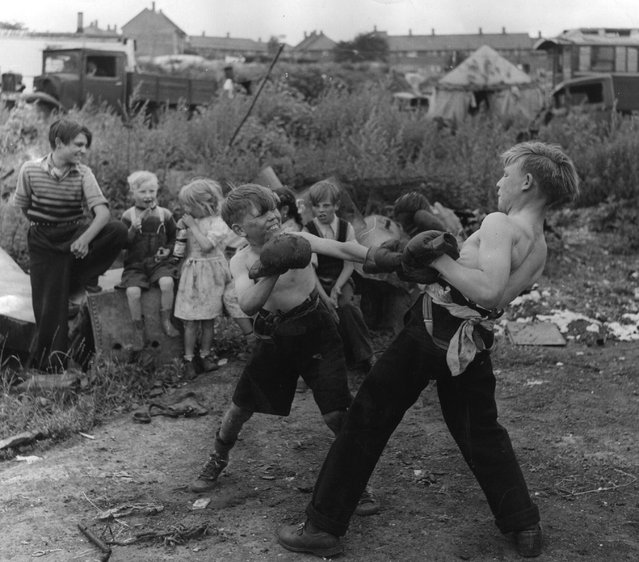
The unromantic gypsies. Children boxing in a gypsy camp in Kent, England on July 1, 1951. Like all boys these gypsy lads like to try their hand at boxing. Encouraged by their friends they fight it out on Corke's Meadow. Few Romanies now live a life of wandering romance. Most are like the three hundred squatters of Corke's Meadow, Kent, which is part of a “gypsy problem” that involves about 100,000 today. Of those about 25,000 can be rightly called gypsies, the rest are Mumpers and Posh-rats and Hobos. Corke's Meadow has both kinds. “Picture Post” cameraman Bert Hardy photographs the Corke's Meadow gypsies in their encampment. (Photo by Hulton-Deutsch Collection/Corbis via Getty Images)

The unromantic gypsies. Children boxing in a gypsy camp in Kent, England on July 1, 1951. Like all boys these gypsy lads like to try their hand at boxing. Encouraged by their friends they fight it out on Corke's Meadow. Few Romanies now live a life of wandering romance. Most are like the three hundred squatters of Corke's Meadow, Kent, which is part of a “gypsy problem” that involves about 100,000 today. Of those about 25,000 can be rightly called gypsies, the rest are Mumpers and Posh-rats and Hobos. Corke's Meadow has both kinds. “Picture Post” cameraman Bert Hardy photographs the Corke's Meadow gypsies in their encampment. (Photo by Hulton-Deutsch Collection/Corbis via Getty Images)
Details
12 Mar 2017 00:01:00
The frog and snake. Clinging on with sticky toes, a green tree frog sits bravely on its unlikely friend – a large tree python. Curled around the branches of a small coconut tree, the snake appears relatively undisturbed by the bold passenger that has clambered onto its skin. Grown in captivity together, the pair display no signs of aggression or fear, comfortable with their encounters high up in the leafy branches.  Photo enthusiast Fahmi Bhs watched in surprise as the frog slowly climbed along the scales of the metre long snake in a zoo in Jakarta, Indonesia. (Photo by Fahmi Bhs/Solent News/SIPA Press)

Clinging on with sticky toes, a green tree frog sits bravely on its unlikely friend – a large tree python. Curled around the branches of a small coconut tree, the snake appears relatively undisturbed by the bold passenger that has clambered onto its skin. Grown in captivity together, the pair display no signs of aggression or fear, comfortable with their encounters high up in the leafy branches. Photo enthusiast Fahmi Bhs watched in surprise as the frog slowly climbed along the scales of the metre long snake in a zoo in Jakarta, Indonesia. (Photo by Fahmi Bhs/Solent News/SIPA Press)
Details
08 Aug 2014 11:09:00
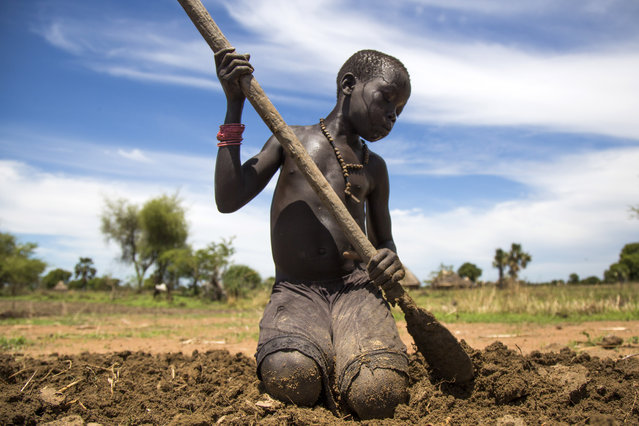
Nyibol Lual, 13 years old, helps her family to prepare the land for cultivation on May 31, 2017, in Panthau, Northern Bahr al Ghazal, South Sudan. The family has a small land where they cultivate sorghum. An estimated 63 per cent of the population in Northern Bahr al Ghazal is experiencing severe food insecurity, according to the latest Integrated Food Security Phase Classification (IPC) report. The situation is particularly bad in Aweil West and Aweil South counties, where the exhaustion of household food stocks and growing dependence on financially inaccessible markets have left the population facing Emergency levels of food insecurity. (Photo by Albert Gonzalez Farran/AFP Photo)

Nyibol Lual, 13 years old, helps her family to prepare the land for cultivation on May 31, 2017, in Panthau, Northern Bahr al Ghazal, South Sudan. The family has a small land where they cultivate sorghum. An estimated 63 per cent of the population in Northern Bahr al Ghazal is experiencing severe food insecurity, according to the latest Integrated Food Security Phase Classification (IPC) report. The situation is particularly bad in Aweil West and Aweil South counties, where the exhaustion of household food stocks and growing dependence on financially inaccessible markets have left the population facing Emergency levels of food insecurity. (Photo by Albert Gonzalez Farran/AFP Photo)
Details
01 Jun 2017 10:10:00
A girl in a vamire costume poses for pictures during the traditional park picnic on the first day of the annual Wave-Gotik Treffen, or Wave and Goth Festival, on May 17, 2013 in Leipzig, Germany. The four-day festival, in which elaborate fashion is a must, brings together over 20,000 Wave, Goth and steam punk enthusiasts from all over the world for concerts, readings, films, a Middle Ages market and workshops. (Photo by Marco Prosch)

A girl in a vamire costume poses for pictures during the traditional park picnic on the first day of the annual Wave-Gotik Treffen, or Wave and Goth Festival, on May 17, 2013 in Leipzig, Germany. The four-day festival, in which elaborate fashion is a must, brings together over 20,000 Wave, Goth and steam punk enthusiasts from all over the world for concerts, readings, films, a Middle Ages market and workshops. (Photo by Marco Prosch)
Details
18 May 2013 12:47:00
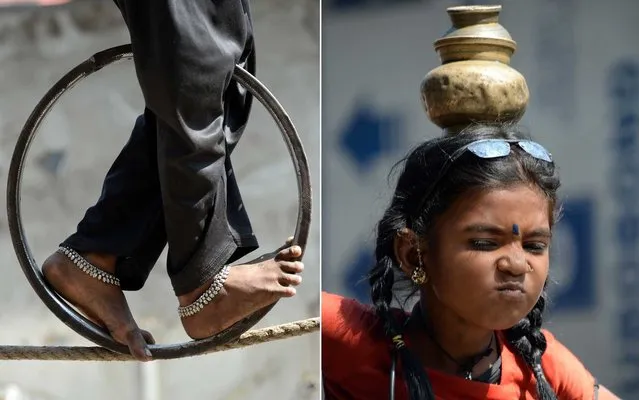
Nine year old girl Barsati reacts while walking on a tightrope in Mumbai on February 11, 2014. Barsati, and her younger brother Rajababu, (4) earn an average of around 2000 rupees (32 dollars) per day from pedestrians and tourists performing various acts on the tightrope near the city's iconic landmark Gateway of India. (Photo by Indranil Mukherjee/AFP Photo)

Nine year old girl Barsati reacts while walking on a tightrope in Mumbai on February 11, 2014. Barsati, and her younger brother Rajababu, (4) earn an average of around 2000 rupees (32 dollars) per day from pedestrians and tourists performing various acts on the tightrope near the city's iconic landmark Gateway of India. (Photo by Indranil Mukherjee/AFP Photo)
Details
15 Feb 2014 12:02:00
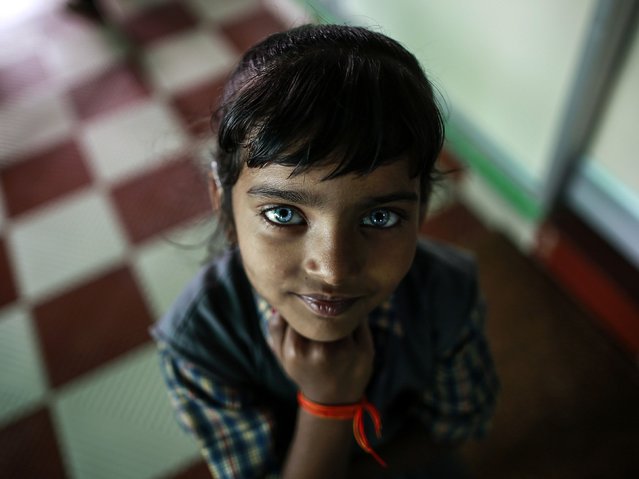
A girl who suffers from hearing and speech disorders reacts to the camera at a rehabilitation centre supported by Bhopal Medical Appeal, for children who were born with mental and physical disabilities, in Bhopal November 11, 2014.(Photo by Danish Siddiqui/Reuters)

A girl who suffers from hearing and speech disorders reacts to the camera at a rehabilitation centre supported by Bhopal Medical Appeal, for children who were born with mental and physical disabilities, in Bhopal November 11, 2014. The rehabilitation centre only treats families they believe have been affected by the Union Carbide gas leak 30 years ago. Human rights groups say that thousands of tonnes of hazardous waste remain buried underground, and the government has conceded it is contaminated. There has, however, been no long-term epidemiological research which conclusively proves that birth defects are directly related to the drinking of the contaminated water. (Photo by Danish Siddiqui/Reuters)
Details
30 Nov 2014 12:00:00
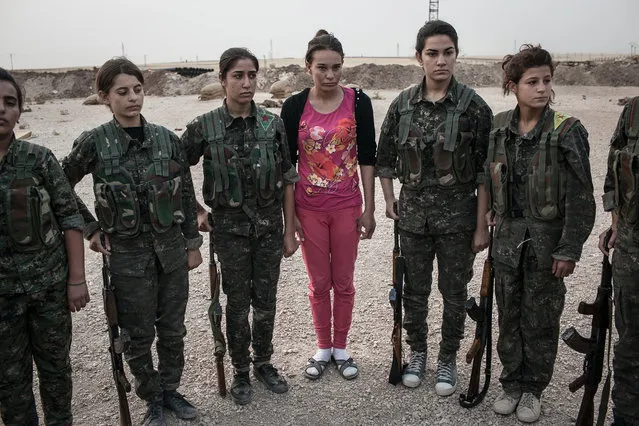
A young YPJ recruit (in pink) arrives to the training base for her first day in training near Derek City, Syria. The YPJ schedule is demanding and requires discipline – new soldiers in training get about 6 hours of sleep a night and wake up at 4 AM to begin exercising; afterwards, their day consists of a full schedule of drills and classroom lessons. Before joining the YPJ many of the girls had never participated in physical activity or sports before. (Photo by Erin Trieb/NBC News)

A young YPJ recruit (in pink) arrives to the training base for her first day in training near Derek City, Syria. The YPJ schedule is demanding and requires discipline – new soldiers in training get about 6 hours of sleep a night and wake up at 4 AM to begin exercising; afterwards, their day consists of a full schedule of drills and classroom lessons. Before joining the YPJ many of the girls had never participated in physical activity or sports before. (Photo by Erin Trieb/NBC News)
Details
10 Sep 2014 12:01:00