“The Portuguese Water Dog is a breed of working dog as classified by the American Kennel Club. Portuguese Water Dogs are originally from the Portuguese region of the Algarve, from where the breed expanded to all around Portugal's coast, where they were taught to herd fish into fishermen's nets, to retrieve lost tackle or broken nets, and to act as couriers from ship to ship, or ship to shore. Portuguese Water Dogs rode in bobbing fishing trawlers as they worked their way from the warm Atlantic waters of Portugal to the frigid fishing waters off the coast of Iceland where the fleets caught cod to bring home. Portuguese Water Dogs were often taken with sailors during the Portuguese discoveries”. – Wikipedia
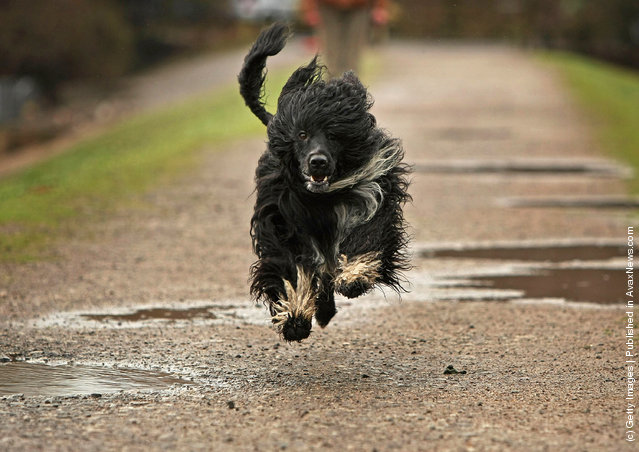
Photo: Kix, a Portuguese Water Dog , enjoys a walk around the muddy fields near his home before the grooming and preparation starts for this years Crufts on March 3, 2009 in Telford, England. (Photo by Christopher Furlong/Getty Images)
Pedestrians and workers pass an upside down car art installation in a car park on the South Bank in London, February 19, 2015. British artist Alex Chinneck's illusory piece, entitled “Pick yourself up and pull yourself together”, and on display in the working car park for a week, sees a Vauxhall car suspended upside down, appearing to be gripping onto a peeled back length of tarmac. (Photo by Toby Melville/Reuters)
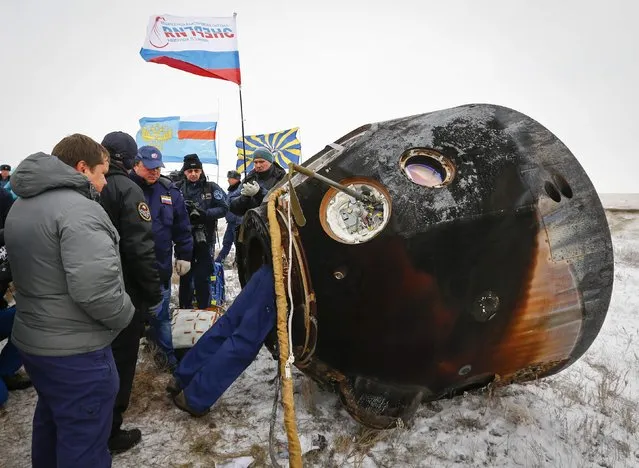
Ground personnel work next to the Soyuz TMA-13M capsule of the International Space Station (ISS) crew of Alexander Gerst of Germany, Maxim Suraev of Russia and Reid Wiseman of the U.S. after its landing near the town of Arkalyk in northern Kazakhstan November 10, 2014. A veteran Russian cosmonaut and two International Space Station crewmates, one from the United States and one from Germany, returned safely to Earth on Sunday with a parachute landing of their Soyuz capsule in Kazakhstan, ending 5-1/2 months in orbit. (Photo by Shamil Zhumatov/Reuters)
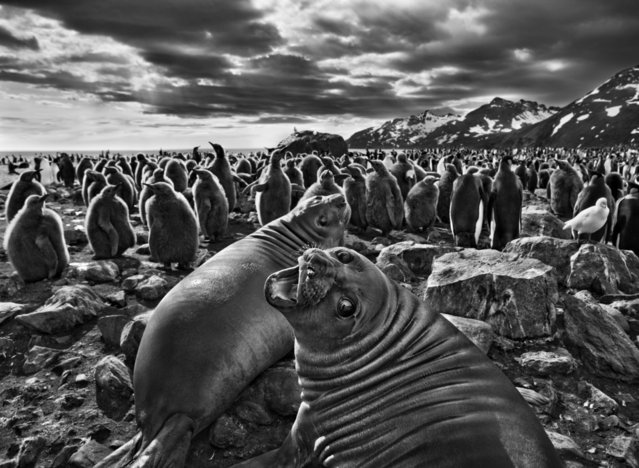
Sebastião Salgado is a Brazilian documentary photographer living in Paris. He has produced several books, and his work has been exhibited extensively around the world. His latest work, «Genesis», premieres at The Natural History Museum in London on April 11, on view through September 8, 2013. Photo: On South Georgia, a barren island in the far South Atlantic, a pair of southern elephant seal calves beckon before a colony of king penguins. “The male seals can grow to almost five tons,” says Salgado, “but these are just babies. This one looked at me with beautiful eyes”. (Photo by Sebastião Salgado/Amazonas/Contact Press Images)
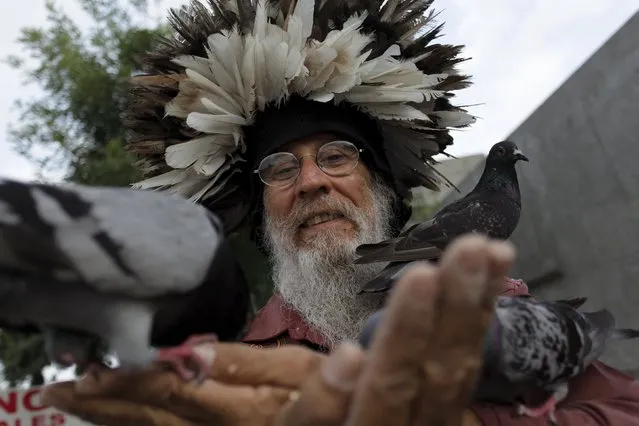
Jesus Moreno, 60, feeds pigeons in downtown Monterrey, Mexico July 7, 2015. For the past 30 years Moreno, who was once homeless, a drug addict, and formerly working as a investigative policeman, has been feeding pigeons twice a day, because to him they represent peace and the only way to communicate to God, local media reported. (Photo by Daniel Becerril/Reuters)
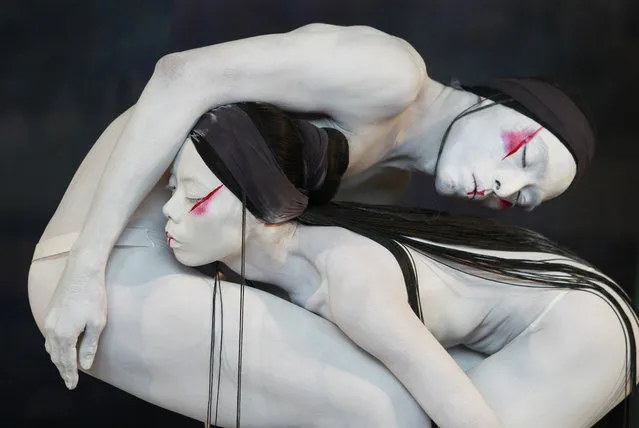
Dancers from the “Legend Lin Dance Theatre” perform the artistic director and choreographer Li-chen Lin's classic works “Hymne aux Fleurs qui Passent, Anthem to the Fading Flowers” during a rehearsal at the National Theater Concert Hall in Taipei, Taiwan, Tuesday, August 18, 2015. “Hymne aux Fleurs Qui Passent” pays tribute to the cycle of the year and the complementary principles of Yin and Yang whose eternal struggle provides the driving force behind the changing of the seasons. (Photo by Chiang Ying-ying/AP Photo)
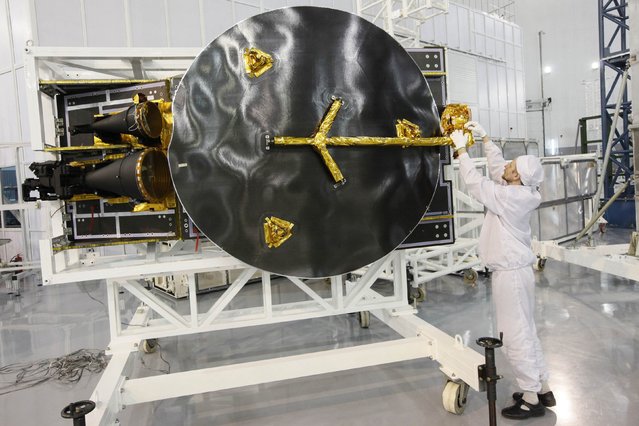
Engineer Mikhail Venin works on an antenna for the Express AM8 new generation geostationary telecommunications heavy satellite at the large-sized transformed mechanical systems centre of the Reshetnev Information Satellite Systems company in the Siberian town of Zheleznogorsk April 2, 2014. The Express AM6 is a new generation satellite providing services including Russian governmental and presidential mobile communication, digital television and broadcasting, according to the Reshetnev company representatives. (Photo by Ilya Naymushin/Reuters)