Loading...
Done
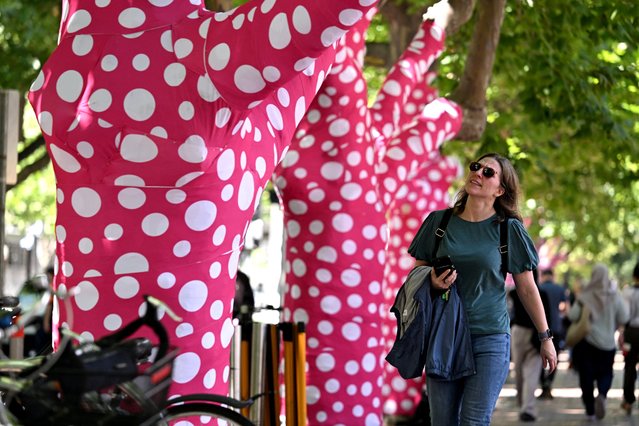
A woman looks at some of the 60 plane trees wrapped in a pink-and-white polka-dot design developed especially for Melbourne by Japanese contemporary artist Yayoi Kusama titled “Ascension of Polka Dots on the Trees”, in Melbourne on November 27, 2024. The National Gallery of Victoria’s (NGV) world-premiere blockbuster exhibition Yayoi Kusama will be on display from 15 December 2024 to 21 April 2025. (Photo by William West/AFP Photo)

A woman looks at some of the 60 plane trees wrapped in a pink-and-white polka-dot design developed especially for Melbourne by Japanese contemporary artist Yayoi Kusama titled “Ascension of Polka Dots on the Trees”, in Melbourne on November 27, 2024. The National Gallery of Victoria’s (NGV) world-premiere blockbuster exhibition Yayoi Kusama will be on display from 15 December 2024 to 21 April 2025. (Photo by William West/AFP Photo)
Details
23 Jan 2025 05:10:00


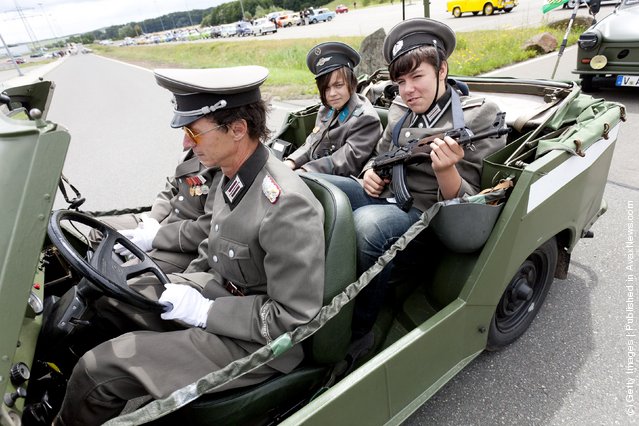
“The Trabant is a car that was produced by former East German auto maker VEB Sachsenring Automobilwerke Zwickau in Zwickau, Sachsen. It was the most common vehicle in East Germany, and was also exported to countries both inside and outside the communist bloc. The main selling points was that it had room for four adults and luggage in a compact, light and durable shell and that it was fast (when introduced) and durable. With its mediocre performance, smoky two-stroke engine, and production shortages, the Trabant is often cited as an example of the disadvantages of centralized planning; on the other hand, it is regarded with derisive affection as a symbol of the failed former East Germany and of the fall of communism (in former West Germany, as many East Germans streamed into West Berlin and West Germany in their Trabants after the opening of the Berlin Wall in 1989). It was in production without any significant changes for nearly 30 years with 3,096,099 Trabants produced in total”. – Wikipedia

Photo: Enthusiasts weared in uniforms of the former eastern german army trive in a military Trabant car as fans and owners of East German-era Trabant cars gather at the 2011 International Trabantfahrer Treffen (International Trabant Drivers Meeting) on June 26, 2011 in Zwickau, Germany. The Trabant, also known as the Trabi, was among the main cars produced in communist East Germany and built by VEB Sachsenring Automobilwerke in Zwickau for 30 years until 1989. Today the car has cult status for many followers and one company, IndiKar, is even seeking to revive the brand in a modern, electric version. (Photo by Carsten Koall/Getty Images)

Details
27 Jun 2011 12:21:00
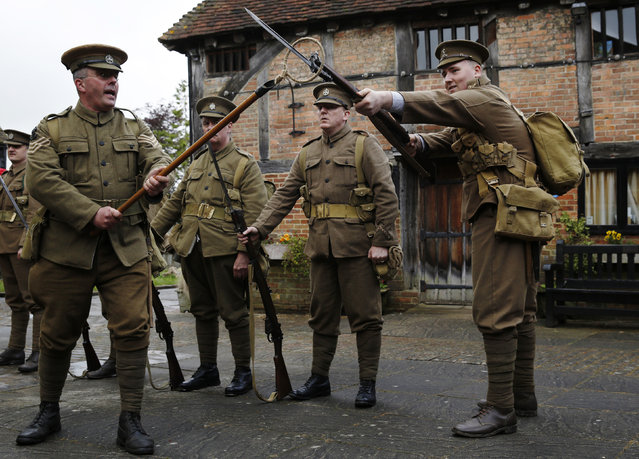
Factory landlord Lawrence Taylor (L), portraying a Colour Sergeant from the King's Royal Rifle Corps, part of the Rifles Living History Society, performs a drill with Connor Young (R) of the Queen's Own Royal West Kent Regiment Living History Group as they recreate the life of a First World War soldier at the Eden Valley Museum in Edenbridge in southeast England May 10, 2014. (Photo by Luke MacGregor/Reuters)

Factory landlord Lawrence Taylor (L), portraying a Colour Sergeant from the King's Royal Rifle Corps, part of the Rifles Living History Society, performs a drill with Connor Young (R) of the Queen's Own Royal West Kent Regiment Living History Group as they recreate the life of a First World War soldier at the Eden Valley Museum in Edenbridge in southeast England May 10, 2014. Lawrence has always had an interest in military history and specifically “The Rifles” – his veteran father's WWII regiment. When he became a re-enactor he chose not to re-enact WWII as many of the veterans are still alive, and he felt uncomfortable as he remembers his father would have flashbacks and nightmares about the war. United by a fascination with military history and a fondness for dressing up, groups such as the Rifles Living History Society and the Queen's Own Royal West Kent Regiment Living History Group get together to recreate aspects of life during the First World War. Reuters photographer Luke MacGregor photographed members of the groups, both as they took part in living history events and at their day jobs. (Photo by Luke MacGregor/Reuters)
Details
26 Aug 2014 10:12:00
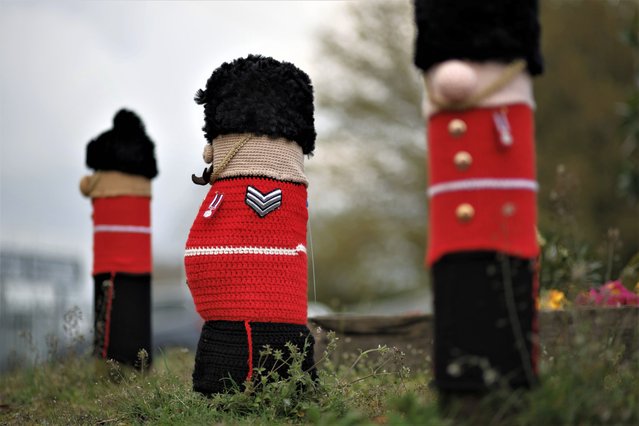
A view of knitted Grenadier Guards figures made by members of the 'Hurst Hookers' knitting group after their fitting to posts during a pre-coronation 'yarn bombing' in the village of Hurst, near Reading, England, Friday, April 21, 2023. Heather Howarth and her friends in the village of Hurst, a stone’s throw from Reading, west of London, have fashioned a woolly coronation procession to rival the pomp and circumstance that will take place when Charles is crowned on May 6 at Westminster Abbey. (Photo by David Cliff/AP Photo)

A view of knitted Grenadier Guards figures made by members of the 'Hurst Hookers' knitting group after their fitting to posts during a pre-coronation 'yarn bombing' in the village of Hurst, near Reading, England, Friday, April 21, 2023. Heather Howarth and her friends in the village of Hurst, a stone’s throw from Reading, west of London, have fashioned a woolly coronation procession to rival the pomp and circumstance that will take place when Charles is crowned on May 6 at Westminster Abbey. (Photo by David Cliff/AP Photo)
Details
25 Jul 2024 04:15:00
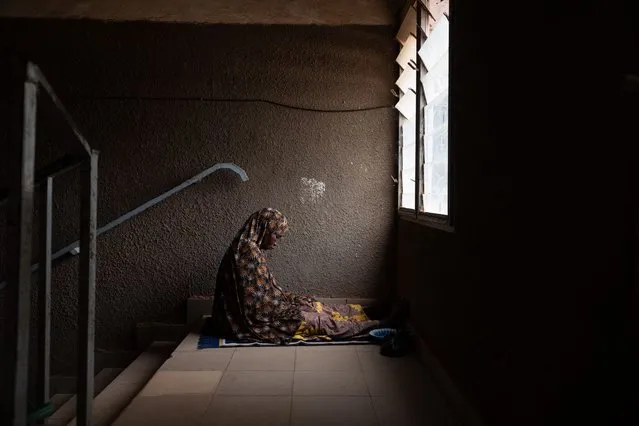
A worshipper prays during the Friday prayer at the Great Mosque in Ouagadougou, on January 28, 2022. Burkina Faso, the scene of a military coup on Monday, was suspended from the Community of West African States (ECOWAS) on Friday, following a virtual summit of the organization whose heads of state will meet again on February 3 in Accra to reassess the situation in this country. (Photo by Olympia de Maismont/AFP Photo)

A worshipper prays during the Friday prayer at the Great Mosque in Ouagadougou, on January 28, 2022. Burkina Faso, the scene of a military coup on Monday, was suspended from the Community of West African States (ECOWAS) on Friday, following a virtual summit of the organization whose heads of state will meet again on February 3 in Accra to reassess the situation in this country. (Photo by Olympia de Maismont/AFP Photo)
Details
02 Feb 2022 07:54:00
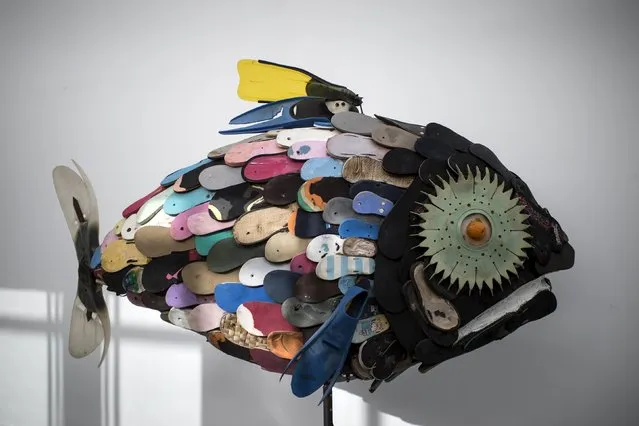
A sculpture of a fish made from waste products collected from the sea is displayed during the exhibition Keep The Oceans Clean by art collective Skeleton Sea, at the Torre Madariaga Biodiversity Centre in Busturia, Spain, May 17, 2015. (Photo by Vincent West/Reuters)

A sculpture of a fish made from waste products collected from the sea is displayed during the exhibition Keep The Oceans Clean by art collective Skeleton Sea, at the Torre Madariaga Biodiversity Centre in Busturia, Spain, May 17, 2015. Skeleton Sea, a group of surfers and artists, recycle waste collected from the world's oceans to create artworks and draw attention to the dangers faced from overfishing, pollution and oil spills. (Photo by Vincent West/Reuters)
Details
19 May 2015 11:16:00
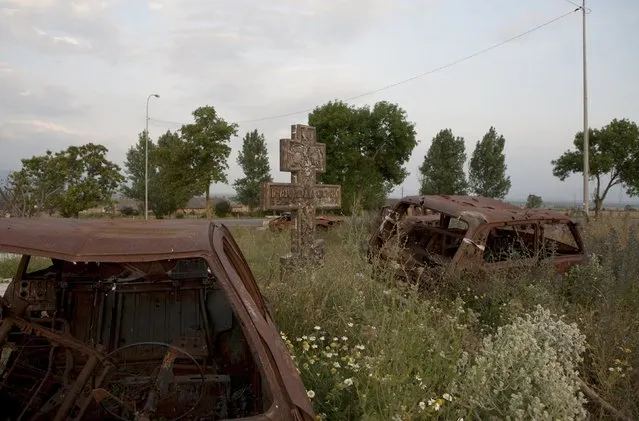
Abandoned cars are seen around a cross in the village of Tbeti near Tskhinvali, the capital of the breakaway region of South Ossetia, Georgia, July 4, 2015. President Vladimir Putin signed a treaty with Georgia's rebel South Ossetia region on March 18 that almost completely integrates it with Russia, alarming Georgia and the West a year after Moscow took over Crimea. (Photo by Kazbek Basaev/Reuters)

Abandoned cars are seen around a cross in the village of Tbeti near Tskhinvali, the capital of the breakaway region of South Ossetia, Georgia, July 4, 2015. President Vladimir Putin signed a treaty with Georgia's rebel South Ossetia region on March 18 that almost completely integrates it with Russia, alarming Georgia and the West a year after Moscow took over Crimea. Russia won a five-day war with Georgia in 2008 over the fate of South Ossetia and another rebel region, Abkhazia. It formally recognizes both regions as independent states and signed a similar treaty with Abkhazia last year. (Photo by Kazbek Basaev/Reuters)
Details
09 Jul 2015 11:43:00
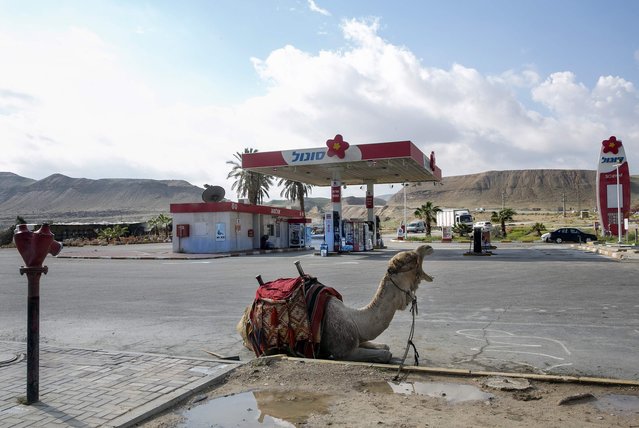
A camel rests at a fuel station in the Judean desert near the West Bank city of Jericho January 11, 2015. Reuters photographers from Mali to Mexico have shot a series of pictures of fuel stations. Whether it is plastic bottles by the roadside in Malaysia or a futuristic forecourt in Los Angeles, fuel stations help define our world. (Photo by Baz Ratner/Reuters)

A camel rests at a fuel station in the Judean desert near the West Bank city of Jericho January 11, 2015. Reuters photographers from Mali to Mexico have shot a series of pictures of fuel stations. Whether it is plastic bottles by the roadside in Malaysia or a futuristic forecourt in Los Angeles, fuel stations help define our world. Oil prices steadied above $48 a barrel on Tuesday, recovering from earlier losses as the dollar weakened against the euro. Oil prices have dropped nearly 60 percent since peaking in June 2014 on ample global supplies from the U.S. shale oil boom and a decision by OPEC to keep its production quotas unchanged. (Photo by Baz Ratner/Reuters)
Details
28 Jan 2015 12:15:00