Loading...
Done
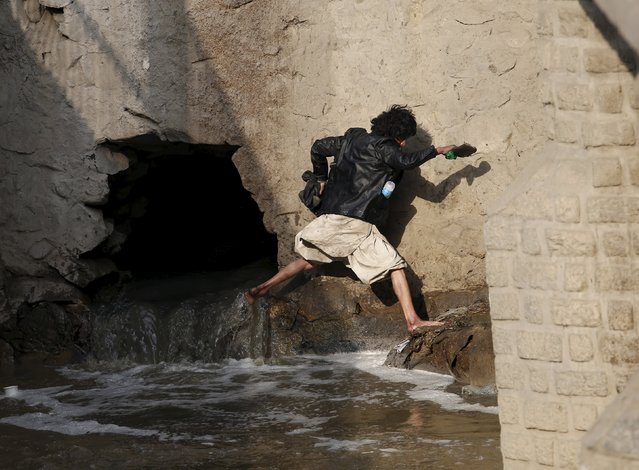
A man runs away during a police round up of suspected drug addicts in Kabul, Afghanistan December 27, 2015. Afghan officials have opened a new drug treatment centre in an abandoned NATO military base in Kabul, in the latest attempt to stamp out the country's massive problem of drug abuse. Camp Phoenix, a former training camp on the edges of Kabul set up by the U.S. army in 2003, will take in around 1,000 homeless drug addicts who will receive food, medical attention and treatment, said Public Health Minister Ferozuddin Feroz. (Photo by Ahmad Masood/Reuters)

A man runs away during a police round up of suspected drug addicts in Kabul, Afghanistan December 27, 2015. Afghan officials have opened a new drug treatment centre in an abandoned NATO military base in Kabul, in the latest attempt to stamp out the country's massive problem of drug abuse. Camp Phoenix, a former training camp on the edges of Kabul set up by the U.S. army in 2003, will take in around 1,000 homeless drug addicts who will receive food, medical attention and treatment, said Public Health Minister Ferozuddin Feroz. (Photo by Ahmad Masood/Reuters)
Details
11 Jan 2016 08:00:00
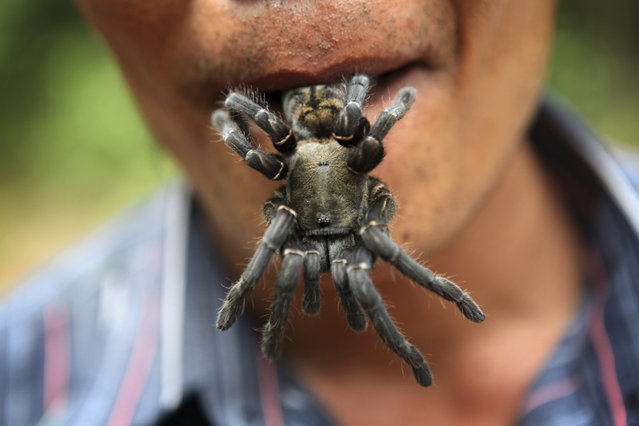
A Cambodian tuk tuk driver and guide with a tarantula in his mouth shortly after is was dug from the ground on June 7, 2010 in Skuon, Kampong Cham Province, Cambodia. The trade for spiders and other insects as food and for medicinal purposes has been in effect since the 1970's in Cambodia but only very recently have tourists been finding a way to see where the spiders are hunted in the nearby countryside. One guide, who can be found in Kampong Cham Town has started offering tours to tourists who can find him. (Photo by Tim Whitby/Getty Images)

A Cambodian tuk tuk driver and guide with a tarantula in his mouth shortly after is was dug from the ground on June 7, 2010 in Skuon, Kampong Cham Province, Cambodia. The trade for spiders and other insects as food and for medicinal purposes has been in effect since the 1970's in Cambodia but only very recently have tourists been finding a way to see where the spiders are hunted in the nearby countryside. One guide, who can be found in Kampong Cham Town has started offering tours to tourists who can find him. (Photo by Tim Whitby/Getty Images)
Details
04 Sep 2016 09:27:00
Sеx worker Geraldine, wearing cat make-up, excitedly holds up a dress she is thinking of buying from a street vendor, so that her partner, sitting nearby to keep her company, can see it, as she waits for clients outside the Revolution subway station, in Mexico City, Saturday, March 13, 2021. According to Geraldine, 30, the pandemic has cut clients and increased risks to the sеx workers but has also brought out more assistance for them too, both from dedicated organizations such as the activist group Brigada Callejera or “The Street Brigade” and from individuals who have donated food or clothing. (Photo by Rebecca Blackwell/AP Photo)

Sеx worker Geraldine, wearing cat make-up, excitedly holds up a dress she is thinking of buying from a street vendor, so that her partner, sitting nearby to keep her company, can see it, as she waits for clients outside the Revolution subway station, in Mexico City, Saturday, March 13, 2021. According to Geraldine, 30, the pandemic has cut clients and increased risks to the sеx workers but has also brought out more assistance for them too, both from dedicated organizations such as the activist group Brigada Callejera or “The Street Brigade” and from individuals who have donated food or clothing. (Photo by Rebecca Blackwell/AP Photo)
Details
25 Apr 2021 07:38:00
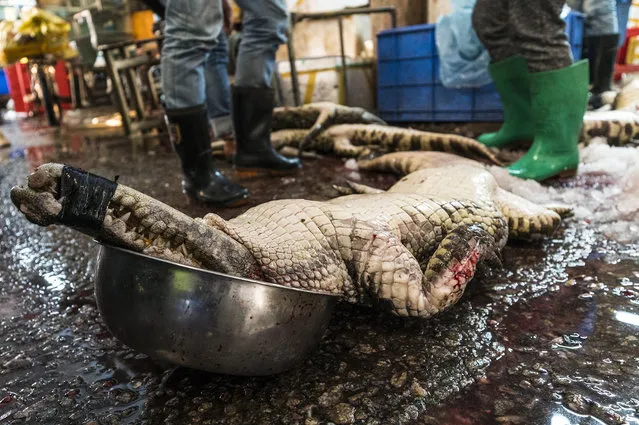
A dead crocodile is seen on Huangsha Seafood Market in Guangzhou, Guandong Province, China, 22 January 2018. Tsukiji Market of China or Huangsha Seafood Market is biggest one in Southern China and one of the biggest in China, as there are literally hundreds of different varieties of fish and seafood scattered throughout the market. Since the proximity of the fish market is so close to the Zhujiang River, it's quite easy for the large fishing vessels and fishermen to unload their fresh catch right at the market, which ensures that the fish and seafood remain fresh. Fish and other seafood are coming there from all around the globe. Seafood Market is full of different kinds of live fish, live shellfish, and live seafood on display in crystal clear tanks and it's common to see 5-star chefs, retailers and expats to source for fresh and high-quality seafood supplies for reasonable prices. While it is a wholesale fish market, since many Guangzhou restaurants and businesses come to purchase their seafood here, the public is welcome to come and even purchase. Many local Chinese have the vendors slice up fresh salmon fillets to take home or carry seafood into one of the nearby specialty restaurants, where they will cook if for them and serve it with vegetables and other side dishes of their choice. One of the biggest attractions for both, tourists and buyers, on market are crocodiles, which are brought there alive in wooden cases with taped jaws so they can?t accidentally bite. They are from crocodile farms from Guangdong, China and from Vietnam. Crocodile meat is popular in most Asian countries and it is consider as delicate one. Crocodiles weight from 10 to 25 kg and bigger ones are about 2 years old. They cost about 70 RMB (8.90 EURO) when bout as whole, or if you buy as parts most expensive and appreciated parts are paws 120 RMB (15.26 EURO) per kg, and tail 100 RMB (12.72 EURO) per kg. (Photo by Aleksandar Plavevski/EPA/EFE)

A dead crocodile is seen on Huangsha Seafood Market in Guangzhou, Guandong Province, China, 22 January 2018. Tsukiji Market of China or Huangsha Seafood Market is biggest one in Southern China and one of the biggest in China, as there are literally hundreds of different varieties of fish and seafood scattered throughout the market. (Photo by Aleksandar Plavevski/EPA/EFE)
Details
17 Apr 2020 00:05:00
Tourists play at a beach covered by a thick layer of green algae on July 3, 2013 in Qingdao, China. A large quantity of non-poisonous green seaweed, enteromorpha prolifera, hit the Qingdao coast in recent days. More than 20,000 tons of such seaweed has been removed from the city's beaches. (Photo by ChinaFotoPress/ChinaFotoPress)

Tourists play at a beach covered by a thick layer of green algae on July 3, 2013 in Qingdao, China. A large quantity of non-poisonous green seaweed, enteromorpha prolifera, hit the Qingdao coast in recent days. More than 20,000 tons of such seaweed has been removed from the city's beaches. (Photo by China Foto Press)
Details
04 Jul 2013 11:01:00
A humanoid robot named “Yangyang” shows a facial expression during its demonstration at the Global Mobile Internet Conference (GMIC) 2015 in Beijing, China, April 29, 2015. (Photo by Kim Kyung-Hoon/Reuters)

A humanoid robot named “Yangyang” shows a facial expression during its demonstration at the Global Mobile Internet Conference (GMIC) 2015 in Beijing, China, April 29, 20155. The android was produced jointly by China's Shanghai Yangyang Intellegent Robot Science Service center and Japanese professor Hiroshi Ishiguro, with the aim of popularising robotics among the young. (Photo by Kim Kyung-Hoon/Reuters)
Details
30 Apr 2015 10:50:00
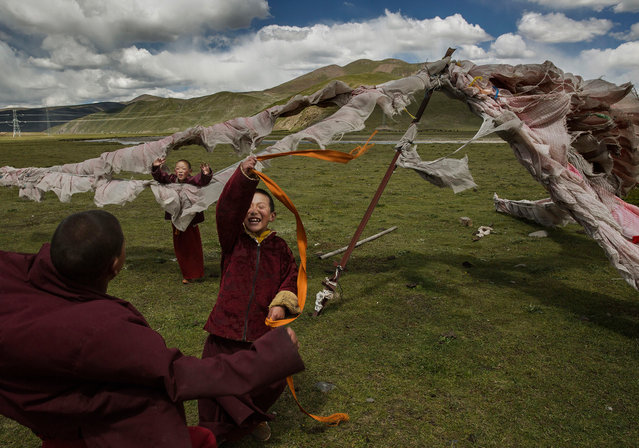
Young Buddhist novice monks play at a Tibetan nomadic summer grazing area on July 24, 2015 on the Tibetan Plateau in Yushu County, Qinghai, China. (Photo by Kevin Frayer/Getty Images)

Young Buddhist novice monks play at a Tibetan nomadic summer grazing area on July 24, 2015 on the Tibetan Plateau in Yushu County, Qinghai, China. Tibetan nomads face many challenges to their traditional way of life including political pressures, forced resettlement by China's government, climate change and rapid modernization. The Tibetan Plateau, often called “The Roof of the World”, is the world's highest and largest plateau. (Photo by Kevin Frayer/Getty Images)
Details
12 Aug 2015 13:16:00
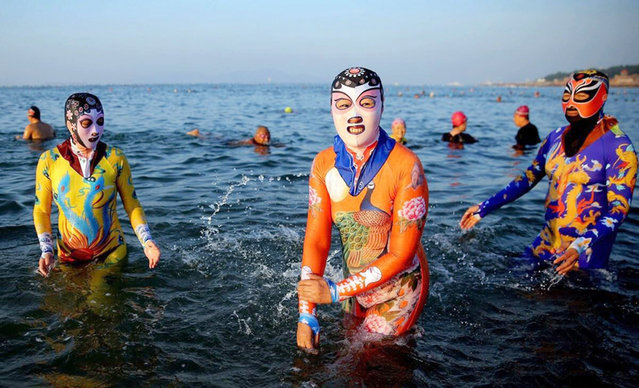
Zhang Shifan's sixth-generation facekinis in Shandong Province, Qingdao, East China. (Photo by CEN)

Zhang Shifan's sixth-generation facekinis in Shandong Province, Qingdao, East China. A woman credited with inventing the bizarre swimwear known as the “facekini” has now proudly presented the sixth generation of the iconic beach clothing. The new facekini models are not only more comfortable, they also come in a wider variety of colours and patterns, bringing both style and practicality to beach-goers in Qingdao City, in East China's Shandong Province, who fear tan lines. (Photo by CEN)
Details
02 Sep 2016 13:29:00