Loading...
Done
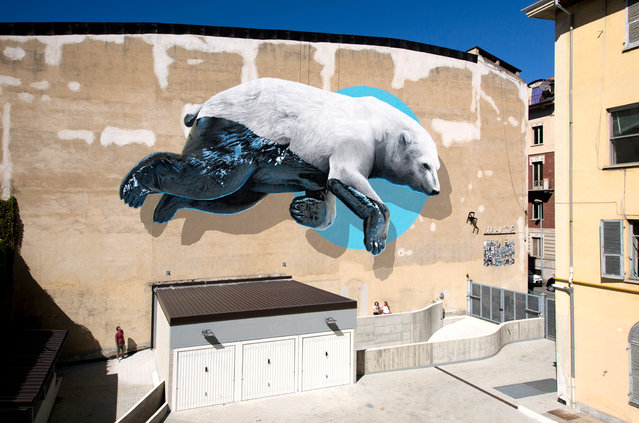
A polar bear whose bottom half is caked in oily black gunk. A whale wrapped in striped fabric: a pseudo straightjacket. These are the messes climate change leaves behind, the things we know are happening but often don’t have the opportunity to see with our own eyes. Swiss street art duo Christian Rebecchi and Pablo Togni, otherwise known as NeverCrew, met in art school when they were 15 and started making work together soon after. As a team, the artists adorn the world with eye-popping and gut-wrenching images depicting the consequences of humanity’s actions on earth. Here: “Black machine” mural painting and installation on the Colosseo theater in Turin, Italy, in September 2015. (Photo by NeverCrew/The Huffington Post)

A polar bear whose bottom half is caked in oily black gunk. A whale wrapped in striped fabric: a pseudo straightjacket. These are the messes climate change leaves behind, the things we know are happening but often don’t have the opportunity to see with our own eyes. Swiss street art duo Christian Rebecchi and Pablo Togni, otherwise known as NeverCrew, met in art school when they were 15 and started making work together soon after. As a team, the artists adorn the world with eye-popping and gut-wrenching images depicting the consequences of humanity’s actions on earth. (Photo by NeverCrew/The Huffington Post)
Details
13 Aug 2016 11:09:00
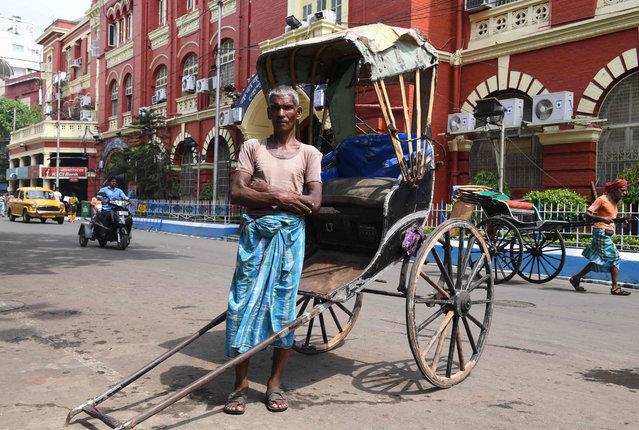
Mohammad Ashgar, 65, an Indian rickshaw puller, poses for a photograph next to his rickshaw in Kolkata on April 21, 2018. A mainstay of 19 th century transportation options, the hand- pulled rickshaw survives in India only in Kolkata after being outlawed elsewhere. The local puller's union puts the number of pullers in the city at 3,000. The union has resisted all previous attempts to ban their livelihood, previously organising mass protests of their members against moves to stamp out the practice. (Photo by Dibyangshu Sarkar/AFP Photo)

Ahead of May Day, AFP' s video and photo teams spoke to men and women around the globe whose jobs are becoming increasingly rare, particularly as technology transforms societies. Here: Mohammad Ashgar, 65, an Indian rickshaw puller, poses for a photograph next to his rickshaw in Kolkata on April 21, 2018. (Photo by Dibyangshu Sarkar/AFP Photo)
Details
02 May 2018 00:01:00
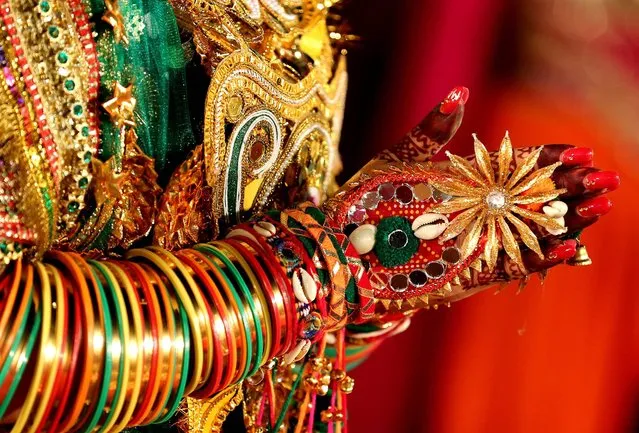
A photograph made available on 02 October 2016 showing Indian people dressed in traditional attire performing the Garba dance, a ritual performed to appease Goddess Durga, in a religious event named, “Abhivyakti 2016” during the nine-day long Navratri festival in Bhopal, India, 01 October 2016 Celebrated twice a year during the spring and the fall season, the Navratri festival is dedicated to the Hindu Goddess Durga. (Photo by Sanjeev Gupta/EPA)

A photograph made available on 02 October 2016 showing Indian people dressed in traditional attire performing the Garba dance, a ritual performed to appease Goddess Durga, in a religious event named, “Abhivyakti 2016” during the nine-day long Navratri festival in Bhopal, India, 01 October 2016 Celebrated twice a year during the spring and the fall season, the Navratri festival is dedicated to the Hindu Goddess Durga. (Photo by Sanjeev Gupta/EPA)
Details
07 Oct 2016 09:02:00
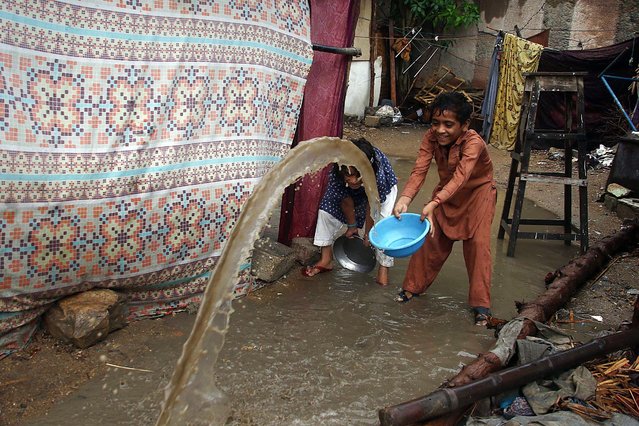
A boy removes rain water from his hut after a heavy downpour in Karachi, Pakistan, 28 August 2016. Heavy monsoon rains across the country has claimed dozens of lives in last few weeks as Pakistan Meteorological Departmen office predict more rains in coming days. (Photo by Shahzaib Akber/EPA)

A boy removes rain water from his hut after a heavy downpour in Karachi, Pakistan, 28 August 2016. Heavy monsoon rains across the country has claimed dozens of lives in last few weeks as Pakistan Meteorological Departmen office predict more rains in coming days. (Photo by Shahzaib Akber/EPA)
Details
30 Aug 2016 11:41:00
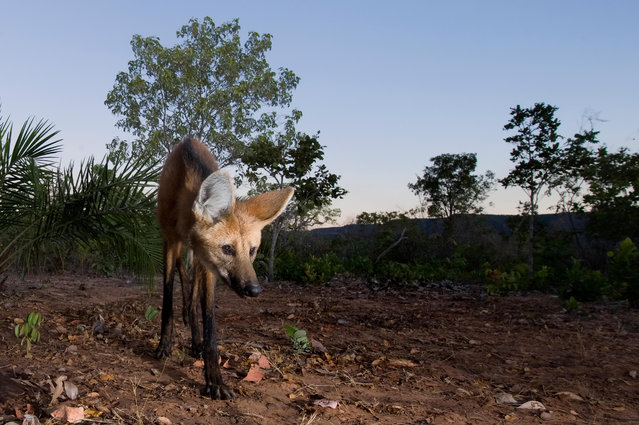
The maned wolf is among the large mammals in the Brazilian Cerrado that are threatened by the increasing conversion of grasslands into farmland for grazing and growing crops. (Photo by Ben Cranke/Nature Picture Library/Alamy Stock Photo)

Global wildlife populations will decline by 67% by 2020 unless urgent action is taken to reduce human impact on species and ecosystems, warns the biennial Living Planet Index report from WWF (World Wide Fund for Nature) and ZSL (Zoological Society of London). From elephants to eels, here are some of the wildlife populations most affected by human activity. Here: The maned wolf is among the large mammals in the Brazilian Cerrado that are threatened by the increasing conversion of grasslands into farmland for grazing and growing crops. (Photo by Ben Cranke/Nature Picture Library/Alamy Stock Photo)
Details
28 Oct 2016 10:47:00
Argentina's forward #22 Lautaro Martinez shoots to score during the 2026 FIFA World Cup South American qualifiers football match between Argentina and Peru at the La Bombonera stadium in Buenos Aires on November 19, 2024. (Photo by Juan Mabromata/AFP Photo)

Argentina's forward #22 Lautaro Martinez shoots to score during the 2026 FIFA World Cup South American qualifiers football match between Argentina and Peru at the La Bombonera stadium in Buenos Aires on November 19, 2024. (Photo by Juan Mabromata/AFP Photo)
Details
18 Feb 2026 07:30:00
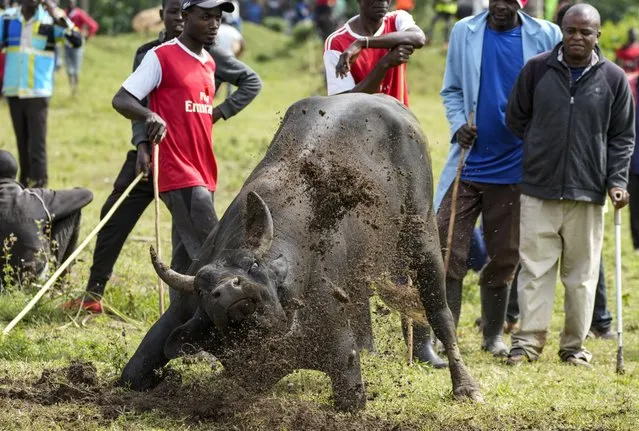
A bull rolls in the mud as it prepares to fight another bull at a bullfight in Kabaras, Kakamega county Kenya, Friday, October 20, 2023. (Photo by Brian Inganga/AP Photo)

A bull rolls in the mud as it prepares to fight another bull at a bullfight in Kabaras, Kakamega county Kenya, Friday, October 20, 2023. (Photo by Brian Inganga/AP Photo)
Details
01 Nov 2023 00:05:00
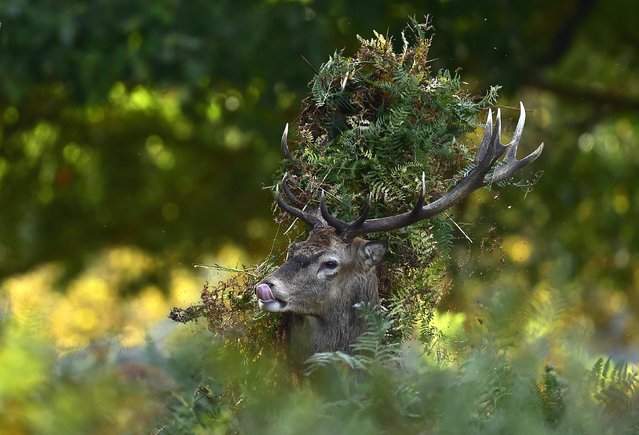
A male red deer with antlers covered in bracken, walks through undergrowth in Richmond Park in south west London, October 3, 2014. Over 600 red and fallow deer roam in the largest of London's Royal Parks, and have their numbers managed in an annual cull each November and February. (Photo by Toby Melville/Reuters)

A male red deer with antlers covered in bracken, walks through undergrowth in Richmond Park in south west London, October 3, 2014. Over 600 red and fallow deer roam in the largest of London's Royal Parks, and have their numbers managed in an annual cull each November and February. (Photo by Toby Melville/Reuters)
Details
04 Oct 2014 12:17:00